The Pomorian Old Believers
Please join our Telegram Group for updates when new articles from Priestless Traditions are posted.
For the attached chat – direct message me, letting me know which Priestless group you belong to, and I will send a link to the chat. For now, this chat must remain limited only to Priestless Old Believers.
Browse the works of the Pomorians
By Mikhail Olegovich Shakhov.
Already in the first decades after the Schism, the state authorities and the official Church acted together as persecutors of the zealots of the ancient piety. Old Belief then faced the necessity of defining its attitude toward the state and toward society. It had to formulate its social position.
The “Pomorian Answers” made their own laconic but very weighty contribution to this task. The principles outlined in the “Pomorian Answers” remain relevant even in our own day.
If we turn to the history of European sectarian and heretical movements, we can easily discover something. Many of them possessed a clearly expressed, theoretically and doctrinally substantiated anti-state, democratic-socialist orientation. In some sects, this reached the point of complete anarchism and the denial of any statehood whatsoever. A striking example is the Anabaptists in 16th-century Germany.
Relying on their own interpretation of Holy Scripture, the heretics preached material equality. The Anabaptists even preached intellectual equality—by destroying libraries. They rejected judicial proceedings, oaths, military service, and the estate structure of society.
After the anathemas of the Council of 1667, and under the influence of the ever-growing scale and cruelty of the repressions, the Old Believer thinkers were forced to abandon the hope of the tsar’s return to the true faith. The deviation of the highest civil and ecclesiastical authorities from the ancient piety—together with the cruel persecutions—confirmed them in one conviction. The last stronghold of Orthodoxy, the Third Rome, had fallen.
The governmental repressions acquired a special significance in the religious consciousness of the zealots of antiquity. They became a vivid confirmation of this thesis. They also became a stumbling block for their civic conscience.
Indeed, if the civil authority lost its right to former respect and lost all authority, then obedience to such authority was no longer entirely natural. Moreover, if the tsar was a servant or instrument of the Antichrist, then obedience to him would be a sin—a service to the Antichrist himself. Struggle and resistance to such a tsar would seem to be a God-pleasing deed.
However, the spiritual leaders of the Old Believers did not draw such a radical conclusion. They did not elevate the struggle against the state to the level of a religious doctrine. The defense of Old Belief against governmental persecutions was of a passive character. Even the most radically inclined Old Believers preferred not armed struggle, but flight to remote regions.
P.I. Melnikov wrote: “Can one fail to recognize the true dignity in the long-suffering patience of the Russian people, which is evident in our schismatics? Had this been in the West, long ago rivers of blood would have flowed—as they flowed during the Reformation or the Thirty Years’ War, the religious wars in England.”
Thus, in contrast to heresies that possessed a definite doctrine, concept, and theological justification for the transformation or abolition of the state, the Old Believer doctrine remained alien to the problems of the political restructuring of the state and society. It did not act as a carrier of the idea of the violent establishment of religious ideals of social justice.
It is indicative that Old Believer literature—whose total volume is enormous—completely ignores issues of state and social structure. All questions arising from the position of Old Belief within a state that is heterodox to it concerned the Old Believers only in one aspect: Is it possible under these conditions to preserve the “ancient piety”?
In all Old Believer writings there is one tendency, one coloring—religious. Not a single word against the life of the state. Not a single hint at the injustice of the social order. Not a single complaint about economic conditions. There are speeches about worldly well-being and mentions of public calamities—but exclusively in connection with religious causes.
Drawing on the theory drawn from Old Testament history—that the transgressions and impiety of the tsar bring down God’s punishment upon the entire people—Old Believer writers pointed to the cause of the sufferings being experienced and those that might yet come. They pointed not in the centralization of state power, not in the trampling of zemstvo rights, not in economic exploitation—but exclusively in the betrayal of the ancient piety.
I.F. Nilsky asserts that Old Believer writings accurately reflect the real interests and views of the Old Believers. The assumption that they did not speak fully openly out of fear of governmental persecution is completely unfounded. Therefore, the absence of social protest in Old Believer literature adequately expresses the absence among the Old Believers of interest in secular social problems.
As is well known, the “Pomorian Answers” were written precisely as answers to the questions of the Synodal missionary hieromonk Neofit. He sought to provoke the Old Believers into statements that could be qualified as an insult to the monarch and the official Church.
Neofit asked: “Does our pious sovereign the Emperor Peter the Great and Autocrat of All Russia, and the Most Holy Governing Synod, and all Orthodox Christians (i.e., the reformed Orthodox) truly and with firm hope have the hope of obtaining salvation, or do you reckon them as Orthodox or count them among some kind of heretics, those who have fallen away from the Eastern Church?” (question 52). And: “For what guilt do people now in the (new-rite) church not attain salvation, but perish?” (question 78).
In the “Pomorian Answers,” on the questions of whether Emperor Peter I, the Synod, and the followers of the new-rite church are Orthodox, it is repeatedly emphasized that the Old Believers do not consider themselves entitled to pass judgment on the piety of the sovereign and the authorities. Only the Lord Himself can judge who abides in the true faith and who will save his soul.
Doubting the Nikonian innovations, the Old Believers said: “We do not examine his Imperial Majesty’s Orthodoxy, but we willingly desire every good for his God-loving Majesty and we pray to the Lord God for it. (…) We do not despise the Most Holy Governing Synod, but we honor it reverently, and we do not revile the episcopal dignity with dishonorable words” (answer 52). And: “To judge others whether they are being saved or not, and for what guilt—this we do not dare, nor do we strive to write articles on this, for we utterly refuse to judge others” (answer 78).
Of course, one must take into account the forced evasiveness of the Old Believers answering the questions of the missionary who sought to convict them of disloyalty to the authorities. But the position taken by the Old Believers is principled. We do not judge other people—the authorities and clergy who have chosen their own path in religious life. We only strive ourselves to follow the patristic tradition and ask that we not be hindered in this.
Characterizing the social position that Old Belief consistently adhered to, two fundamental points must be highlighted:
— Do not judge the salvific quality, truth, or falsity of another faith. Do not judge the righteousness and piety of people of another faith. But preserve one’s own fidelity to Ancient Orthodoxy. Stand for one’s right to preserve the ancient piety.
— The second principle, formulated by the remarkable Old Believer thinker of the 20th century A.V. Antonov: “Old Belief is resistance to evil by non-violence.” In response to evil, to injustice, to discrimination, we do not rebel. We do not resort to violence. But we resist evil by doing good within the framework of law-abidingness. We build churches, engage in charity, preserve spiritual heritage. In a word, we build our own rather than destroy what is alien—even if it is unrighteous.
In the fair opinion of P.I. Melnikov—who specially studied the question of the socio-political moods of the Old Believers—even the most radically inclined Old Believer bezpopovtsy (priestless), who refused to pray for the tsar, in principle recognized the necessity of tsarist authority. They were alien to anti-monarchical and democratic aspirations.
Old Believer writers always proudly mentioned the origin from noble boyar and princely families of the boyarynya Morozova, Princess Urusova, the brothers Denisov (princes Myshetsky). On the contrary, the attempts of A.I. Herzen and V.N. Kelsiev to spread revolutionary-democratic propaganda among the Old Believers met with complete failure.
The Old Believer metropolitan Kirill, in his epistle to the Russian priestly Old Believers, warned them against all enemies and traitors to the tsar—“especially against the malicious atheists nesting in London and from there disturbing the European powers with their writings. Flee therefore from those accursed ones… for they are forerunners of the Antichrist, striving through anarchy to prepare the way for the son of perdition.”
The priestless (bezpopovtsy) soglasie (agreements)—which in the imagination of adherents of theories about a “peasant anti-church movement” appeared to represent an even more favorable environment for revolutionary work—in fact shunned contacts with “unfaithful” revolutionary propagandists no less than with Nikonian heretics. We have not succeeded in finding any information about the success of Narodnik propaganda attempts among the bezpopovtsy.
The Old Believers of the Preobrazhensky Almshouse presented to Emperor Alexander II, on April 17, 1863, in the Winter Palace, a most loyal address. It stated: “Great Sovereign! Many voices are raised to your throne: permit us also to speak our truth: Traitors and agitators sought to slander us before the whole world and to equate us with themselves. They lied about us. We preserve our rite, but we are your faithful subjects. We have always obeyed the powers that be. But to you, Tsar-Liberator, we are devoted with our hearts. In the novelties of your reign we hear our ancient ways. Upon you, Sovereign, rests the spirit of our virtuous Tsars. Not only in body, but in soul we are Russian people. Russia is our native mother; we are always ready to suffer and die for her. Our ancestors were Russian people, they labored on the Russian Land, and died for it. Shall we disgrace the memory of our fathers and grandfathers and of all Russian Christians from whom we received our blood? Enemies, plotting against your dominion, kindle rebellion in Poland and threaten us with war. Great Sovereign! The right hand of God exalted the dominion of your ancestors: it will grant the Tsar-Liberator victory over the ancient enemies and oppressors of the Russian Land, who tore the Russian people from their roots and violated their faith. Your throne and the Russian Land are not alien goods to us, but our own by blood. We shall not be slow to appear in their defense and will give for them all our possessions and our lives. May your dominion not diminish, but be magnified; may our ancestors not be put to shame in us; may our Russian antiquity rejoice in you. All our hopes are in you, and our devotion to your throne is unshakable. Reign long, Great Sovereign, to the glory of Russia and to the consolation of your faithful subjects!”
Alexander II replied to this address with the following words: “I am glad to hear from you and thank you for your sympathy with the common cause. They wanted to blacken you before me, but I did not believe it, and I am convinced that you are as faithful subjects as all the rest. You are my children, and I am your father, and I pray to God for you, just as I do for all who, like you, are close to my heart.”
Three hundred years after the writing of the “Pomorian Answers”, much in Russia has radically changed. The persecutions of Old Belief carried out by the state and the official Church have receded into the past. In our day Old Belief steadfastly preserves the Ancient Orthodox faith—without departing from the negative attitude toward the Nikonian reform that was laid down by the first defenders of Ancient Orthodoxy.
But in the modern world, when the preservation of traditional spiritual and moral values has acquired paramount importance for the preservation of Russia, the social position of Old Belief—its dialogue with Russian society and the state—must develop on the principles laid down in the “Pomorian Answers”: not to become a judge of people of another faith, but to preserve one’s own faith, showing respect and tolerance, finding the possibility of peaceful coexistence and service to the common good.
From a hectograph of the Old Believers of the priestless zakonobrachnoye (lawful-marriage) soglasie [or agreement/faction] of the early 20th century.
The Beginning of the Church, Its Appearance and Composition as It Existed at the Time of Its Initial Establishment, and Its Past, Present, and Future Existence
The holy earthly Church Militant received its beginning from its Creator, the Lord God, in the persons of the first man, Adam, and his wife, Eve.
Concerning this, the great teacher, the blessed Methodius, Bishop of Patara, says: “that the Church originated from Adam.” Thus, in the Scriptures, the very society and assembly of the faithful is often called the Church, in which those who are most perfect according to the degree of their progress constitute, as it were, one person and the body of the Church.
This Church is composed of sixty queens, eighty concubines, and virgins without number, as stated in the Song of Songs of Solomon, chapter 6, verse 8–9: “There are sixty queens and eighty concubines, and virgins without number. My dove, my perfect one, is the only one, the only one of her mother, the favorite of the one who bore her. The daughters saw her and called her blessed; the queens and the concubines also, and they praised her.”
On this, the blessed Methodius, a teacher of the 3rd century, interprets as follows: “The sixty queens are those who, from the first-created [Adam] down to Noah, successively pleased God, because they had no need of prescriptions and laws for salvation, since the creation of the world in six days was still recent for them. They remembered how God created the world in six days, what happened in Paradise, how man, having received the commandment not to touch the tree of the knowledge of good and evil, fell, being seduced by the author of evil. Therefore, symbolically, these souls who, shortly after the creation of the world, successively cherished love for God and were, if one may so express it, almost offspring of the first age and close to the six-day creation—since they lived immediately after the six days of creation—are called sixty queens. For they enjoyed great honor, conversing with angels and often beholding God in waking vision, not in dreams. Consider what boldness Seth had before God, Abel, Enoch, Enos, Methuselah, Noah—the first lovers of righteousness and the first among the firstborn written in the heavens [Heb. 12:23], who inherited the kingdom as a kind of firstfruits of plants for salvation, as an early fruit offered to God.
The eighty concubines are those who lived after the Flood, namely, the succession of prophets. Their knowledge of God was more remote, and they needed another teaching that would serve them as a remedy. Therefore, the succession of prophets from the time of Abraham—on account of the significance of circumcision, in which the number eight is contained, and from which the Law also depends—is called eighty concubines, inasmuch as, before the betrothal of the Church to the Word, they were the first to receive the divine seeds and foretold the spiritual circumcision on the eighth day. Therefore, God entrusted to His Son to inspire the prophets with His future coming into life in the flesh, at which time the joy of the spiritual eighth day would be proclaimed.
The virgins are the ancient righteous ones, whose number is innumerable—the multitude of those who lived righteously under the guidance of the higher ones and who, in youthful zeal, diligently struggled against sin. But neither the queens, nor the concubines, nor the virgins are compared to the Church. For she, created and chosen above all of them, consisting and united from all the apostles, is the Bride surpassing all in the beauty of flourishing youth and virginity. Therefore, she is blessed and praised by the others, since she abundantly saw and heard what those desired to see even for a short time but did not see, and to hear but did not hear. “Blessed,” said the Lord to His disciples, “are your eyes because they see, and your ears because they hear; for truly I say to you that many prophets and righteous men desired to see what you see and did not see it, and to hear what you hear and did not hear it” [Matt. 13:16–17]. Therefore, the prophets bless the Church and marvel at her, because what they themselves were not vouchsafed to hear and see, she was deemed worthy of and became a partaker thereof. For there are sixty queens and eighty concubines and virgins without number; but she alone is “my dove, my perfect one” [From the complete collection of the works of St. Methodius, Bishop and Martyr, a Father of the Church of the 3rd century. Translated from Greek. Printed in St. Petersburg, 1877, pages 27–29, 28–60–61, 64].
Secondly, in the Apocalypse, chapter 12, the same Church is described, which the Lord God showed to His beloved disciple John the Theologian as follows: “Now a great sign appeared in heaven: a woman clothed with the sun, with the moon under her feet, and on her head a garland of twelve stars. Being with child, she cried out in labor and in pain to give birth. And another sign appeared in heaven: behold, a great, fiery red dragon having seven heads and ten horns, and seven diadems on his heads. His tail drew a third of the stars of heaven and threw them to the earth. And the dragon stood before the woman who was ready to give birth, to devour her Child as soon as it was born. She bore a male Child who was to rule all nations with a rod of iron. And her Child was caught up to God and His throne. Then the woman fled into the wilderness, where she has a place prepared by God, that they should feed her there one thousand two hundred and sixty days” [Rev. 12:1–6].
On this chapter, Andrew of Caesarea interprets that the woman is the Church, citing the words of the same blessed Methodius, who, in a discourse from the person of the virgin Procla, says: The woman giving birth in the presence of the hostile dragon is the Church. The woman appearing in heaven is our mother the Church, whose children will all come together to her after the resurrection, gathering to her from everywhere, according to the words of the prophet Isaiah [60:1–7]: “Arise, shine, O Jerusalem; for your light has come, and the glory of the Lord has risen upon you. For behold, darkness shall cover the earth, and thick darkness the peoples; but the Lord will arise upon you, and His glory will be seen upon you. And nations shall come to your light, and kings to the brightness of your rising. Lift up your eyes all around and see; they all gather together, they come to you; your sons shall come from afar, and your daughters shall be carried on the arms.”
Interpretation: The Church, having attained the never-setting light and clothed in the radiance of the Word as in a garment, will rejoice. For with what other more precious or worthy adornment should a queen be adorned, who is clothed in light as in a garment, in order to become the Bride of the Lord, for which she was called by the Father? Come then, elevating your mind, behold this great woman, like bridal virgins, shining with pure and immaculate, whole and unfading beauty, in no way inferior to the radiance of light, clothed in light itself instead of garments, adorned on her head with shining stars instead of precious stones. For what is clothing to us is light to her; what is gold or a shining stone to us is stars to her—not such as are found in their visible places, but better and more brilliant, so that those here may be considered no more than their images and likenesses [Works of Methodius, page 69].
The Work of the Church: The Birth of Children in Baptism
Thus, at our faith and conversion, the Church stands before us as in the image of the moon, enduring the pangs of birth and regenerating the soulish into the spiritual until the fullness of the nations is reached; therefore, she is our mother. For just as a woman, having received the formless seed of her husband, in due time gives birth to a complete human being, so also the Church, continually conceiving those who flee to Christ and forming them according to the image and likeness of Christ, in due time makes them citizens of that blessed life. Therefore, she must necessarily be present at baptism as one giving birth to those purified by it. Hence, her action at baptism is also called the moon, because those being regenerated, being renewed, shine with a new brilliance, which is the new light; therefore, they are called the newly-illumined [From the same book, page 70].
The birth from the woman in the Apocalypse is not the birth of Christ, but the birth of believers in baptism. Thus, you too must acknowledge that the Church carries the baptized in her womb. As it is said in Isaiah: “Before she was in labor, she gave birth; before her pain came, she delivered a son. Who has heard such a thing? Who has seen such things? Shall the earth be made to give birth in one day? Or shall a nation be born at once? For as soon as Zion was in labor, she gave birth to her children” [Isaiah 66:7–8]. Whom did she escape? Of course, the dragon, so that this spiritual Zion might give birth to a male people who would have no feminine weaknesses or effeminacy, rising in unity with the Lord and strengthened in zeal [Works of Methodius, page 71, chapter 7].
The males are the believers in baptism, likened to Christ—the saints themselves, the anointed ones.
For this reason, the Church carries in her womb and endures the pangs of birth until Christ who is born is formed in us [Gal. 4:19], so that each of the saints, through participation in Christ, might be born an anointed one. In this sense, it is said in one place in Scripture: “Do not touch My anointed ones, and do no harm to My prophets” [Ps. 104:15 (LXX)]. For those baptized into Christ, with the participation of the Spirit, become anointed ones, and the Church here assists in forming the Word in them and in their transformation [From the same book of Methodius, page 71, chapter 8].
The dragon is the devil; the stars drawn from heaven by the dragon’s tail are the heretics.
The devil, plotting intrigues and lying in wait to pervert the mind dedicated to Christ in the enlightened ones and the image and likeness of the Word reborn in them. The stars that he, touching their summits with the tip of his tail, drags down to the earth are the heretical sects. For the assemblies of the heterodox must be called dark, gloomy, and lowly revolving stars; because they too appropriate to themselves knowledge of the heavenly, faith in Christ, the soul’s dwelling in the heavens, and proximity to the stars, as if children of light; but they are cast down, being drawn away by the wiles of the dragon, because they do not remain within the threefold image of piety, deviating from its orthodox worship of God [From the same book, chapter 10, page 73].
“And when the dragon saw that he had been cast to the earth, he persecuted the woman who gave birth to the male child. But the woman was given two wings of a great eagle, that she might fly into the wilderness to her place, where she is nourished for a time and times and half a time, from the presence of the serpent” [Rev. 12:13–14].
The woman who gave birth to the Son and lives in the wilderness is the Church.
She who gives birth and has given birth in the hearts of the faithful to the male infant—the Word—and who has withdrawn undefiled and unharmed from the fury of the beast into the wilderness, is our Mother the Church. The wilderness into which she has come and is nourished there for one thousand two hundred and sixty days is truly free from evils, unproductive and barren for corruption, not easily accessible or passable for many, but fruitful and nourishing, flourishing and accessible for the saints, full of wisdom and producing life—this is the beautiful and richly planted, fragrant abode of virtue, where aromas flow when the north wind rises and the south wind blows [Song of Songs 4:16]. And all is filled with divine dew, crowned with unfading plants of immortal life, where we now gather flowers and with pure fingers weave for the Queen a purple and radiant crown of virginity. For the Bride of the Word is adorned with the fruits of virtue. And the one thousand two hundred and sixty days during which we are here is such precise and excellent knowledge of the Father and the Son and the Spirit, by which our Mother rejoices and exults, growing during this time until the appearance of the new ages, when in the heavenly assembly she will not dimly perceive through knowledge, but clearly behold “that which is,” abiding together with Christ [From the same book of Methodius, “The Banquet of the Ten Virgins,” pages 34–35, chapter 11].
And thus, having come into this wilderness barren for evils, the Church is nourished here, soaring on the wings of virginity, which the Word of God called the wings of a great eagle [Rev. 12:14; Ezek. 17], having conquered the serpent, armed with the helmet of salvation, the breastplate, and the girdle [Eph. 6:14–17], fearing neither the wiles nor the slanders of this beast [From the same book, page 75].
Question: What are the flowers and plants of our Mother the Church, and what radiant crown of virginity must we weave, with what fruits must this Bride adorn herself by cultivating them, and what helmet, breastplate, and girdle must one have to conquer the serpent, fearing not his wiles?
Answer: For it is evident that when I dedicate myself to the Lord, when I strive to keep the flesh not only free from union but unstained by other impurities. And what it means to dedicate oneself wholly to the Lord must be explained: If I open my mouth for one thing and close it for another—if I open it to expound the Scriptures, that I may as far as possible glorify God orthodoxly and magnificently, and close it, applying to it a door and barrier, so as not to speak idly—then my mouth is virginal and dedicated to God; my tongue has become a reed, an instrument of wisdom; for through it the spiritual Word writes with clear letters, illuminating the mind with the depth and power of the Scriptures—the Lord, the eternal Scribe and swift Writer. My tongue becomes the reed of this Scribe! To Him it is virginally surrendered and dedicated, like a beautiful reed writing more beautifully than poets and orators who expound human teachings. Likewise, if I train my eyes not to gaze with desire upon bodily beauty and not to delight in unseemly spectacles, but to contemplate the things above, then my eyes too are virginal and dedicated to the Lord. If I stop my ears against slander and idle talk, but open them to the Word of God, frequenting the wise, then I have dedicated my hearing to the Lord. If I restrain my hands from usury, from profiteering, from covetousness, from striking blows, then my hands are virginal for God. If I keep my feet from walking the paths of debauchery, then I have dedicated my feet to God, walking not to courts and banquets where the ungodly gather, but employing them to fulfill some commandment. What then remains for me, if I am virginal also in heart, dedicating to the Lord all its thoughts, thinking nothing evil, having in me neither pride nor anger, and day and night occupying myself with the things of the Lord—this is to be pure with great purity, to vow the great vow [Blessed Methodius, in the same book, chapter 4, pages 44–45].
The ten horns of the dragon are vices opposed to the Ten Commandments. Thus, one head of the dragon is intemperance and luxury; he who crushes it will be crowned with the crown of chastity. Another head is fear and despondency; he who tramples it will receive the crown of martyrdom. Another head is unbelief and madness and other similar forms of impiety; he who strikes and slays them will be honored for this, having in manifold ways crushed the power of the dragon. The ten horns and antlers that he bears on his heads are the ten oppositions to the Decalogue, by which he customarily wounds and casts down the souls of many, contriving and inventing what is contrary to the commandment: “You shall love the Lord your God” [Deut. 6:5] and the rest of the commandments. Behold his fiery and bitter fornication, by which he casts down the intemperate; behold adultery, behold falsehood, behold love of money, behold theft, and other vices akin and related to them, which rage, having grown upon his murderous heads [From the same book, chapter 13, page 78].
Thirdly, in the Gospel proclamation, the same Church is expounded upon these words: “My dove, my perfect one, is the only one; she is the only one of her mother; she is the favorite of the one who bore her. The daughters saw her and called her blessed; the queens and the concubines, and they praised her. Who is she who looks forth as the morning, fair as the moon, clear as the sun, awesome as an army with banners? I went down to the garden of nuts to see the fruits of the valley, to see whether the vine had flourished and the pomegranates had budded. There I will give you my breasts: my soul did not know it; it placed me on the chariots of Aminadab” [Song of Songs 6:9–12].
On these songs, the blessed Theodoret interprets as follows: And as for “on the chariot of the daughter of Aminadab”: the chariot is the Church, and Aminadab is interpreted as “the good will of the Father,” that is, to do and walk according to the Father’s commandment. Concerning this, the virgins sing rejoicing: how she is adorned; and how sweet is the love of your food; who will give you milk, O bride, and the breasts of my mother that nursed me. Having found you outside, I will kiss you, and henceforth embrace you, and bring you into the house of my mother, and into the chamber of her who conceived me.
That chamber we call the place where the spirits of the righteous are. And the mother she calls this present age of life. And “adorned and made sweet” she names the Church, where the multitude of the faithful, receiving the commandments as food, are saved. [Printed in the margin:] “In the Church the faithful receive the commandments as food.”
And these are the breasts of my mother: The mother she calls the heavenly Jerusalem, which pours forth honey and milk—milk for the young, honey for those perfect in understanding. This food is defiled when the bride is together with the bridegroom, as it is written: I will give you to drink wine spiced with aromas, and the drink of the fruits of my orchard. If you find my beloved, tell him that I am wounded with love for him; with this love the bride is wounded, by which she prays, desiring the coming of the Savior. And “I will give you to drink spiced wine” means by keeping the commandments, which those who receive in the womb from fear labor and give birth to the spirit of salvation. [Printed in the margin:] “Understand what the Church is and what her mystery is: she is the Bride of the Son of God.”
And “if you find my beloved, tell him”—this refers to the fleshly coming of Jesus; but the Church herself also, for the sake of the vision of the Son of God, “tell also His beloved”—this is spoken to the prophets, or rather to the prophet the Forerunner, who is John himself, who said: I am the friend and intercessor; I will draw souls to faith in Christ. For He Himself is the Bridegroom; He Himself is also the friend, desiring to be united with them. And this the virgins unanimously sing in praise, saying: Come, beloved, and turn your eyes, for you have given me wings. And the garments of my robes are removed—how shall they be clothed in my garment? And I have washed my feet—how shall I defile them? Those feet are of those who walk, preserving the prophetic oracles and guarding the apostolic traditions, and do not turn aside to corruption. And having put off the garments of skin—groaning, terror, and worldly lusts—and having been cleansed from earthly things, that is, from the old man of the flesh, and clothed in the new garment, which is to receive our Lord, the Word in our heart, and pure feet. In the ancient times the Lord said: Moses! Moses! Remove the sandals from your feet, for the ground on which you stand is holy. And the eyes have received wings: the eyes are the teachers in the churches, who by their teaching raise many souls to the heavenly kingdom. And to these in the songs it is said: His cheeks are as a bed of spices, growing myrrh-plants, full of myrrh. Your nostrils are like a tower of Lebanon, looking toward the face of Damascus. The nostrils breathing the fragrance of divine words are reverence. Damascus is interpreted as the teaching of tongues, who will see the image of the face—the knowledge of God. The cheeks breathing as a bed of spices, growing myrrh-plants of peace, are the holy Gospels, sprouting salvation for souls and perfuming the nostrils from the law and the prophets and the divine commandments, receiving useful teaching with humility. The lips are lilies dropping myrrh—that is, the words of God, bringing forth hearing of the commandments and vision of understanding. Myrrh is the mortification of Jesus, which He also commanded us, mortifying earthly life by fasting, to keep baptism. As the pupil guards the eye, lest a beam fall in and hinder true vision. This the King sings: O beloved! On my bed at night, Him whom my soul loves, I sought. And I found Him. I called Him, and He heard me, until I brought Him into the house of my mother. The house of the mother He calls the heavenly wisdom of the heart, for the house of God is the Word. And the chamber is called the heart: for I will dwell in them and walk among them, and I will be their God, and they shall be My people. Therefore it is the chamber, because in it lie all good things: faith, love, hope, good thoughts, chastity, almsgiving, tears; these are gold and silver and precious stones. For these are not placed on the body, but are the beauty of virtuous souls. On my bed at night. The bed He called perfect virtue; and night He calls the secret place of prayer: by these calling the Beloved, to be heard. Whose souls are mountains and valleys. Mountains indeed for the height of virtues, valleys for lowliness, since they receive the preaching of faith and hold it in themselves through humility, in which the Only-begotten rests. Behold, He comes leaping upon the mountains, skipping upon the hills. As Christ the Sun of righteousness came, leaping upon the mountains—that is, upon the prophets; skipping upon the hills—that is, upon the apostles. This also the Wisdom of God said: afterward He came into the souls of the righteous. For it shall be, He says, in the last days, manifest shall be the mountain of the Lord, which is the Church. What is the leaping of the Word: He leaped from heaven into the virginal womb; He leaped from the womb onto the cross; He leaped from the cross into Hades; again He leaped onto the earth—O new resurrection! Again He leaped from the earth to heaven and sat at the right hand of the Father; again He will come to judge the earth.
My beloved is like a gazelle or a young stag on the mountains of Bethel. The mountains of Bethel are the lofty teachings of the righteous. Bethel is called the house of God; these are the righteous. As the Bridegroom said: I will dwell in them and walk among them, whose house we are. The Brother of our soul, the Lord Christ, and the Bridegroom to the bride, is likened to a gazelle on the buildings of human hearts. He is also likened to a stag, because He is the destroyer of poisonous serpents [Up to here from the Explanatory Gospel, reading 45, chapter 9, pages 86–87–88].
Fourthly, through the prophet David, this Church is praised, saying: “The daughters of kings have rejoiced in your honor” [Ps. 44].
On this, the great Basil interprets as follows: Who are the daughters of kings if not the noble, great, and royal souls, which, through that divine condescension to men, having known Christ, have rejoiced in His honor with true faith and perfect love, glorifying His divinity. He says that the fragrance of these was abundantly present at the garments of Christ. By this is understood the allegorical preparation of words and dogmas. With this the prophet himself explains Christ’s rich love toward the world: “The queen stood at Your right hand, in gilded clothing adorned and variegated.” He now speaks of the Church, which, as we learned in the Song of Songs, is the one most perfect dove of Christ, who places at Christ’s right hand all those glorified by good deeds, separating them from the evil, as a shepherd separates the sheep from the goats. The queen stands forth—that is, the soul betrothed to the Word in bridal manner, over which sin does not reign, but which is a partaker of Christ’s kingdom, standing at the right hand of the Savior in gilded clothing—that is, adorning herself with dogmas mentally woven and gloriously and sacredly embellished. And since the dogmas are not uniform but manifold and diverse, containing moral, natural, and mystical words, therefore Scripture says that the bride’s garment is highly variegated.
“Hear, O daughter, and see, and incline your ear; forget your people and your father’s house, and the King will desire your beauty; for He is your Lord, and you shall worship Him.” The prophet calls the Church through this to hearing and observance of what is commanded: by the name “daughter” he appropriates her to himself, as if he had made her his daughter through love. Hear, O daughter, and see. By the word “see” he teaches her to have a mind for contemplation and knowledge of what is taught. Imagine, he says, creation, and by the order existing in it, ascend finally to the contemplation of the Creator: then, bending her lofty neck of pride, he says: incline your ear—not to run after external fables, but to receive the humility of the voice that is in the Gospel word: incline your ear to this teaching, so that you may forget those wicked customs and paternal teachings. Therefore: forget your people and your father’s house—for everyone who commits sin is of the devil. Drive out, he continues, the demonic teachings; forget the sacrifices, nocturnal dances, and fables inflaming to adultery and every impurity. For this reason I called you my daughter, that you might hate the father who formerly begot you unto destruction. For if by forgetting you erase the defilement of evil teachings, then, having received your beauty, you will appear desirable to the King the Bridegroom; for He is your Lord, and they shall worship Him. All the glory of the king’s daughter is within, clothed in golden fringes and variegated: virgins shall be brought to the King after her—that is, when she has been cleansed from the ancient teachings of wickedness and, having heeded instruction, has forgotten her people and her father’s house, then the Holy Spirit, seeing her hidden purity, declares concerning her: all, he says, the glory of the king’s daughter—that is, of Christ’s bride, who through adoption has become the king’s daughter—is within; the bridal beauty is inward. For he who adorns himself well before the Father who sees in secret, and prays, and does all things not to be seen by men but to be seen by God alone—he has all glory within, like the king’s daughter. And the golden fringes with which she is wholly clothed and variegated are also within. Seek nothing in external gold and bodily adornment: but understand some worthy garment that adorns him who was created in the image of the Creator, concerning which the Apostle also says: having put off the old man with his deeds, and having put on the new, which is renewed in knowledge after the image of Him who created him. And he who has put on the bowels of mercy, kindness, humility, meekness, and longsuffering is clothed inwardly and adorned in the inner man. The fringes are attached to the garment, and these are spiritual: and therefore called golden, because the word is greater than the deed, as certain fringes that extend from the foundation to the act of weaving. Certain souls follow the Lord’s bride, who, not having received the seed of alien words, shall be brought to the King, following after the bride. Let those also hear who have vowed virginity to the Lord. [Below]
Instead of your fathers, sons have been born to you: you have appointed them princes over all the earth. Since above she was commanded to forget her people and her father’s house, therefore, in reward for obedience, now instead of fathers she receives sons, adorned with such dignities that you have appointed them princes over all the earth. Who then are the sons of the Church? It is clear that they are the sons of the Gospel, who have taken possession of the whole earth: for into all the earth, says Scripture, their sound has gone out. And if anyone understands the bride’s fathers as the patriarchs, he does not err in thus understanding the word concerning the apostles: for in place of those, these sons were born to her by Christ—those who do the works of Abraham and therefore are equally honored with them, because they did what was like them, for which their fathers were deemed worthy of great honor. The princes of the whole earth are the saints, on account of appropriating to themselves authority for good; for the very nature of goodness ascribes principality to them: as to Jacob He gave authority over Esau: Be, He said, lord over your brother [Gen. 27:29].
And thus those who were equally honored with the fathers and received preeminence over all on account of the virtuous struggle—these are the sons of Christ’s bride and are appointed by their mother princes over all the earth.
“I will make Your name to be remembered in every generation and generation; therefore the peoples shall confess You forever and to ages of ages.” After all this, since this word is spoken from the person of the Church, he adds: I will make Your name to be remembered in every generation and generation. What then is the Church’s remembrance? It is the confession of the peoples [Up to here Basil the Great, from his book: “9 Homilies on the Hexaemeron, 13th homily on various psalms of his works,” pages 66–67 and 68, translated from Greek, Moscow 1890].
Fifthly, the Explanatory Psalter also relates concerning these words of the prophet: “The queen stood at Your right hand, in gilded clothing adorned and variegated.” Now he begins to prophesy concerning the bride: and by the bride almost all interpreters understand the Church; for the Apostle in the Epistle to the Ephesians, chapter 5, quite openly teaches that the Church is Christ’s bride. To this may be added that the varied adornment of the bride consists not only in various virtues, which are necessary for all and each, but also in various gifts by which the Church is adorned according to the diversity of members. For the gifts are different: some are of apostles, others of martyrs, others of virgins, others of teachers, others of confessors, and yet others of others.
“Hear, O daughter, and see, and incline your ear, and forget your people and your father’s house.”
He now addresses the Church itself, piously and faithfully exhorting her, calling her daughter. Incline your ear—that is, humbly submit to His commandments: and forget your people and your father’s house—that is, so that you may more easily serve the Bridegroom, forget the world and the things that are in the world: for the Church was chosen out of the world, and came out of the world, and though it is still in the world, yet it ought not to be of the world, just as her Bridegroom is not of the world. This world is rightly called the house of our father the old Adam, cast out of Paradise into the world; and those who love the good things of this world are rightly called the world. Or perhaps someone would prefer to understand by the father of all the lawless the devil, who is the father of these, according to the Lord’s word: “You are of your father the devil” [John 8:44]. In truth, whoever considers what we said above concerning the ineffable love of the Bridegroom, who gave Himself up to snatch us from the deep pit and raise us to the highest heaven, and to make us a glorious bride for Himself—such a one without difficulty will detach his love from the world, to bring it wholly to the Bridegroom. The word “forget” has great force: for it signifies that love for the world must be uprooted from the root, so that it departs not only from desire and thought, but even from the very memory of all, as if it had never existed. “And the King will desire your beauty; for He is your Lord, and you shall worship Him.” And since the true beauty of the bride is inward and consists in virtues, especially in obedience to His commandments, or in love on which all the commandments hang. The Lord requires nothing more from His servants than obedience, as if to say: You must count your Bridegroom as greater than your people and your father’s house: for He redeemed you both from the service of the devil and from the service of the law under which your fathers groaned, and therefore made you His own, so that you cannot without offending Him return to the ancient fellowship with your people and to the weak elements of the world. Under the name of worship, nothing else can be understood here than such worship by which the bride, who in herself is poor, naked, and destitute, offers thanksgiving to the Bridegroom who calls her to marriage, to wedlock, and to the sharing of all good things. “All the glory of the king’s daughter is within, clothed in golden fringes and variegated.”
For it is not of a material church that is spoken here, but of the people who are the people of God and members of Christ, whose chief beauty and adornment consist in virtues.
“I will make Your name to be remembered in every generation and generation: therefore the peoples shall confess You forever and to ages of ages.”
I will make Your name to be remembered in every generation and generation—that is, I will praise and glorify You in all ages, eternal God, Lord Jesus Christ, our Redeemer, for Your infinite goodness and mercy which You have shown to the Church, Your most precious bride … having redeemed her with Your blood and betrothed her to Yourself; therefore the peoples, turned to You by faith, shall confess and give thanks to You forever and to ages of ages.
“I will declare Your name to My brethren: in the midst of the church I will sing praise to You.” I will declare, He says, Your name to My brethren—that is, when I rise from the dead, then I will send the apostles into the whole world, and through them I will declare Your name—that is, I will make the knowledge of Your divinity manifest to all men, who are My brethren according to the flesh; and thus in the midst of the church I will sing praise to You—that is, no longer in the bodily corner of Judea, but in the midst of the great church gathered from Jews and Gentiles into one.
This passage the Apostle cites in his Epistle to the Hebrews, saying: For which reason He is not ashamed to call them brethren, saying: I will declare Your name to My brethren; in the midst of the church I will sing praise to You. Since He said: in the midst of the church I will sing praise to You—which was to be fulfilled through those believing in His name—therefore here He turns His word to the believers themselves and exhorts them to the glorification of God. From You is My praise; in the great church I will confess You. That is, that praise which I will sing to You through My faithful will begin from You and continue forever in honor of Your most holy name: in the great church gathered from every nation, people, and tribe, and spread throughout the whole world by preaching and established in faith [Up to here from the Explanatory Psalter. Ps. 21, p. 81; Psalm 44, pages 209, 210, 211, 212. Printed by the Synod, 1891].
Sixthly, The apocalyptic vision of the Church in the Shepherd of Hermas, an apostolic man of the mid-second century, explained to him by the Angel Uriel. This vision is described in the book “The Apostolic Fathers” on page 134 as follows: the revelation to Hermas is written thus:
One time Hermas fell asleep, and the Spirit carried him away to a wild, uninhabited place, where he began to pray and confess his sins. Suddenly the heavens opened, and Hermas sees a woman who reproached him for his former sins …
First Vision:
Before him stood a chair covered with snow-white wool: upon it sat an aged Lady in shining garments and with a book in her hands. She began to read to him from it, but Hermas could not retain in his memory what was read, because it was terrifying, and he remembered only the final words, in which it spoke of the transformation of all nature and the fulfillment of the promise for the elect if they keep the commandments of God. Four young men carried the chair to the east, and two men bore the aged Lady on their shoulders. She departed with a smile and said to Hermas: “Be of good courage!”
Now Hermas understood wherein his own guilt consisted, and his gaze was elevated to the contemplation of the general fate of the world and the Church. But these further visions—partly terrifying, partly joyful—were still obscure to him, just as the apparition itself was enigmatic.
Second Vision:
A year later, Hermas was caught up by the Spirit to the same place; before him appeared the aged Lady with a book. She asked whether he could proclaim what was written in it to God’s elect and gave it to him to copy. He finished the transcription, in which he understood nothing, and suddenly the book was taken from him by an invisible hand.
Fifteen days passed; Hermas fasted and prayed, and the meaning of the book was revealed to him: in it was proclaimed the nearness of the Last Judgment and the necessity of repentance for himself, his household, and the whole Church.
Then Hermas received from a glorious young man an explanation of the aged Lady who had appeared to him: this is the Church of God, which was created before all things and for whose sake the world was made.
Third Vision:
Subsequently, the aged Lady herself appeared to him in his house; approving him for not yet having given the book to the presbyters, she said: When I finish all My words, then through you they will be made known to the elect; for this purpose you will write two books and send one to Clement and the other to Grapte [a deaconess]. Clement will send it to the foreign cities … Grapte will instruct the widows and orphans, and you will read it in this city of Rome together with the presbyters who preside over the Church.
Fourth Vision:
Hermas fasted and prayed for further revelations. The aged Lady appeared to him at night and promised to appear to him the next morning in the field, at the place where he desired. He came to that place and with astonishment found a bench with a linen cushion and a canvas spread over it: he began to pray and confess his sins.
Then the aged Lady appeared, accompanied by six young men; she led him to the bench, and commanded the young men to build a tower. Seating him on the left side—for the right side, according to her words, belongs to the martyrs—she pointed out to Hermas a great square Tower being built. The Tower was being constructed over waters from shining square stones by the six young men; thousands of men assisted them, bringing stones from the depth of the water or from the earth. The stones brought from the depth were smooth and fitted together so well that the Tower appeared to be built as if from a single stone. Of the other stones, some were used in the building, others were set aside, and yet others were cast far from the tower. Thus, around the tower lay many rough stones or those with cracks or round ones unfit for the building. And of those cast away, some rolled onto the road and from there into the wilderness, or into fire, or into water—though not falling into it.
The aged Lady explained this vision to Hermas: The Tower, she said, is I, the Church … it is built upon the waters of baptism by the highest Angels of God, whom multitudes of other lower ones assist. The square and white stones are the apostles, bishops, teachers, and deacons who piously perform their duties. The stones drawn from the depth are Christian martyrs. The stones taken from the earth and used in the building are the newly converted and faithful. The stones placed around the tower signify those who have sinned but desire to repent. The rough stones are those who harbor enmity in their hearts. The round stones must be hewn to fit the work: thus the rich of this world are unfit for the Lord unless their riches are hewn away. Of the stones cast far from the Tower, some rolled into the wilderness: these are Christians who, through doubt, have left the true path, thinking they can find a better one, and wander in desolate places; others rolled into the fire—these are those who have forever fallen away from God and burn in impenitence; the stones that rolled toward the water signify those who have heard the word and are ready to be baptized but are held back by thoughts of the holiness of the truth. Nevertheless, for all these repentance is not closed; but they will not enter the Tower, but a much lower place, when they have suffered and repented of their root sins.
Moreover, Hermas saw that the building of the Tower was supported by seven women, who signify Christian virtues: these are faith, continence, simplicity, innocence, modesty, knowledge, and love.
To the question about the time of the Tower’s completion, he received the answer that the Tower is still being built but will soon be finished!
In conclusion of these revelations, which Hermas was to transmit to all, the aged Lady gave him for reading in the assembly of the faithful a discourse containing an exhortation to repentance addressed to all the sons of the Church in general and especially to those in authority. While the Tower is being built, let the rich do good to the poor, lest their groans ascend to the Lord and the rich be removed from the Tower with their treasures. Let those in authority in the Church and the presidents bear no poison in their hearts, but maintain unity among themselves and admonish one another.
And then the aged Lady vanished. Hermas wondered why the aged Lady appeared to him each time in different forms. After fasting and prayer, he received an explanation from the young man, who said the following:
In the first vision, the Church appeared very old, seated on a chair, because the spirit of the faithful had grown old and weakened from their sins and doubts: sitting on the chair is a sign of this weakness. God had mercy on them and renewed their spirit with revelations and strengthened them in faith. Therefore, in the second instance, the Church appeared with a younger and more joyful face, though with aged hair and body, and standing rather than sitting. Finally, as a sorrowful person forgets grief at joyful news, so the souls of the faithful were encouraged and comforted by revelations of future goods: this is why in the third vision she appeared even younger and brighter, and her seating on a bench with four legs signifies a firm position. Thus will those who sincerely repent grow young and strong.
Therefore, to the near completion of the Church—so comforting and beneficial for the faithful—there must precede a tribulation, the image of which was presented to Hermas in the fourth vision.
Fifth Vision:
Twenty days later, Hermas, walking in a solitary place and amid prayers lifting up to God, heard a voice: “Do not doubt, Hermas!” Having gone a little farther, he saw before him an extraordinary dust rising to heaven, and behind it, when the sun broke through, appeared a huge beast from whose mouth issued fiery locusts. [p. 177] The beast resembled a whale and was about one hundred feet long, with a head like a clay vessel.
Hermas began to weep and pray to the Lord to save him from it. Then he remembered the word he had heard: “Do not doubt, Hermas …”
And so, brethren [says Hermas], clothing myself in faith in God and remembering the great works He had shown me, I boldly went toward the beast. The beast, roaring, approached with such force that in its attack it could have destroyed a city. I drew near to it, and the enormous beast stretched itself out on the ground, showing nothing but its tongue; it did not move while I passed by it.
This beast had four colors on its head: black, then red or bloody, then golden, and finally white. After I had passed the beast and gone about thirty feet, a beautifully adorned virgin met me, as if coming out of the bridal chamber, in white shoes, clothed in white garments up to her forehead. A mitre was her veil, and her hair was white.
From previous visions, I guessed that this was the Church. I rejoiced; she greeted me: “Hail, O man!”
I returned the greeting, saying: “Hail, Lady!” She answered: “Nothing met you, O man?” I said to her: “Lady, I met such a beast that could destroy peoples, but by the power of God and His great mercy, I escaped it.”
“You escaped happily,” she said, “because you cast your care upon the Lord and opened your heart to Him, believing that you can be saved by no one else but His great and glorious name. For this, the Lord sent His Angel who is set over the beasts, whose name is Thegri, and he closed its mouth so that it did not devour you. You have escaped a great tribulation because of your faith, since you did not doubt at the sight of such a beast. Go, therefore, and declare to God’s elect His great works, and tell them that this beast is a type of the great tribulation that is coming. Therefore, if you prepare yourselves and repent before the Lord with all your heart, you can escape it, if your heart is pure and spotless, and you serve God blamelessly in the remaining days of your life. Cast your cares upon the Lord, and He will heal them. You who are double-minded, believe in God, that He can do all things and turn away His wrath from you and send scourges upon the double-minded. Woe to those who hear these words and despise them; it would be better for them not to have been born.”
I asked her about the four colors the beast had on its head, and she answered me: [says Hermas]
The black color signifies the world in which you live; the fiery and bloody—that this world must perish through blood and fire; the golden part is you who have fled this world. For as gold is tested by fire and becomes useful, so you who live among them are tested. Those who remain steadfast and are tried by them will be purified. As gold sheds its dross, so you shed every sorrow and distress, and be purified and fit for the building of the Tower. The white part signifies the coming age in which God’s elect will live; for those chosen by God for eternal life will be spotless and pure. Therefore, cease not to speak this in the ears of the saints. You also have the type of the great tribulation that is coming. If you wish, it will be nothing to you; remember what has been written for you.
Having said this, she departed. After the Church herself had revealed the necessity of universal repentance among the faithful in view of the threatening persecution and the soon-following end of the world, the moral conditions of this repentance are presented in a new series of revelations, which take the form of commandments placed in the book “The Shepherd.” Here they are omitted.
After Hermas had written the commandments and parables, the Shepherd came to him—that is, a man of venerable appearance in pastoral clothing. He wore a white cloak, a bag on his shoulders, and a staff in his hands. This is the Shepherd, or the Angel of repentance, to whom Hermas was entrusted for the rest of his life. He taught twelve commandments, with the command to write them down, as well as the further revelations for the faithful.
Then this Shepherd said to Hermas the following: I wish to show you all that the Spirit who spoke to you in the form of the Church revealed to you.
That Spirit is the Son of God. At that time you were not yet strong in power, so the Church showed you the building of the Tower, appearing in female form. But now you are prepared for the appearance of that same Spirit, who will enlighten you … and the Shepherd carried Hermas to the top of a mountain in Arcadia and showed him a vast plain surrounded by twelve diverse mountains. In the midst of the plain rose a white square stone higher than the mountains—ancient, but with a new door recently cut in it, which shone brighter than the sun. Around the door stood twelve beautiful virgins. Soon six men of majestic and venerable appearance came; they summoned many other strong men and commanded them to build a Tower over the door. The virgins drew stones from the depth of the water and passed them through the door to the builders. First, ten white hewn square stones were brought, then twenty-five … then thirty-five … and finally forty stones … so that the foundation of the Tower consisted of four rows of stones. Then they ceased drawing stones from the water, and it was commanded to bring stones from the twelve mountains. Those stones that passed through the virgins into the building changed their former varied colors and became uniformly white; but those delivered directly by the men, not passing through the hands of the virgins, did not change. Then, by command of the six men, they were carried back to whence they were taken. Since the work was finished that day but the Tower not yet complete—its completion will follow when the Lord of the Tower inspects the building. The builders went to rest, but the virgins remained by the Tower. The Shepherd and Hermas departed thus.
After a few days, Hermas and the Shepherd came again to the same place; and since they were awaiting the arrival of the Lord, they entered the Tower itself, where they found only the virgins. And behold, a great multitude of men appeared, and in the midst was one of extraordinary stature, so tall that he surpassed even the Tower itself. Around him were those six men who oversaw the building of the Tower. The virgins immediately approached him, kissed him, and accompanied him. He inspected the Tower carefully and tested the stones with the rod he held in his hand; some of them proved to be black, others rough, others spotted or cracked, and so forth. These were ordered to be removed and placed around the Tower, and in their place other stones were to be taken—not from the mountains, but from the nearest field. Of the new stones, the shining and square ones were used in the construction, while the round ones were likewise placed around the Tower. The Lord entrusted to the Shepherd the task of hewing the rejected stones and using those that were fit in the building, and then He departed. The Shepherd did so, but those stones that proved unfit even afterward were carried back to where they had been taken from. Now there was not a single stone left around the Tower, and the Tower appeared without joints, as if built from a single stone or hewn from one rock.
The next day the Shepherd came and explained everything to Hermas as follows:
The stone and the door are the Son of God. The stone is ancient because He is older than every creature and was with His Father in the counsel concerning the creation of the world …
The door is new because He appeared in the last days to give access to the kingdom of God; and no one will enter it unless he bears the name of the Son of God.
The majestic man who inspected the Tower is the Son of God Himself.
The Tower is the Church.
Its builders are the angels of God, who also have access to God through the Son.
The virgins are the holy spirits, the powers of the Son of God, and everyone who bears His name must also possess these powers. The four most important among them are: faith, continence, strength, and patience; after these follow: simplicity, innocence, chastity, joy, truthfulness, knowledge, concord, and love.
Of the stones that were brought from the depth: the first ten signify the first age. The next twenty-five, the second age, of righteous men. The further thirty-five are the prophets and servants of the Lord. The last forty are the apostles and preachers of the Son of God. They were drawn from the water because only through the water of baptism can one receive the seal of the Son of God, be spiritually vivified, and enter the kingdom of God.
The Old Testament righteous ones died in holiness but did not have this seal; after their death, the apostles and teachers—who already bore the seal of the Son of God—descended to them, preached to them, and imparted it. With them the apostles descended into the water and ascended again with them: therefore they too are presented as taken from the water.
The twelve mountains signify the twelve nations of the world among whom the Son of God was preached by His apostles.
These nations differ not by their origin but by their inner qualities, and they represent various classes of believers according to their virtues and vices.
The stones taken in place of the rejected mountain stones and dug from the nearest field are fragments of the white mountain, which signifies believers who have preserved childlike simplicity and innocence. To them belong the newly converted who have just believed [Jews and other nations] and those who will yet believe before the completion of the Church. For this impending completion, the members of the present Church must prepare themselves in simplicity, peace, and repentance while the Tower is still being built.
Finally, the Lord of the Church Himself, in the form of an angel, came to the house of Hermas together with the Shepherd to whom He had entrusted him. Approving Hermas’s obedience to the Shepherd, He commanded him to persevere in fulfilling the commandments given to him and to proclaim the power of this angel, who has authority over repentance for the whole world. [p. 144] He sent into Hermas’s house the twelve virgins who pleased Him—the spiritual powers—to assist in fulfilling the commandments, and in conclusion said to Hermas:
“Manfully perform this ministry and declare to every man the greatness of God … Tell all not to cease, as much as each is able, to do good … The one who lacks suffers great torment and grief in life: he suffers as one bound in chains, and many, unable to endure such a wretched condition, are ready to die. Whoever knows the misfortune of such a person and does not deliver him commits a great sin and is guilty of his blood. Therefore do good as much as each has received from the Lord … If you do not hasten to amend yourselves, the building of the tower will be finished … and you will not enter it! …”
After these words He departed, taking the Shepherd and the virgins with Him, promising to send them back again to the house of Hermas.
At one time I asked the Angel [says Hermas], “Tell me, Lord, in detail, what do the twelve mountains signify? And what are they?”
The Angel of repentance led me to Mount Arcadia, which had the shape of a breast, and we sat on its summit. He showed me a large plain, around which were twelve mountains, each of a different appearance.
The first mountain was black as soot.
The second mountain was bare, without plants.
The third mountain was covered with thorns and thistles.
On the fourth mountain were half-withered plants, the upper part of which was green, but near the roots dry, and some plants had completely withered from the sun’s heat.
The fifth mountain was rocky, yet it had green plants on it.
The sixth mountain had clefts in some places small, in others large; in these clefts were plants, but not very flourishing, appearing rather withered.
The seventh mountain had flourishing plants and was entirely fertile; every kind of cattle and birds of the air gathered food from it, and the more they fed from it, the more abundantly it produced plants.
The eighth mountain was full of springs, and from these springs every kind of God’s creation was watered.
The ninth mountain had no water at all and was completely barren; on it were deadly serpents fatal to men.
On the tenth mountain were very large trees; it was entirely shaded, and under the shade the cattle lay resting.
The eleventh mountain was very rich in trees, and these trees were covered with various fruits, so that anyone who saw them desired to taste of their fruits.
The twelfth mountain was entirely white, of the most pleasant appearance; everything on it was beautiful.
“Now, Lord,” I said [says Hermas], “explain to me the meaning of the mountains, why they are so different and varied in appearance?”
“Listen,” says the angel: “these twelve mountains that you see signify the twelve tribes that inhabit the whole world. Among them the Son of God was preached through the apostles.
These twelve peoples, just as you saw the mountains so varied, are so varied in mind and inner disposition.
I will show you the meaning of each of them. First of all, Lord,” [says Hermas] “explain to me: since these mountains are so different, how is it that the stones from them, when placed in the building of the Tower, became uniform in color and as shining as the stones taken from the depth?”
“Because,” he says, “all the nations under heaven, having heard the preaching, believed and were called by one name—the name of the Son of God. Therefore, having received His seal, they all received one spirit and one understanding, and one faith and one love arose among them. And together with His name, they clothed themselves with the spiritual powers of the virgins. That is why the building of the Tower became uniform in color and shining like the sun. But after they had come together into one and become one body, some of them defiled themselves and were cast out from the generation of the righteous, returned to their former state, and even became worse.”
“How is it, Lord,” I say, “that those who came to know the Lord became worse?”
And the angel said: “Those who did not know the Lord, if they do evil, are liable to punishment for their unrighteousness. But he who has known the Lord must already refrain from evil and do good. And if he who ought to do good instead does evil, is he not more guilty than the unbeliever in God!
Therefore, although those who did not know God and do evil are destined for death, yet those who have known the Lord and seen His wonderful works, if they do evil, will be punished twofold and will die forever. Thus the Church of God will be purified …
As you saw that the rejected stones were thrown out of the Tower and delivered to evil spirits, and the Tower was thus purified so that it appeared as if made from a single stone—so it will be with the Church of God when she is purified, and the evil hypocrites, blasphemers, double-minded, and all who commit various kinds of unrighteousness are cast out from her; she will be one body, one spirit, one understanding, one faith, and one love, and then the Son of God will triumph among them and rejoice, having received His people pure.
“Now explain to me, Lord,” [says Hermas to the angel] “the actions and meaning of each of the mountains, so that every soul hoping in the Lord, having heard this, may glorify His great, wonderful, and glorious name.”
The twelve mountains signify the twelve peoples.
The first mountain, black, signifies believing apostates and blasphemers of the Lord, and betrayers of the servants of God: death awaits them, and there is no repentance! And they are black because their race is lawless.
The second mountain, bare, signifies believing hypocrites and teachers of falsehood; they are very close to the first and bear no fruit of righteousness. For as their mountain is empty and barren, so these people, though they have the name, have no faith, and there is in them no fruit of truth. Nevertheless, repentance is possible for them if only they repent immediately; but if they delay, death will come to them together with the first.
“Why, Lord,” says Hermas, “is repentance open to the latter but not to the former? After all, their deeds are almost the same?”
“Because,” says the angel, “repentance is possible for them in that they did not blaspheme their Lord nor betray the servants of God; but out of desire for gain they deceived people, and each taught according to the lusts of sinners; for this deed they will bear punishment, but repentance is open to them because they were not blasphemers of the Lord nor betrayers.”
The third mountain, covered with thorns and thistles, signifies believers among whom some are rich and others have given themselves over to many occupations; for thistles signify the rich, and thorns those who have devoted themselves to many cares. Such people will not have communion with the servants of God but will withdraw from them, drawn away by their own affairs. And the rich enter into communion with the servants of God with difficulty, fearing lest something be asked of them. For such people it is hard to enter the kingdom of God. Just as it is hard to walk barefoot over thorny plants, so for people of this kind it is hard to enter the kingdom of God. But repentance is possible even for them, only they must immediately turn to it, so that what they neglected in former time they may make up for in the remaining days and do good.
The fourth mountain, on which there were very many plants green in the upper part but dry near the roots, and even withered from the sun’s heat, signifies believers who waver, or who have the Lord on their lips but not in their heart. Therefore they are dry at the foundation and lack strength; their words are alive, but their deeds are dead; thus they are neither dead nor alive. In the same way, the double-minded are neither green nor dry—that is, neither alive nor dead. Just as those plants withered as soon as the sun appeared, so also the double-minded, upon hearing of persecution, in their faint-heartedness bow to idols and are ashamed of the name of their Lord; such people are neither alive nor dead; but they can live if they repent quickly.
The fifth mountain, rocky yet having green grasses, signifies believers who, though they believe, learn little. They are bold and self-satisfied, desiring to appear all-knowing, yet they know nothing. Because of this boldness, understanding has departed from them, and vain foolishness has entered. They present themselves as wise, and being foolish, desire to be teachers. Because of this pride, many of them are humbled while exalting themselves, for great demonic possession is boldness and vain self-reliance. Many of them have been rejected, but others, recognizing their error, have repented and submitted to those who have understanding. But for the rest who are like them, repentance is possible, because they were not so much evil as senseless and foolish.
The sixth mountain, with large and small clefts and dry plants in them, signifies believers: the small clefts are those who had quarrels among themselves and became dull in faith from mutual contentions; many of them have repented; the others will do the same upon hearing my commandments, because their quarrels are insignificant and they can easily turn to repentance. The large clefts are those who are stubborn in quarrels, grudge-bearing, and wrathful; such have been cast away from the Tower and are unfit for the building; it is hard for them to live with God. If God our Lord, who rules over all His creation, does not remember evil against those who confess their sins but is merciful, how then can a mortal man, full of sins, stubbornly hold anger against another man, as if he could save or destroy him? I, the Angel of repentance, exhort you who have such a disposition: abandon it and turn to repentance; and the Lord will heal your former transgressions if you cleanse yourselves from this demonic evil; but if not, you will be delivered to death.
The seventh mountain, on which there were green flourishing and abundant plants, so that every kind of cattle and birds of heaven fed from them, and the more they were plucked the more they grew, signifies believers who are always simple-hearted and good, who have no quarrels among themselves but always rejoice in the servants of God, filled with the spirit of the virgins, merciful to every man, and from their labors they immediately and without hesitation do good to all. Therefore the Lord, seeing their simplicity and all their goodness, prospers the works of their hands and grants success in every undertaking.
I, the Angel of repentance, exhort you to remain in such a disposition, and your seed will never be rooted out from you forever. The Lord has approved you and inscribed you in our number, and all your seed will dwell with the Son of God, because you are of His Spirit.
The eighth mountain, with many springs from which every creature of God was watered, signifies the apostles and teachers who preached throughout the whole world and taught the word of the Lord holily and purely, not turning aside to evil desires but constantly walking in righteousness and truth as they received the Holy Spirit. Therefore they dwell with the angels.
From the ninth mountain, barren and having serpents deadly to men: the spotted stones signify deacons who performed their ministry badly, plundering the goods of widows and orphans and enriching themselves from their service. If they remain in their vice, they are dead and have no life or hope in them; but if they turn and perform their service blamelessly, they can live.
The rough stones signify those who denied the faith and did not return to the Lord, became wild and like the desert, do not associate with the servants of God but live in solitude and destroy their souls. Just as a vine left in a fence without any care perishes, is choked by weeds, in time becomes wild and barren to its owner—so these people, despairing of themselves, have become wild and useless to their Lord. Repentance is possible for them if they denied not from the heart … but if anyone did it from the heart … I do not know whether such can have life … I do not speak of the present days, that one who denies now could repent; it is impossible for one who now denies his Lord to obtain salvation. But repentance is given to those who denied in former times. Therefore, whoever intends to repent, let him do so immediately, before the building of the Tower is finished; if he does not hasten, he will be delivered to death.
The short stones signify crafty and slanderous people: they are like the serpents you saw on the ninth mountain. For as the venom of serpents is deadly to man, so the words of such people are destructive to others. They are short in their faith because of their manner of life. Nevertheless, some of them have repented and been saved. Likewise, others like them will obtain salvation if they repent.
The tenth mountain, on which the trees served as shelter for the cattle, signifies bishops and hospitable believers who received the servants of God into their homes without pretense and with gladness—bishops who continually sheltered the poor and widows and lived always blamelessly. Such people are themselves sheltered by God: they are honored by the Lord and have a place among the angels if they persevere to the end in the service of the Lord.
The eleventh mountain, on which the trees were full of every kind of fruit, signifies believers who suffered for the name of the Son of God, who suffered with love and from all their heart delivered up their souls.
I asked [says Hermas], “Why, Lord, do all the trees have fruits, but on some the fruits are less pleasant?”
The angel says: The pleasant fruits are those who suffered for the name of the Lord; they are honored by God, and all their sins are forgiven because they suffered for the name of the Son of God. And why their fruits are different and some better, listen: those who, when brought before authorities, were questioned and did not deny the Lord but suffered willingly are more honored by God; their fruit is better. But those who were in fear and confusion and reasoned in their heart whether to confess God or deny, and then suffered—their fruits are worse, because in their heart was an evil thought, that a servant might deny his Lord. Beware, you who think this, lest this thought take root in your hearts and you die to God. But you who suffer for the name of God must glorify the Lord that He counted you worthy to bear His name, for all your sins will be healed.
The twelfth mountain, white, signifies believers like infants, in whose heart no evil ever arose, who know not what guile is, but always remained in simplicity. Such people will undoubtedly dwell in the kingdom of God, because in no matter did they transgress the commandments of God but remained in the same disposition with simplicity all the days of their life. Those who remain as infants without malice will be more honored than all those mentioned above: all infants are glorious before the Lord and are counted first by Him.
Thus blessed are you who have put away guile from yourselves and clothed yourselves in innocence, because you will be the first to live with God.
After the angel finished explaining all the mountains, I say to him [says Hermas], “Lord, tell me about those stones that were brought from the field and placed in the building of the Tower in place of those removed from the Tower, and also about those round stones that entered the building of the Tower, and about those that still remain round?”
The angel said: The stones that were brought from the field and placed in the building of the Tower in place of the rejected ones are from the slopes of the white mountain. Since the believers from this mountain proved innocent, the Lord of the Tower placed them in the building of this Tower; for He knew that, once entered into the building, they would remain white, and not one of them would blacken. And if He had commanded stones from the other mountains to be placed in the building of the Tower, it would have been necessary for Him to inspect this Tower again and purify it. These white stones are the newly converted who have believed and will believe; for they believe from the heart. Blessed is this race. And now concerning the round and shining stones—they too are all from the white mountain. Why did they prove round? Because riches somewhat darkened them; but they did not depart from God, and no evil word came from their lips, but always righteousness, virtue, and truth. Therefore the Lord, knowing their soul and that they were born and remain good, commanded their riches to be hewn away, but not entirely taken from them, so that from what remained they might do good and live with God, for they too have been somewhat hewn and placed in the building of the Tower.
The other stones that remained round and were unfit for the building have not yet received the seal and are set aside in their place, for they were found very round. Their goods of the present age and vain riches must be hewn away, and then they will be fit for the kingdom of God. They must enter the kingdom of God, for the Lord will bless this race, and none of them will perish; perhaps one tempted by the evil devil may sin in something, but he will quickly turn again to his Lord.
I, the Angel of repentance, count you happy who are innocent as children, because your portion is good and honorable before God. And to all who have received the seal of the Son of God I say: “Have simplicity, do not remember offenses, do not remain in malice! Let there be no bitterness in the soul of any of you from grudge-bearing; heal and remove from yourselves evil contentions, so that the Lord of the flock may come and rejoice, finding His sheep whole.”
But if any one is lost by the shepherds, or if the Lord finds the shepherds themselves evil, what will they answer Him?
Will they say that they were worn out by the flock? He will not believe them! For it is incredible that a shepherd could suffer anything from sheep; and he will be punished even more for his lie.
And I am a shepherd [says the Apostle] and must give account to the Most High for you.
Therefore take care for yourselves while the Tower is still being built.
The Lord dwells in people who love peace, for He Himself loves peace and is far from the contentious and those corrupted by malice.
Return to Him the spirit whole, as you received it from Him. Thus the Lord gave you a pure spirit, but you made it altogether unfit, so that it can serve the Lord for no use, for it has become useless and corrupted by you. For such a deed of yours the Lord will deliver you to death. Thus He will punish all those whom He finds stubbornly remembering offenses. Then the angel said to Hermas: You have asked me everything, but you did not ask about those stones placed in the building whose appearance we corrected?
Hermas said: I forgot, Lord!
Hear about them [says the angel]: these are those who have now heard my commandments and repented from all their heart, and the Lord, seeing that their repentance was good and pure and that they would persevere in it, commanded their former sins to be blotted out. Thus their sins are blotted out. See that they are not seen afterward. [Up to here from the book “Writings of the Apostolic Fathers,” 3rd book of Similitudes, pages 135, 141, 144, 177, 224, 238, 239, 240, 241, 338; or it is also called: “The Book of the Shepherd”].
CONCLUSION
And so now it is clearly evident, as day illuminated by the rays of the sun, what the Church is: from what elements she is composed, what her appearance is, and in what place her beginning is found. Saint Methodius of Patara showed her beginning from Adam, and also in the 12th chapter of the Apocalypse, concerning the woman clothed with the sun, of whom in the interpretation of Andrew of Caesarea the same renowned man relates that from what parts of humanity the Church is drawn from Adam to our times.
Thus the Old Testament Church existing from Adam to Moses and Aaron was absolutely without spiritual headship—that is, without priesthood. This Church clearly prefigured the Church at the end of the world and, in the new grace, the Church of Christ, which existed from the birth of Christ until the ordination of the apostles and until the days when the apostles received the gift of the Holy Spirit—that is, for more than 33 years she existed without spiritual headship, that is, without priesthood.
But the ancient Church from Moses and Aaron had priesthood until the crucifixion of Christ, which prefigured the new-grace Church with new-grace priesthood.
And the fall of the Old Testament priesthood, with the rending of the temple veil when Christ on the cross gave up His spirit, served as a type for the new-grace priesthood, which at various times has fallen throughout the whole world …
But missionaries mockingly say that the Church neither in the Old Testament nor in the new grace was without priesthood not for a single hour.
They even call such priestless communities by various abusive names.
But here the holy Fathers of the first centuries have most clearly shown us the image of the Church—especially the apostolic man Hermas, who lived in the middle of the 2nd century, and who transmits to us a heavenly revelation. The Lord God deigned to reveal this vision to the simple man Hermas and commanded him to deliver it to Clement, who was bishop at the same time.
Here every poorly educated person has access to the understanding of the Church, and the simplest teaching is presented, showing the rules by which one may obtain access to be in the Church and to become a firm stone fit for the building of the Tower.
Here no proud philosopher, no missionary puffed up with his own authority and rank, has any right to protest against this divine revelation sent down from heaven for our sake. Its apocalyptic character consists of a series of revelations communicated to Hermas from the higher spiritual world—in visions of the Church that appeared to him and in the instructions of the angel. This was an extraordinary gift of the Holy Spirit. Hermas was inspired from above for his prophetic ministry, for the exhortation and consolation of the Christians of his time.
Hermas presents the plan of the divine economy of the Church [says the book Writings of the Apostolic Fathers, pp. 146–147], in which angels take part, and he clearly shows how, for the benefit of men, ministering spirits constantly descend from the invisible world into this visible one—spirits appointed by God Himself to raise man through their influence to Christian perfection. In every respect it resembles the prophet Ezra and the Revelation of John the Theologian. At the time when Hermas wrote his book called The Shepherd, which is found in all ends of the universe.
And for those who doubt this writing of revelation, we set forth the testimonies of the holy Fathers, because in Russia this writing is little known.
Irenaeus, who traveled to Rome in 178, and Saint Clement of Alexandria refer to the words of the book The Shepherd and call this book “God-inspired.”
Blessed Jerome and Origen [while he was still a Christian] call Hermas “an apostolic man.”
Eusebius testifies that this book The Shepherd is very useful, like the Wisdom of Solomon.
Blessed Jerome says in another place: the work written by Hermas, The Shepherd, is a useful book belonging to the class of books like the Wisdom of Solomon, the book of Sirach, and others; and finally: it is chiefly established in the Eastern Church as a book useful and edifying, on a level with other sacred books accepted by the Church.
This sacred writing [says the book Acts and Writings of the Apostolic Fathers], written by the Shepherd Hermas—who possessed the gift of edifying speech—was not bound to any ecclesiastical rank; he freely acted in the liturgical assemblies of the faithful, though the presidency in them belonged to the presbyters. Hermas himself had the commission to speak to the assembly of the saints, and everyone who was filled with the Holy Spirit could speak in it.
Nevertheless, the time of the Church’s youth and fresh vigor had passed. The Church appeared to Hermas as an aged Lady seated on a chair, signifying the spiritual weakness of her members. Both among the clergy and among the believing people, Christian life in many had lost the perfections with which it had been adorned in the apostolic age, so that universal repentance became necessary. The leaders of the Church are rebuked for their disagreements among themselves and disputes over preeminence.
The general moral decline of Christian life consisted in attachment to worldly affairs, which was first rebuked in Hermas himself. Distracted and weakened by worldly concerns, they fell into carelessness about serving the one God.
Moreover, members of the Church are rebuked for luxury and effeminacy, which are incompatible with the duties of the servants of God. Many were devoted to sensual pleasures; one, enjoying the creations of God, did not share with the poor who were perishing in need.
There were even some Christians at that time who were such only in name, who had no faith and bore no fruit of truth. Others, in their pride, boasted of all knowledge and took upon themselves the appearance of teachers, and so forth.
Against such errors and the decline of the spiritual life of the faithful, Hermas comes forth with his preaching of repentance, in order to restore and renew the spiritual powers of Christians weakened by sins and to refresh the life of the Church that had grown old in its members.
For this work Hermas was especially stirred by the firm conviction that the Second Coming of Christ was near, for the purification of the Church and the separation of the righteous from the sinners.
Penetrated by this thought, Hermas prophetically proclaims: the end of the world is near, the building of the Tower will soon be finished, but God has granted yet a time for repentance, has allowed an interruption in the building, so that people may repent and be saved. There is still repentance for the servants of God, but it is limited by the near completion of the Tower. [Up to this point from the book: Writings of the Apostolic Fathers, folios 150, 151, 153, 154, 145; and Christian Reading, vol. 3, 1838; and Sunday Reading, 1849 and 1850, no. 13].
Having set forth information about the book The Shepherd, in which the appearance, essence, and image of the Church are revealed, and how each Christian may be in it and obtain the path of salvation—here hierarchical discipline is not mentioned; here not a word is said that without priesthood there is no salvation, but fruits worthy of repentance are proposed. Here Hermas was not told “run to the priest,” but a heavenly voice proclaimed: “Abandon your former lawless deeds, fast and pray and repent!”
Here the Russian false teachers—the missionaries—are exposed: according to their sophistry and vain philosophy, even if people live holy lives and gather together for the glory of God, yet without priests and without their blessing, such an assembly is a “synagogue,” a “demonic Babylon.”
But they lie and condemn recklessly, and the father of lies is the devil. Therefore it is manifest that they lie by the teaching of the father of lies, the devil!
They—that is, the missionaries—never even mentioned this heavenly revelation, whether it is necessary for the human race—that is, for the Church of Christ—or not; among them there is not even a mention of it. But even our contemporary pastors do not know how to be in the inner Church of which Hermas taught,* and to obtain salvation, and to be a firm and suitable stone for the building of the Tower.
But our missionaries and Russian teachers have despised this heavenly teaching! And from this comes a most terrible sentence pronounced upon them: “It would have been better for them not to have been born!” Thus the voice spoke to Hermas: “Woe to those who hear these words and despise them; it would have been better for them not to have been born!”
For this concealment and contempt of this teaching—that true-believing simple folk cannot be the Church—better would it have been for such missionary teachers not to have been born!
They teach and themselves believe in the external appearance and form of glittering temples, the splendor of their own vestments, the glory and majesty of their ranks, drawing the simplest to themselves …
The priesthood in the Church was established by God not because without it the Church supposedly cannot exist, but in order that they might preserve the Church without blemish.
As the Acts of the holy apostles testify, saying thus: “Take heed therefore to yourselves and to all the flock, in which the Holy Spirit has made you overseers, to shepherd the church of the Lord and God which He purchased with His own blood” [Acts 20:28, conception 44].
From this apostolic saying it is evident that bishops were appointed by the Holy Spirit not because without them the Church of Christ cannot exist, but in order that they might shepherd His Church, which Christ redeemed with His own blood.
Likewise the apostle, writing to the Corinthians, says: “And God has appointed in the church first apostles, second prophets, third teachers” [1 Cor. 12:28, conception 153].
The Explanatory Psalter says: “Although the people of God [that is, the Church] have appointed shepherds and teachers by whom they are fed and governed, nevertheless God Himself has special care for them and does not permit the negligence, ignorance, or even malice of the shepherds to cause any harm to them. For the Lord not only created us but also covers and governs us with special providence as a shepherd his flock. When He finds an unfit shepherd, He Himself says through Ezekiel: ‘I Myself will shepherd My sheep’” [Explanatory Psalter, Psalm 94, folios 216 verso and 217, Synod print 1791, 7th indiction, month of October].
This above revelation, most necessary for the understanding and clear comprehension of this salvific and renowned monument of prophecy of the ancient Church, the present, and the future until the Second Coming of Christ—here is her entire destiny. And likewise the delusion of the Greco-Nikonians’ understanding of the essence of the Church of Christ is vividly depicted as false teaching.
Now let the mouths of those who speak lies be stopped—that supposedly without hierarchical discipline the Church cannot exist among true-believing Christians.
To our Russian archpastors and the missionaries dispatched by them for disputations with the Old Believers—on this field of battle the missionaries must take the first step, the first combat in the warfare “concerning the Church.” Here our brave warriors must blush with shame before the whole world for the fact that even to this day they have no need of this book The Shepherd. Then they would have made a strong retreat in this matter from the battle and disputation. Almost the whole world was interested in and reverenced this treasure, but only the Russian missionaries do not respect it and take no interest in it. But one may permit oneself to say concerning their pride: that Russia received enlightenment—both spiritual and secular—after all others in the world; therefore her pastors ought not to conceal this book of divine revelation but to keep it on all their cathedras. But for this disrespect of that book, the judgment pronounced upon them by God in it is: “It would have been better for them not to have been born!” And from the earthly world: eternal shame and disgrace! If even at the end of the apostolic age the Church was beginning to grow decrepit and bent from sins, and God sent this book from heaven to strengthen weak humanity, then all the more in these present times of many sorrows and many pains our missionary pastors ought to teach the people from this book: The Shepherd of Hermas. Where the Holy Spirit teaches: from what and from whom the Church is composed, and what kind of stone one must be to be fit for the building of the Tower, whose construction will soon be finished! ..
But the missionaries have no need of this—that the building of this Tower will soon be finished; rather they grieve over one thing: that the Old Believers do not recognize them as the Church and do not submit to them, but on the contrary expose them in impiety and delusion.
They preach and present themselves as shining piety and enlightenment. And they zealously utter cries: “We are the Church! We are the Church! And the simple folk without us are demonic Babylon and the seed of the enemy! What we bind must be obeyed!” … applying the Gospel words of the Savior: “He who hears you hears Me, he who rejects you rejects Me.” And he who disobeys the Church [that is, us missionaries] is a heathen and a tax collector. And again: those who separate themselves from the Church of God [that is, us Russian archpastors, even though found in heresies] become enemies of God and friends of demons. [Reading this from the book On Faith, folio 15 verso].
But such their teaching—that one must obey them in everything without discernment—is not Christian teaching but that of Jewish teachers, rabbis, and ragasas. [Apokrisis of Christopher Philalethes, part 2, section 2].
And for that teaching and preaching that they—that is, the pastors—are the Church which the gates of hell shall not prevail against—that is, no heresy, no sin, no delusion shall prevail against it, and they are eternally insured and infallible—for this infallible authority they hold the Roman heresy! And this teaching has a great gulf between it and the teaching of the Church of Christ. [Book The Stone of Scandal and the beginnings and causes of the falling away of the Western Church from the Eastern; by Greek Bishop Elias Miniatis, 1859, p. 89].
Here every honorable reader can see, from the footnote, how precious this book The Shepherd of Hermas is, what fame it had even in the most ancient times among numerous holy Fathers, and this proof alone would suffice to indicate the matter “concerning the Church.”
But let us set forth everything that is said by the holy Fathers and universal teachers in various times concerning the holy Church.
[Author’s footnote: * The book The Shepherd of Hermas belongs to the Roman Church in the time after the apostles—that is, the first quarter of the second century. In clear and instructive features it presents the further destiny of that Church and endeavors to establish peace and order in the further Corinthian Church. Here appears the seer of mysteries, deemed worthy of visions and revelations from the supersensible world, in order to transmit them to his brethren in the faith. A preacher of repentance stirred from above, to whom was entrusted the task of rebuking and healing the diseases that arose in the bosom of the Roman Church. His name—that is, the seer’s—“Hermas,” a name that occurs in the greeting of the apostle Paul among the members of the Roman Church [Romans 16:14, and in the service Menaion for April 5, in the canon]. He was a resident of the city of Rome, not belonging to the church clergy. A man simple-hearted, modest, patient, at the same time calm and cheerful, but who, because of his sins and weaknesses, brought upon himself the punishment of God. On the one hand, in his wealth he gave himself more than is fitting for the servants of God to worldly affairs in trade, in which he did not always observe righteousness. On the other hand, out of excessive paternal love he was too indulgent toward his children and did not see that his family was sinning before God. His wife was distinguished by an evil tongue. His sons were devoted to evil passions and became known as betrayers of their parents. And so for this the punishment of God came upon him: from a rich man he became poor, and instead of former prosperity, now worldly cares and needs appeared. But Hermas did not know the cause of such a change in his external condition, did not know his own guilt. Such was the state of that person who was to receive revelation and lessons from the higher world in order to become a messenger and example of repentance for the whole Church, to serve for her admonition and moral purification.
This divine writing: The Book of the Shepherd is known throughout, transmitted everywhere through Clement of Alexandria, in the East and West in the Greek churches.
And in more recent times it became known—not from the Greek original, but in the ancient Latin translation first published by the French scholar Jacques Lefèvre d’Étaples in Paris in 1513. But in 1556 the Greek text appeared in print; it was discovered by the famous Greek Simonides on Mount Athos in a manuscript which, according to the opinion of C. Tischendorf, belongs to the 17th century. In Leipzig a second copy was prepared; it was purchased for the library of Leipzig University, and on the basis of these the first edition of the Greek text was made by Anger and Dindorf in Leipzig in 1856. This manuscript is still in Berlin. The German scholar Dressel, who was engaged in research for his edition of the Writings of the Apostolic Fathers and in examining libraries in Rome, discovered in the Palatine Codex of the Vatican Library [Cod. Vat. Gr. 108, 14th century] a completely new, hitherto unknown translation of The Shepherd of very great antiquity—that is, more than 17 centuries old, 1726 years ago—which he printed. The scholarly archaeologist Tischendorf, during his journey to the East (which was sent at the expense of the Russian government), found in one monastic library a most precious manuscript, which in his judgment belongs to the 4th century—a Codex of the Bible now called the “Sinaitic,” which, besides the Epistle of Barnabas, contains the first part of The Shepherd of Hermas in Greek. This text of The Shepherd was also found by the French scholar Antoine in one Ethiopian monastery, and it was published together with a Latin translation made from it in 1860 in Leipzig by the German Oriental Society. The German scholar Dillmann, who worked on this edition, believes that the Ethiopian translation was made from a Greek exemplar and belongs to the most ancient monuments of Ethiopian literature.
In Russia it was printed in Russian in Christian Reading in 1838, volume 3, and in Sunday Reading in 1849 and 1850, no. 13 [see the book Writings of the Apostolic Fathers, pages 129, 125, 126].
But only the Russian missionaries do not use this book in their preaching, and they treat it negligently, while others consider it as nothing—because they themselves have been raised like fat calves! … and their understanding has grown thick! …]
Concerning the One Holy Eastern Church and Her Glory, That from the Beginning of the World She Has Endured Persecution and the Gates of Hell Shall Not Prevail Against Her
We place our hope in the Lord God!
We divide this exposition into three chapters!
First chapter: that there is one Church on the universe of the Lord and God.
Second chapter: concerning her majesty, that she is above all creation.
Third chapter: that from the beginning of the world she endures persecution.
And after each chapter, a conclusion—that is, a note—concerning the Nikonian Russian Church and her pastors, as to whether that assembly and their millions-strong masses of people belong to the holy Church of Christ.
Chapter One
That There Is One Church on the Universe
“Come, I will show you the bride, the wife of the Lamb” [Rev. 21].
“You are one, my dove, my perfect one,” said the Wisdom of God [Song of Songs 6].
“As You, O Lord God, are Yourself one, so also from all the created cities You have sanctified Zion for Yourself. And from all the flying creatures You have named the one dove for Yourself. And from all the multiplied peoples You have sought out one people for Yourself” [3 Ezra 10].
Who are these people? They are those who know and truly believe in the one true God. Concerning them Christ our Savior prayed to God the Father, saying: “Holy Father, keep them in Your name, those whom You have given Me, that they may be one, as We are.”
The holy apostle Peter also makes known concerning these: “But you are a chosen generation, a royal priesthood, a holy nation, a people for possession” [On Faith, folio 16].
And the holy apostle Paul writes very clearly: “You are the church of the living God.” The same saint writes elsewhere: “One body, one spirit, even as you were called in one hope of your calling; one Lord, one faith,” according to the testimony of the apostles. Therefore all others are heresies, and not faiths [On Faith, folio 16].
In divine Scripture the Church is called by many names, as in the Psalm:
“In the churches bless God the Lord, from the fountains of Israel.”
In the Apocalypse the holy evangelist John writes to seven churches.
Saint John Chrysostom describes both the heavenly and the earthly Church. On the first verse Saints Theodoret and Cyril interpret thus: “For there was one Jewish Church. But here he establishes a multitude of churches, in which he commands all to sing praises to God from the Israelite fountains—that is, from the Holy Spirit, through hymns composed by the holy Fathers. After the rejection of the Jewish Church, Christ the Savior created another holy Church from the Gentiles, concerning which He said to Peter: ‘On this rock I will build My church, and the gates of hell shall not prevail against it’” [Matt. 67].
On the second verse in the Apocalypse, Saint Andrew in his interpretation names the seven Eastern churches on account of the notable deeds which the Son of God enumerates there; thereby he testifies to the praise of the holy Eastern Church, her faith, and her patience. And on account of the sevenfold number of the age, the days of the week, and the seven angels to whom the order of the Church is entrusted.
On the third verse, Saint John Chrysostom, on Psalm 14, speaks concerning the heavenly Church and the earthly: “Lord, who shall dwell in Your tabernacle,” he describes thus: “Let us see mystically and understand what the tabernacle is, and what the mountain of God is, and how it is fitting first to dwell in the tabernacle, and then on the mountain of God. The tabernacle of Moses and the temple of Solomon were types of the two Churches of Christ: that is, the one on earth was imaged by the tabernacle of Moses. But the temple of Solomon, built on the mountain, was the type of the heavenly Church. There are two Churches in number, but one in faith. Concerning this one on earth the Lord said: ‘On this rock I will build My church.’ But concerning the heavenly the apostle said: ‘You have come to Mount Zion, to the city of the living God, the heavenly Jerusalem, to the assembly of innumerable angels, and to the church of the firstborn enrolled in heaven.’”
“Just as then the tabernacle of Moses in the wilderness was often carried from place to place, and those who dwelt in it were made strangers and sojourners—so also the Church of Christ built on earth is a tabernacle shining with desert life.”
“Again, the temple of Solomon was built on the mountain, immovable as long as it remained the temple of God. So also the Church of Christ on earth has sojourners in it. But the upper Church has eternal inhabitants, and there are no strange sojourners there.”
Likewise on the fifth chapter of the Apocalypse, the interpretation of Saint Andrew, Archbishop of Caesarea in Cappadocia, describes thus: “By the four living creatures and the elders it is shown that there was one flock and one Church of angels and men, united by Christ God who joined what was distant and broke down the middle wall of partition.”
The same on the seventh chapter says: “After this I looked, and behold, a great multitude which no one could number … and all the angels stood around the throne and the elders: behold, one Church of angels and men.”
The same on the twenty-first chapter writes: “The heavenly Jerusalem descends from the bodiless above even to men, for Christ our God is the common head of both. This city is composed of the saints, concerning whom it is written: ‘Holy stones are scattered upon the earth,’ having Christ the cornerstone” [Zechariah 9].
Saint John Chrysostom, in his first homily on the union with the Corinthians, in the interpretation concerning the Church, writes: “There is one Church of God, not only in Corinth but throughout the whole universe. For the name ‘church’ is not a name of division, but of union and concord” [below].
“It is fitting that there be one Church throughout the universe, even though divided in many places.”
He also says: “For the Church is nothing else but a house built by our souls” [below].
“This Church was not built from this stone, but from gold and silver and precious stones, and much gold has been scattered everywhere” [Apostolic Homilies, p. 1681].
And again: “I call the Church not merely the place, but the way of life—not the church walls, but the church laws. When you flee to the Church, do not run to the place but to the counsel; for the Church is not walls and roof, but faith and life” [Margarit, Discourse 10, on “The Queen Stood at Your Right Hand”].
The venerable Nikon of the Black Mountain writes:
“For the catholic Church is not walls, but right teachings and the traditions of the divine rules, and of the holy councils, and of the holy apostles, as the Lord said to the chief apostle: ‘You are Peter, and on this rock I will build My church, and the gates of hell shall not prevail against it.’ Do you see what the catholic Church is? For the great Peter himself. The Antiochene churches were often destroyed by the Gentiles. But the laws and traditions of the divine Fathers and the divine rules remain undestroyed forever by those who hold them” [Taktikon, Discourse 22].
Question: Did the Lord found the Church on Peter himself?
Answer: Saint Cyprian on the unity of the Church, Irenaeus, and others say [in the book On Faith, folio 64]:
Do the opponents answer the above words that Christ built the Church on Peter, and that to him He entrusted to feed His sheep? But we will briefly declare this, with God’s help. First let us set forth the words of Christ: “You are Peter, and on this rock I will build My church.” By the name Peter is interpreted “rock”; or from the rock the rock—every faithful man is to be understood thereby. And on every such one, as on a rock, Christ promised to build His Church. The verse: “On the rock of faith establish me” [Saint Ambrose].
A second interpretation of the name: the holy apostle Peter is to be understood; and not only Peter himself but also the other apostles are such rocks; many teachers from the saints understand thus [On Faith, folio 64].
A third explanation of the name “rock” (which in Greek is Petra, not Petros): Christ Himself is to be understood [Cyril, Patriarch of Alexandria, book 3; Augustine, chapter 33].
A fourth explanation: by the name Peter—that is, rock—the faith, or the confession spoken by Peter, is to be understood. What faith? From Christ the rock [Petra] Peter [rock] was named. [On Faith, folio 64 verso].
This Chrysostom, Gregory, Damascene, Theophylact testify concerning this:
“You are Peter, and on this rock I will build My church”—that is, On Faith of the confession which you confessed: “You are the Christ, the Son of the living God.” And on that confession Christ built His Church, which is the faithful people baptized in His name [On the Right Faith, folio 65].
Saint Theophylact said in his interpretation: “This confession which you have confessed will be the foundation of those who believe in Me, so that every man who wishes to build a house of faith must lay this foundation.”
And as for those teachers who write that Christ built His Church on Peter himself, this was shown under a figure at that time. For as Christ the rock promised [and afterward fulfilled] to give to Peter the keys of the kingdom of heaven—not then, but when it was said to him together with all the apostles: “Whose sins you remit, they are remitted to them; and whose sins you retain, they are retained.” It was promised to Peter, but given equally to all, and all the apostles were sent by Christ for the building of the Church. And what He said to Peter, “Feed My sheep,” and when He asked him thrice, “Peter, do you love Me?” and concerning these words, “And you, when you have turned again, strengthen your brethren.”
These same words the ancient teacher of the Western Church Augustine, interpreting, said: Christ entrusted His lambs to Peter, who also shepherded Peter. Therefore, brethren, hear attentively that you are Christ’s sheep. For we too hear with fear, “Feed My sheep.” And if to Augustine, then to all bishops and presbyters on the threefold questioning, Saint Isidore of Pelusium writes, revealing: The threefold questioning of the Lord to Peter concerning love was not asked by the Lord in ignorance, but by the threefold questioning the good Physician healed the threefold denial. Concerning these words: “I have prayed for you, that your faith fail not,” according to Chrysostom: these words were spoken by Christ on account of Peter’s denial.
Saint Theophylact on the word “and you, when you have turned again, strengthen”: “For you, Peter, when you have turned again, will be a good example to all in repentance, so that no one of the faithful, seeing what happened to you, may fall into despair.”
And blessed Augustine says: When it was said to Peter, “I will give you the keys of the kingdom of heaven, and whatever you bind on earth,” then Peter signified the catholic Church which was built on the rock, from which he also received this name Peter—not from Peter the rock, but from the rock Peter. And as Christ is not from the Christian but the Christian from Christ, therefore the Lord says, “On this rock I will build My church”—because Peter said, “You are the Christ, the Son of the living God”; on this rock which you have confessed I will build My church; for the rock was Christ, on which foundation Peter himself was also built. For no other foundation can anyone lay than that which is laid, which is Jesus Christ. Therefore the Church which was founded on Christ received the keys of His kingdom of heaven in Peter—that is, the authority to bind and loose sins. For what belongs to Christ belongs to the Church; this Peter shows in the rock, by which Christ the rock is understood, and Peter the Church [up to here Augustine, Homily 124].
Likewise in the Prologue it is written thus concerning this:
“Hear, brethren, in the Gospel the Lord Himself speaking living words to His disciples, which, listening to and writing on our hearts, let us be spiritual: then kingly what God said to Peter: ‘You are Peter’—that is, the firm rock of faith. For Peter is called rock, on which Christ built the spiritual Church, against which the gates of death cannot prevail, where the Creator Himself laid the foundation and raised the walls by faith; who can resist it? To that faith whoever flees will be saved. To that, brethren, let us flee; there we will receive remission of all sins” [Prologue, June 29].
The Reading Menaion narrates concerning the martyr Agatha, who was founded on Peter’s faith, and the gates of hell did not prevail against her. It writes thus: The holy martyr Agatha, after long seduction by the governor, said: “Let it be known to you that my mind and thought are founded on the rock, and can never be separated from the love of Christ; and your threats are like rivers which, though they dash against my house, yet cannot shake it: it stands founded on the rock, which is Christ the Son of the living God.” Saying this, she watered her breast with streams of tears [Reading Menaion, February 5].
The book The Stone of Scandal explains: The holy teachers on the saying “On this rock I will build My church” teach that under the name of the rock on which the Church of Christ is built and founded is understood the confession of Peter itself; thus Chrysostom, explaining this saying, says: on this rock—that is, On Faith of the confession. In the same way Theodoret, Augustine understand. Others understand the rock as Jesus Christ Himself, whom Peter confessed, as is evident from the testimony of the same Augustine, who in his 76th homily on the 14th chapter of the Gospel of Matthew, and similarly in other places, says: on this rock which you confessed, saying “You are the Christ,” etc., I will build My church—that is, on Myself, the Son of the living God, I will build My Church: on Myself I will build you, and not on you Myself … Such an explanation agrees also with Holy Scripture, in which the rock and the cliff and the foundation are preeminently called and are the Lord Himself—for example, Isa. 16; Ps. 117:22; 1 Cor. 3:11, 10:4. And that many, on the basis of this saying, call the blessed Peter the rock and foundation of faith, and in the Menaion on January 16 it is sung: “The rock Christ gloriously glorifies the rock of faith, the chief seat of the disciples.” But to this opinion two explanations can be presented. First, although the blessed one is ecclesiastically and by some Fathers called rock and foundation of faith in general, yet not in the sense in which the papists call it. And in what sense precisely, let them hear the great Basil, who in his interpretation on the second chapter of Isaiah says that Peter was called rock because he, like a firm rock, was strengthened in faith, and like an unshakable cliff stood firm against worldly temptations. “The soul of the blessed Peter,” he says, “was called a precious stone because it firmly established itself in faith, stood firm and unshakable against the blows of temptations.”
Concerning this same saying “You are Peter,” let them hear also another Basil of Seleucia, who says that Peter was called rock because he first uttered the confession which is the true rock of faith, and received this name as a sign of his confession.
The Lord, he says, having called this confession rock, calls rock also him who first uttered it, turning the property of the confession into his name; for it is truly the rock of piety. Secondly, if Peter is called the rock of faith and the foundation of the Church, is he the only one so called? Are not all the apostles? And the believers?
And did not John see the heavenly Jerusalem having twelve foundations, and on these twelve foundations the names of the apostles of the Lamb [Rev. 21]?
Whoever wishes, let him read thus concerning this Origen, Commentary on Matt. 16, ch. 1; Cyprian, Letter 27; Basil, Theodoret, Jerome, and Augustine, Commentary on Psalm 87, which begins with the words “His foundations are on the holy mountains” [same book].
And Saint Chrysostom says: At the same time, wishing to show him that he must be of good courage, when the denial is blotted out, He grants him primacy before the brethren—that is, primacy of order and honor, such as exists among brethren, and not primacy of authority and dominion, such as exists between master and slaves.
In another place the same teacher says: After this grievous fall [for there is no evil equal to denial] He restored to him his former honor and entrusted to him the care of the universal Church.
Therefore, to feed the sheep of Christ means to have care for the catholic Church [on the words: “Feed My lambs,” “Feed My sheep”]. But did not Jesus Christ entrust this care to all the apostles in general? Saint John continues: Since they were to receive care for the universe, Jesus Christ entrusted His sheep to the worthy apostles.
And concerning the apostle Paul he says that care for the whole universe was entrusted to him. And this care for the universe undoubtedly means nothing else but to preach the Gospel throughout the whole universe, to teach all in the faith, and to baptize them in the name of Jesus Christ—which He granted equally to all of them in common when He said: “Go into all the world and preach the Gospel to every creature; teach all nations, baptizing them in the name of the Father and of the Son and of the Holy Spirit.”
The Church of Christ throughout the whole world is as it were one common flock, whose management all the apostles received in common.
We, together with Saint Chrysostom, acknowledge that the apostles were all equally laborers, warriors, and shepherds—not of land, not of carnal battles, not of irrational animals, but of rational souls and battles against demons.
Let us add to this the well-known saying of Augustine: “The keys and the authority to feed Christ granted not to one, but to unity—that is, not to Peter alone, but to the rest of the apostles all together.”
Nevertheless, it is worthy of note that our Lord Jesus Christ deigned to honor with special distinction only one of all the apostles, for to him alone He spoke the aforementioned words, which truly are signs of special honor. And this apostle, exclusively honored by the Lord, is the blessed Peter, as Saint Chrysostom notes in his interpretation on the 17th chapter of the Gospel of Matthew, concerning the didrachmas in Capernaum.
The incarnate Wisdom of God, who did nothing in vain or without purpose, undoubtedly had here some purpose and hidden intention. Let us endeavor to reveal them. Among the characteristic properties by which the true Church is distinguished, the first, chief, and exclusive one consists in this: that she is one—that is, that all believers are united among themselves in the unity of faith, as the apostle Paul says: “One Lord, one faith, one baptism” [Eph. 4:5], so that the Catholic Church is as it were one building composed of many constituent parts, or one holy temple built in the Lord on the foundation of the apostles and prophets, with Jesus Christ Himself as the chief cornerstone; she is as it were one body consisting of many members having one head—that is, Christ Himself; or rather, she is the perfect, whole body of Christ, whose members are all baptized into one, and from which whoever separates himself is as it were a rotten or dead member! Therefore unity of faith is necessary for the integrity of the Church!
Therefore Jesus Christ, in the person of His holy apostles—who constituted as it were His newborn Church—prefers only one above all the rest, places only one as the foundational stone, entrusts the keys to only one, appoints only one as shepherd, with this purpose: to show us the high unity which He desires in His Church, which is His mystical body—that is, that all disciples and angels, both in the building and in the governance of the Church of God, should be so concordant and unanimous among themselves that though many, they constitute only one, one body and one spirit, according to the expression of Paul. For if in every society and intercourse it is necessary for the preservation of order that someone be first among all, is it not just to think that Jesus Christ, having placed one first among all of them in the person of the apostles and disciples, wished thereby to preserve order among them?
And the blessed Peter was placed first either because he was older than all, or because he was the first-called among all the apostles [for although Andrew first followed Christ, yet to the apostolic ministry Peter was first called, according to the words of the evangelist Luke: “And Jesus said to Simon: Fear not; from now on you will catch men”]; or because he was more fervent than the others in love for Christ, swift in deeds and prompt in answers, and therefore was [as Augustine says in many places] the representative of the whole assembly of disciples and of the whole Church.
In his quality as representative of the whole assembly of disciples and of the Church he received answers from Jesus Christ—that is, when Jesus said: “I will give you the keys,” “Feed My lambs,” “Feed My sheep” [Matt. 16:19; John 21:15–16], speaking to Peter He was speaking to all the disciples, speaking to him who was the representative of the whole society. Therefore all the expressions found in the holy Fathers by which they exalt the blessed one must be taken precisely in this sense—that is, in all of them Peter appears as the representative of the whole society of the apostles.
Saint Cyprian, who lived around 260 A.D., says that Jesus Christ preferred Peter—that is, one above all the others—for no other reason than to show the high unity which He desires in His holy Church.
Augustine also testifies: the first brother, representing the whole brotherhood and as it were the type of perfect unity binding and uniting into one the members of the ecclesiastical body whose head is Christ Himself. We do not take away from the most blessed chief apostle that honor which Christ granted him; for we do not speak against the apostle Peter; but on the other hand we do not ascribe to him alone what all had in common—that is, the care and governance of the catholic Church. In short, we ascribe to him primacy of honor, but not primacy of authority. Primacy of authority can belong to someone either as a father among his sons, or as a teacher among his disciples, or as a king among his subjects. But all such primacies Jesus Christ utterly rejected from the society of the apostles and His disciples: “But do not be called teachers; for One is your Teacher, Christ, and you are all brethren. And do not call anyone on earth your father; for One is your Father, He who is in heaven” [Matt. 23:8–9].
By these words Jesus Christ decisively rejects singular authority in His Church, in which, according to His desire, equality must be preserved, and therefore He entrusted the governance of it equally to all the apostles.
But the Latins conclude from this that Peter alone is the rock and foundation of the Church, that he alone received the keys—that is, the authority to bind and loose—and that to him alone was entrusted the feeding of the rational sheep—that is, the believers [up to here from the book The Stone of Scandal, or Exposition of the Beginnings and Causes of the Falling Away of the Western Church from the Eastern, by the Greek Bishop Elias Miniatis who lived in the 17th century, translated from Modern Greek by E. Lovyagin of the St. Petersburg Academy, 1854, pp. 93, 94, 95, 96, 98, 99, 100, 101, 102, 103, 104, 105].
Question: What is the Church of God?
Answer: The Church of God is the assembly of all the faithful of God who hold unshakeably the one Orthodox faith and abide in love, embracing immovably the evangelical teaching [Large Catechism, chapter 25].
The word “church,” in Greek “ἐκκλησία,” properly means assembly, society, union of any people. Ekklēsia—that is, convocation or gathering, from ekkaleō, I call out, I assemble [Large Catechism, chapter 25, folio 119 verso].
And again: That this one Church is universal or catholic—that is, that she embraces all the faithful everywhere in the whole world and in every age and contains them all. Moreover, all the faithful in the whole world who now are, were, and will be—these are the one catholic Church and the house of God, which is the pillar and ground of the truth [Catechism, chapter 25].
That every man ought to know the true Church—not an invented one, but the one bride of the heavenly Bridegroom, pure and not defiled. And whoever does not abide with her and is not found in her cannot inherit that eternal and blessed life after this temporal life [On Faith, chapter 23].
Saint Cyril, Archbishop of Alexandria, says: Those who separate themselves from the communion of the Sion Church become enemies of God and friends of demons [On Faith, folio 15 verso].
For the catholic Church, for her composition, does not require a certain number of people, but is built by pious people who firmly and rightly keep the faith, even though they be very few, as the Lord Himself said: “Do not fear, little flock, for it is your Father’s good pleasure to give you the kingdom.” From the interpretation: The Lord calls “little flock” those who wish to learn from Him, or in this world the saints who are small and lowly, with voluntary non-possession of goods [from Luke, conception 67].
And again He said: “For where two or three are gathered together in My name, I am there in the midst of them” [from Matthew, conception 76].
The holy apostles Peter and Paul, canon 10: But if the ungodly hold the place, flee from it, for it has been defiled by them. For as the venerable holy hierarchs sanctify, so the ungodly defile.
Canon 11: But if it is not possible to gather together either in a house or in a church, let each sing to himself, and read, and pray, or two or three together. For wherever, says the Lord, two or three are gathered in My name, there am I in the midst of them.
Theodore the Studite, Letter 39: Therefore I remind you as the humblest brother and son: let us not be silent, lest a Sodom-like cry arise among us; let us not spare the earthly, lest we lose the heavenly. Let us not give scandal to the Church of God, which can consist of three Orthodox according to the definition of the saints, lest we be condemned by the Lord’s judgment [p. 283].
And Saint John Chrysostom says: Listen to the prophet saying: “Better is one who does the will of the Lord than thousands of lawless ones.” Nothing is weaker than many transgressors; nothing is stronger than one who lives according to the law of God [Homilies on Acts, folio 253].
He also says: Beloved, when a great multitude does not do the will of God, it differs in nothing from those who do not exist. I pray and desire and would gladly accept to be cut in pieces if only I could adorn the Church with a multitude—but a multitude of the skilled. But if this is impossible, then I desire to have even a few skilled. Do you not see that it is better to have one precious stone than tens of thousands of copper coins? Do you not see that it is better to have one healthy sheep than tens of thousands full of mange? [Homilies on Acts, folio 80].
Saint Gregory the Theologian says: “Better is piety even in the open air and without a house than impiety in a costly house. For where two or three are gathered in My name, there am I in the midst of them” [Oration 14, verse 9].
For apostolic majesty and authority consist not in cities and thrones, but in right dogmas of the true faith and divine way of life, governed by apostolic and patristic teachings, and thus it is known [Book of Kirill, folio 371].
For it is better to keep the customary prayers of God with two or three than to draw a multitude of transgressors [Gospel Homilies, from Matthew, moral teaching 17].
Athanasius the Great, Question 24: Who are the true worshippers who worship God neither on that mountain nor in Jerusalem, but in spirit and in truth?
Answer: These are those who live in deserts and mountains and caves and ruins of the earth, who, apart from ecclesiastical assembly, by good deeds enlightened by the divine Spirit, worship God and our Father who is in heaven in spirit and in truth, living blamelessly and serving God piously and wisely, shining in every piety and purity of virtues, and they do not require a church or a place, but making themselves temples by good deeds, they please God unceasingly in every place and everywhere, and serve Him purely all the days of their life [Tablet, in the interpretation of Proverbs, folio 14].
The venerable Ephraim the Syrian: Concerning the fathers who finished their course and shone in fasting: They are perfect, filled with righteousness, for they are members of the Church; they do not separate themselves from the flock, for they are children of holy illumination. Below: They have churches as their tongues, by which they perform their fervent prayers. Below: They themselves are priests to themselves; they heal our diseases by their prayers [Discourse 111].
The same says: Hasten for your brother while there is time. Love God with all your soul as He has loved you; be a church of God, and the Most High God will dwell in you; for a soul having God in herself is called a church, holy and pure, and the divine mysteries are served in her, and the heavenly powers hasten always to visit her, because the Lord has dwelt in the soul. Angels and heavens rejoice over her and hasten to honor the soul, because she is called the church of their Master [Ephraim, Discourse 83].
In the book Margarit it is said: “Do not trust in lying words, saying: ‘The temple of the Lord, the temple of the Lord it is.’ Not the temple sanctifies those who gather, but those who gather make the temple holy” [folio 78].
Below, folio 136: “Do you desire to see a temple? Do not run to the synagogue, but be yourself a temple; for you are the temple of the living God, it is said. Beautify this house therefore; drive out every evil thought, that you may be an honorable member of Christ, that you may be a temple of the Holy Spirit.”
The book Apokrisis of Christopher Philalethes: It is asked: Does a place receive sanctification from people and deeds, or do people and deeds receive their holiness, importance, and fame from places? I ask: Did not Christ promise His presence to the faithful in every place where only two or three are gathered in His name? And if not every place is suitable for holy deeds, then why does the holy apostle Paul say that he wishes men to pray in every place, lifting up holy hands without wrath and doubting? Why then does the same Paul, and Saint Stephen, and moreover the Lord Himself through the prophet Isaiah, rebuke those people who bind Him to churches and holiness to places?
Finally I ask concerning the holy teachers why they turned away simple people who looked upon the holiness of places with delusion and relied upon them.
Our Greek Hilarion wrote in one place thus: “I remind you of one thing: beware of the Antichrist. It is evil that you have excessive inclination to walls and delight in them; it is evil that you consider the Church of God to be in buildings. It is evil that you place the name of peace under them. Or is it a doubtful matter that the Antichrist will sit in them? Mountains, forests, lakes, caves, prisons, and abysses are my safest building; for in them the prophets lived and prophesied while submerged.”
Again the Latin teacher Augustine wrote these words: “What does it matter if, when we wish to pray to God, we seek a suitable and holy place? Cleanse your inward parts and, having driven out every evil desire, prepare a temple in your heart; desiring to pray in the church, pray in yourself, and so conduct yourself always that you may be a temple of God; for there God will hear where He dwells.” From this it is clearly shown that not people and deeds are sanctified by places, but places are sanctified through deeds and people [Up to here from Apokrisis of Christopher Philalethes, in the second part of the answer, section 4, printed in Vilna in 1597].
Chapter Two
Concerning the Majesty and Glory of the Church, That She Is Above All Creation
Saint John Chrysostom says:
The Church is an angelic place, an archangelic place. The kingdom of God. Heaven itself [Corinthians, Homily 36].
Therefore truly one might call her in every way both a court of justice and a hospital, a school of philosophy, a trainer of souls, and a course of instruction leading to heaven [2 Corinthians, Homily 15].
The same says: For the Church is heavenly. And she is nothing else but heaven. And elsewhere: In the Church all things are spoken from heaven by God. The Church is not walls and roof, but faith and life [below]. Nothing is equal to the Church, and she never grows old; she has ascended above the heavens. Neither barbarians nor demons shall overcome her. How many have warred against the Church, and those who warred perished. She is assailed but not conquered. And why did He permit the battle? That He might show a more glorious victory [below]. Do not depart from the Church, for nothing is stronger than the Church. Your hope is the Church, and your salvation is the Church. She is higher than the heavens, firmer than stone, broader than the earth. She never grows old but is ever renewed. Therefore, to show her firmness, Scripture calls her a mountain; unchangeable. It calls her a rock; incorruptible. It calls her a virgin; precious. It calls her a queen; akin to God. A daughter; fruitful. It calls her by myriads of names, that it may present her nobility [Margarit, Discourse on “The Queen Stood at Your Right Hand”].
The same Chrysostom: For the Church is greatly beloved by God. Not this one enclosed by walls, but this one enclosed by faith. For the sake of the Church the heaven was stretched out, the sea poured forth, the air extended. The earth was founded. Paradise was planted. Great wonders were wrought. The sea was divided and again united. The rocks were split. For the sake of the Church there were prophets. For the sake of the Church there were apostles. And what greater shall I say? For the sake of the Church the only-begotten Son of God became man, as Paul said: “He who did not spare His own Son, that He might heal the Church.” And He poured out the blood of His Son for the sake of the Church. This blood sprinkles the Church. Therefore her branches and her leaves do not wither. Her trees do not cast their leaves; she is not subject to the corruption of time, for the grace of the Spirit works this. “I created her,” says Christ, “who established the heaven, but not for the sake of heaven did I pour out blood. Not for the sake of heaven was I crucified, nor for the sake of heaven did I assume a heavenly body. And why do I say heavenly? I did not assume an angelic body, that you may know that the Church is more precious than heaven, than angels, and than all creation. Therefore heaven and earth shall pass away, but My words shall not pass away” [up to here Chrysostom in the Discourse on Pentecost].
Such clear testimonies from divine Scripture concerning the holy Church have I brought forth, sharpening great consolation for the Orthodox children of the Sion Church, by which they are enriched and grow. But this must be known: that the title of sonship abides not in vain naming, but in the deed of fulfilling the church commandments.
That they may show love to their mother first diligently, according to the Psalmist, by frequently visiting the holy Church, and living and working in her fruits acceptable to the Lord, and especially by coming with zeal to the fair haven of the Church**) with David, praying and saying: “I will enter Your house, I will worship toward Your holy temple in fear of You.” And we have not recalled this in vain, for some despise church assemblies, which are praised by all the saints and commanded in Holy Scripture under prohibition not to come to the Church. It is possible to pray at home, but not as in the Church. For where there is a common assembly of angels and men, and of the Lord Himself, on account of His most pure words: “For where two or three are gathered in My name, there am I in the midst of them” [On Faith, folio 20]. For the Church is more firmly rooted than heaven. And it is easier for the sun to cease its course than for the Church to remain dishonored.
It is also necessary for the right-believing to know that the holy Orthodox churches here mentioned are only those, and not the apostates. These one must hate with the prophet David. For thus he said: “I have hated the congregation of evildoers” [Ps. 25].
And the holy apostles Peter and Paul, canon 10, command: If the ungodly hold the place, flee from it, for it has been defiled by them. For as the venerable holy hierarchs sanctify, so the ungodly defile.
And in Laodicea, canon 33, forbids praying with them, or eating, or receiving anything from their communion.
Having described such safeguards, I beseech the sons of the Church not to despise this salvific instruction [On Faith, folio 21, chapter 2].
**) The church haven is the gathered church of Orthodox Christians, in houses or fields. As the Octoechos of the first tone relates in the preface, and in the book Temple of Piety on p. 16 concerning a certain woman who fled at night with her infant into the field to the praying Christians; to the prefect’s question she answered: “I am fleeing to the catholic Church.”
Chapter Three
The Church from the Beginning of the World Endures Persecution, and That the Gates of Hell Shall Not Prevail Against the Church
“On this rock I will build My church, and the gates of hell shall not prevail against it” [Matt. 67].
Christ the Savior, the eternal Son of God, in His divine Gospel said to Pilate:
“My kingdom is not of this world. If My kingdom were of this world, My servants would fight, so that I should not be delivered to the Jews” [John 59].
One must marvel and be astonished at the wondrous dispensation of the Son of God—what help He showed of Himself for the seeking of eternal life; and what manner of sojourn in the world He made in great patience and poverty; what was the cause of this. The holy apostle Peter in his first epistle writes: “Christ also suffered for us, leaving us an example, that you should follow His steps. And this is acceptable before God, for to this you were called” [chapter 59].
The holy apostle Paul, leading to the same, says: “Let us run with endurance the race that is set before us, looking unto Jesus, the author and finisher of our faith” [Hebrews 331].
From these soul-saving apostolic indications, having understood what was the cause of the patience of our Head, Christ—that the members of His body might with desire and joy, according to the apostle, partake of Christ’s sufferings and follow His steps [1 Peter 58].
Knowing that we were redeemed not with corruptible silver or gold from our vain manner of life, but with the precious blood of Christ.
And that the holy Eastern Church, the true bride of Christ, was founded in exile on the foundation of her Head, and through apostolic and martyric blood was brought forth into walls, and in that foundation of suffering she must be perfected—concerning this no one of the faithful marvels, that in this world she abides in persecution and bondage, looking rather to Christ as her leader, who not only had no kingdom of this world but had not where to lay His head. And He delivered Himself to the powers of this world and assured that the servant is not above his master. And since, according to the apostle: “You are the body of Christ,” which from the assembly of the faithful—I speak of men of every age, rank, the holy of God and righteous martyrs, and venerable and all pious from the ages—is composed and is called the Church. And when we hear in Scripture that the Church endures persecution, battle against the Church—not concerning walls and ramparts, but concerning the faithful of God must be understood. In brief, with God’s help: that the Church from the beginning of the world is in persecution and remains unconquered.
The holy apostle Paul clearly writes concerning the saints of God who are the Church [Hebrews 330]:
“All the saints who through faith subdued kingdoms, worked righteousness, obtained promises. Others were slain, not accepting deliverance, that they might obtain a better resurrection. Still others had trial of mockings and scourgings, yes, and of chains and imprisonment. They were stoned, they were sawn in two, were tempted, were slain with the sword. They wandered about in sheepskins and goatskins, being destitute, afflicted, tormented—of whom the world was not worthy.”
Here the holy apostle describes the ancient saints, from whom the Church of Christ was composed; from the beginning in righteous Abel the Church began to endure persecution. Concerning him the holy apostle describes. And Christ the Savior in the holy Gospel mentions him, saying: “That on you may come all the righteous blood shed on earth, from the blood of righteous Abel to the blood of Zechariah, son of Barachiah.”
Concerning others of the saints who before the Flood were found in patience for the sake of God’s righteousness, as the first book of Genesis or the Hexaemeron testifies:
Righteous Noah was mocked by his own son Ham before the Flood [Gen. 9].
Abraham the friend of God in Egypt by Pharaoh, and in Philistia in the land of Gerar by Abimelech.
Righteous Lot by the Sodomites.
Patriarch Isaac by Ishmael. Likewise Jacob by his kinsman brother Esau.
Joseph endured cruel exile from his kinsmen brothers.
And the people of God in Egypt—did they endure little? Concerning them God Himself testifies: “I have surely seen the oppression of My people who are in Egypt.”
And Moses with Aaron—did they endure little persecution from the ungrateful and hard-hearted Jews?
Concerning Samuel, David, Elijah, Elisha, Isaiah, Jeremiah, and the other prophets.
Again in Babylon the prophet Daniel, the three youths, and the rest who were in that Babylonian captivity.
Tobias, Mordecai, and all the people of God in the time of Esther and Judith, and before the captivity from the idolatrous kings of the Jews and Israelites.
Again after the return from Babylon in the time of the Maccabees from Ptolemy, from Antiochus, and others—persecutions, beatings, plundering, torments, various deaths came upon the then Church and upon all the chosen saints of God, even to the very incarnation of our Lord Jesus Christ.
Behold, already briefly yet completely from Abel it has been shown that the Church of God always endured persecution. Always she set battle, yet was never conquered, for all the faithful, inspired by the Holy Spirit of God, coming with the hope of the coming of Christ, struggled, endured torments, wounds, and death.
And if before the law and in the Old Law, which was a shadow of the new grace, they endured such struggles for piety—what then in the very truth, in the coming of the Son of God Jesus Christ our Savior, who came to free the human race from the slavery of the devil? As from the very hour of His birth immediately [that is, soon in that hour] He endured various persecutions: from Herod the slaughter of fourteen thousand infants. And He Himself fled into Egypt with His most pure Mother and with Joseph. And thus the Church in Christ began to receive persecution. And all the time of His life was passed in great persecution and patience, as He Himself testifies in His divine Gospel: “Foxes have holes and birds of the air have nests, but the Son of Man has nowhere to lay His head.” What mockings from the godless Jews He endured—some called Him a Samaritan, and having a demon, and a false prophet, and a glutton and winebibber, and a carpenter. And after many miracles and signs wrought by Christ, having seized Him they beat Him, tormented Him, and nailed Him to the cross in the midst of thieves, and wrought various mockings upon Him. And after burial and resurrection they slandered that His disciples stole Him and He did not rise.
And if the Jews crucified Christ the Lord of glory Himself, what then of His apostles and disciples and all the faithful—will they not persecute them likewise and deliver them for piety to torments and various deaths? Not in vain was such assurance given by our Savior: “A disciple is not above his teacher, nor a servant above his master.”
After the glorious ascension of the Lord and the descent of the Holy Spirit, so the faith began to multiply from the apostolic teaching. And immediately the Jews rose up against them and delivered the apostles to prisons and dishonored them.
As the holy evangelist Luke writes concerning this: “At that time there arose a great persecution against the church in Jerusalem”—not against that built by Solomon which the Jews then possessed, but against the believers in Christ—understand persecution. For at that time churches of the faithful were not yet built.
And from this it is well known that there he shows: “At that time Herod the king stretched out his hand to harass some from the church. He killed James the brother of John with the sword.” The same would have happened to Peter if the prayer of the Church had not helped him. Another James, the brother of the Lord according to the flesh, the first bishop of Jerusalem appointed by Christ Himself, was slain by the cruelty of the Jews.
This was done also to the other apostles, disciples of Christ, and to many faithful. And though not all finished in martyrdom, yet they endured persecutions, bonds, torments, wounds, and various sorrows, and struggled even unto death. And not only from high priests and chief tormentors did these things happen to them, but also from within from false brethren heretics disturbing the Church of God—that is, devouring the hearts of the right-believing. As the Acts of the Apostles testify, and not only the apostles themselves but also after them their successors the holy teachers and the whole Church—that is, the Orthodox Christians—from pagan kings and tormentors for the faith of Christ crucified struggled so firmly and courageously that the tormentors could not overcome them, though they delivered them to deaths, yet they could in no way separate them from the faith. And the more they killed them, the more they multiplied, and the Church of God was sharpened in faith and strengthened in the power of Christ, and never had rest from great and fierce storms, east and west through three hundred years, even to the first Christian emperor, great Constantine. If one wished to enumerate all their sufferings one by one, it would be impossible.
Saint John the evangelist in the Apocalypse, describing the former saints and concerning the latter, said thus: “After these things I looked, and behold, a great multitude which no one could number.” And what people that is he declares below: “These are they who have come out of great tribulation, and have washed their robes and made them white in the blood of the Lamb.”
And Saint Gerasimus, who lived in the four-hundredth year after Christ, writes thus:
That the Church of God could celebrate the very martyrs at five thousand every day through the whole year, but even after that the persecution or torment did not cease.
Then what heretic disturbing the Church and rising up against the faithful of God by diabolical inspiration—since there were many heretics even in the time of persecution besides idolaters.
Then the faithful of God were grievously persecuted by the Arians and by many other heretics in the coming years; the Church of God had no rest. And from the iconoclasts great affliction came upon the Orthodox, and thus always the bride of Christ flourished greatly in oppression, and was free from all heretical defilements, and now always remains, concerning which the words of Christ are fulfilled: “That the gates of hell shall not prevail against it” [On the Right Faith, pp. 21, 22, 23, 24 and verso].
What Are the Gates of Hell That Shall Not Prevail Against the Church?
Answer: Saint John Chrysostom says: The gates of hell he calls tribulations which give birth to death. And the gates of hell, Christ said, shall attack her, but they shall not prevail against her. What then? She shall be assailed but shall not receive defeat. The Church receives storm but is not drowned.
See: tormentors, kings, sharp swords, teeth of beasts, deaths, furnaces, frying pans, iron hands, hooks [hammers], and all prepared torments—the devil emptied his quiver, yet did not harm the Church. How many tormentors warred, and not one prevailed; they themselves perished, but the Church remained whole [Chrysostom in the Discourse on Pentecost, and in the book On Faith, folio 25].
Again Chrysostom says: How many battles were raised against the Church, and many armies prepared, and weapons sharpened. And every kind of torment and punishment devised, and frying pans, and hangings, and cauldrons, and furnaces, and pits, and precipices, and teeth of beasts, and abysses, and plunderings, and other myriads of torments unspeakable in word or endurable in deed—and not only from outsiders but from their very own … For not only citizens against citizens but kinsmen against kinsmen, and own against own, and friends against friends were torn apart. But nevertheless from all this nothing destroyed the Church [Margarit, Discourse 3 Against the Jews, folio 99 and verso].
Cosmas the Presbyter says: Christ said: “I will build My church, and the gates of hell shall not prevail against it”—which are heretical teachings: for these are the gates of hell. For though strong ancient kings and princes and clever men attempted to overthrow the Church of God … yet they could not. But they themselves destroyed themselves soul and body [Discourse of Cosmas the Presbyter, at the beginning; and in the book Truly Ancient by Gregory, Metropolitan of St. Petersburg, folio 36].
The Lord before His ascension into heaven solemnly gave His apostles the commandment to go preach the Gospel no longer to the Jews alone but to the whole human race. “Go,” He said, “teach all that I have commanded you” [Matthew 28:18–20, conception 116]. And to encourage them to fulfill this commandment, and that no obstacles or labors or any misfortunes, not even manifest danger to life, might draw them away from fulfilling it, at the same time He said to them: “All authority has been given to Me in heaven and on earth. And lo, I am with you always, even to the end of the age” [Matt. 28:20, conception 116]. Here by the words “with you,” the Lord clearly meant not only the apostles but all true believers in general, whoever of them should be in whatever time: for the holy apostles were not granted the promise to live until the end of the age, and their earthly life has long since ended. But since the Lord promised by these words to be with true believers until the end of the age or world, there is no doubt that true believers will be on earth until the very end of the world—that is, until the very Second Coming of Christ to earth. And since the Church of Christ consists precisely of believers in Christ, it is evident that the Church of Christ in the world will never cease but will exist until the end of the world. Precisely thus the evangelist understood the aforementioned words of the Lord in the Gospel; explaining the said words of the Lord, he says: “He promised to be not only with the apostles but with all who believe in Him and keep His commandments: for the apostles were not to be until the end of the age, and to us His disciples He promises this—that is, Christ” [Gospel Explanation, on Matthew, conception 116, folio 237; up to here from the book Truly Ancient by Gregory, Metropolitan of St. Petersburg, p. 33].
Question. What manner and way of life should a Christian have so that the gates of hell do not overcome him?
Answer. By the grace of God, we have briefly shown from the divine Scriptures the testimonies concerning the Church’s war with the devil — a war unceasing from Abel until the present day. But we shall not stop here: having described the sufferings of the saints, let us ourselves choose what manner of life to follow — the narrow or the broad. Yet let us heed the counsel of Christ the Savior Himself, Who teaches His faithful thus:
“Enter by the narrow gate; for wide is the gate and broad the way that leads to destruction, and many go in by it. Because narrow is the gate and difficult is the way which leads to life, and there are few who find it.” (Matthew 7:13–14; in the text mistakenly cited as Matthew 21).
And in another place He commands: “Most assuredly, I say to you that you will weep and lament, but the world will rejoice; and you will be sorrowful, but your sorrow will be turned into joy.” (John 16:20). What does this mean?
Saint John Chrysostom, in his commentary on the Epistle to the Thessalonians, writes: “Let those who have ears to hear, hear.” This is what a Christian is appointed for — to be always ready to suffer for Christ, he says of all the faithful. And further: “For to this we were called; for this we were born. This is our task, this is our life. Yet you seek rest? Christ suffered so much for us when we were enemies — what can we show of what we have suffered for Him?” (Homilies on Thessalonians, moral teaching 3, folio 2212).
The same saint says: “Know that the righteous are therefore in bondage and sorrows — so that in the age to come they may rest. But the wicked rule in this world and abide in pleasures — so that there they may be tormented.” (To Timothy, chapter 3, moral teaching 8).
Anastasius of Sinai says: “Heretics and wicked sinners do not enter the Kingdom. They receive their reward in this age: wealth, glory, joy, and other worldly goods and beauties. For they are judged by God’s righteous measures: the good done to us by Him, we in turn offer back to Him. Therefore God says to the rich man in the parable of Lazarus: ‘Remember that in your lifetime you received your good things, and likewise Lazarus evil things.’ What does ‘received’ mean? It means: you fulfilled your good deeds which you performed, and received their reward for the sake of riches, purple, fine linen, and daily rejoicing. Likewise Lazarus had certain evil deeds, and because of sickness, poverty, and suffering received here the torment for them. Thus the rich man departed there utterly condemned, while Lazarus utterly righteous. Therefore it is not said ‘you received,’ but ‘you received your good things’ — meaning you fulfilled that for which you were rewarded. As faith without works is dead, so works without faith are dead.” (Book of Canons [Kormchaya], chapter 69, folio 626).
Saint Macarius described the path without which salvation is impossible with these words: “All the righteous walked the narrow and sorrowful path, enduring banishments, afflictions, reproaches, wandering in goatskins, in caves and holes of the earth, as the apostle recounts: ‘hungry, thirsty, naked, beaten, homeless… of whom some were slain, others crucified, others tormented by various torments.’ Finally the Lord Himself of prophets and apostles, as though forgetting His divine glory, became a partaker of our dishonor: a crown of thorns on His head, spittings, blows, and the cross He bore. If God so journeyed on earth, surely you are bound to imitate Him. If apostles and prophets so journeyed, then we too, if we wish to be built on the foundation of Christ and His apostles, must follow them. The apostle says by the Holy Spirit: ‘Imitate me, just as I also imitate Christ.’ But if you seek glory from men, wish to be praised and bowed to, and enjoy life’s pleasures — you have strayed from the path of righteousness. It behooves you to be crucified with the Crucified and suffer with Him, that you may be glorified with Him. For it is most fitting that the bride follow the Bridegroom and so enter into the marriage of Christ. No one can enter life, receive rest, and reign unto endless ages unless by the narrow path and sorrowful way.” (On Faith, chapter 2, folios 25v–26).
Saint John Chrysostom in homily 23 writes: “The true Church is that which endures persecutions, not that which persecutes others. Ask the apostle what Church Sarah prefigured when she drove out the handmaid.” (On Faith, folio 29v).
Blessed Augustine agrees in his homily on all saints: “The Catholic mother Church, spread throughout the whole world, taught by the Savior Himself as Head, is not afraid of the shame of the cross and death, and is especially strengthened not by resisting but by enduring persecutions.”
Saint Gregory the Theologian writes: “Where are those who despise poverty and boast in their riches? Who praise the great church building yet disdain the little flock?”
[Up to this point — that the Church of Christ was always in persecution, and the gates of hell could in no way overcome her.] (On Faith, chapter 2, folio 29).
In essence, all spiritual aspirations of humanity boil down to two main paths: the path of magic and the path of worshiping God.
The second one—worship of God—has an internal distinction: there is genuine worship, based on truth and revelation, and there is false worship, when people, considering themselves servants of the Most High, are in reality following human delusions.
The first path, despite all its variety, is built on one conviction: that through certain means, a person is capable of influencing higher powers and subjecting them to his will.
The mindset of people adhering to a magical worldview is revealed to us through the testimony of Holy Scripture.
The Philistines captured the Ark of God (1 Samuel 5) and God began to punish them (1 Samuel 6) with tumors on their bodies and mice devastating their land. The Philistine lords turned to their priests with the question: “What shall we do with the ark of the Lord?” (1 Samuel 6:2). Let us read this passage in full, 1 Samuel 6:2–4:
2 And the Philistines called for the priests and the diviners, saying, “What shall we do with the ark of the Lord? Tell us how we should send it back to its place.” 3 So they said, “If you send away the ark of the God of Israel, do not send it empty; but by all means return it to Him with a guilt offering. Then you will be healed, and it will be known to you why His hand is not removed from you.” 4 Then they said, “What is the guilt offering which we shall return to Him?” They answered, “Five golden tumors and five golden mice, according to the number of the lords of the Philistines. For the same plague was on all of you and on your lords.”
Why does the guilt offering take the form of tumors and mice? Because the idea of magism is that to influence a certain force, one must reproduce its image. The plague from God came in the form of tumors and mice, so they needed to depict this force by bringing a sacrifice to the God of Israel in order to influence His decision, 1 Samuel 6:5:
“Make images of your tumors and images of your mice that ravage the land, and give glory to the God of Israel; perhaps He will lighten His hand from you, from your gods, and from your land.”
Another example of magical thinking can be found in the Book of the Prophet Daniel.
King Nebuchadnezzar had a dream in which he saw a statue. God revealed this dream to Daniel, Daniel 2:31–35:
31 “You, O king, were watching; and behold, a great image! This great image, whose splendor was excellent, stood before you; and its form was awesome. 32 This image’s head was of fine gold, its chest and arms of silver, its belly and thighs of bronze, 33 its legs of iron, its feet partly of iron and partly of clay. 34 You watched while a stone was cut out without hands, which struck the image on its feet of iron and clay, and broke them in pieces. 35 Then the iron, the clay, the bronze, the silver, and the gold were crushed together, and became like chaff from the summer threshing floors; the wind carried them away so that no trace of them was found. And the stone that struck the image became a great mountain and filled the whole earth.”
And its meaning, Daniel 2:36–45:
36 “This is the dream. Now we will tell the king its interpretation. 37 You, O king, are a king of kings. For the God of heaven has given you a kingdom, power, strength, and glory; 38 and wherever the children of men dwell, or the beasts of the field and the birds of the heaven, He has given them into your hand, and has made you ruler over them all—you are this head of gold. 39 But after you shall arise another kingdom inferior to yours; then another, a third kingdom of bronze, which shall rule over all the earth. 40 And the fourth kingdom shall be as strong as iron, inasmuch as iron breaks in pieces and shatters everything; and like iron that crushes, that kingdom will break in pieces and crush all the others. 41 Whereas you saw the feet and toes, partly of potter’s clay and partly of iron, the kingdom shall be divided; yet the strength of the iron shall be in it, just as you saw the iron mixed with ceramic clay. 42 And as the toes of the feet were partly of iron and partly of clay, so the kingdom shall be partly strong and partly fragile. 43 As you saw iron mixed with ceramic clay, they will mingle with the seed of men; but they will not adhere to one another, just as iron does not mix with clay. 44 And in the days of these kings the God of heaven will set up a kingdom which shall never be destroyed; and the kingdom shall not be left to other people; it shall break in pieces and consume all these kingdoms, and it shall stand forever. 45 Inasmuch as you saw that the stone was cut out of the mountain without hands, and that it broke in pieces the iron, the bronze, the clay, the silver, and the gold—the great God has made known to the king what will come to pass after this. The dream is certain, and its interpretation is sure.”
So, all these parts of the body represent kingdoms. Nebuchadnezzar is the head of gold. But the time will come when his kingdom will be replaced by another—one of silver.
Nebuchadnezzar then makes a statue like the one he saw in the dream, but entirely of gold. Magical thinking is primitive: one must make what was seen in the vision, take all the designations from the interpretation of the vision, and perform a ritual to change the plans of the “higher powers.” And since the Babylonian Empire is the golden head, now the statue must be entirely golden so that the empire will be eternal, Daniel 3:1:
Nebuchadnezzar the king made an image of gold, whose height was sixty cubits and its width six cubits. He set it up in the plain of Dura, in the province of Babylon.
To bring the action to completion and give it power, the culmination of the ritual was universal worship of the statue by all peoples, Daniel 3:4–5:
4 Then a herald cried aloud: “To you it is commanded, O peoples, nations, and languages, 5 that at the time you hear the sound of the horn, flute, harp, lyre, and psaltery, in symphony with all kinds of music, you shall fall down and worship the gold image that King Nebuchadnezzar has set up.”
Thus, worshiping what has been made in miniature should influence the original. According to the magical worldview, now “gold” will not be replaced by “silver.”
Even in our time, a similar method is widely known—the voodoo doll. An image of the person one wishes to influence is made, and whatever is done to this image will happen to the person to whom it is “tied.”
Such thinking is not foreign to modern Christians either. To influence some decision of God, one must perform certain actions before His image. One needs to place more candles before an icon—and preferably ones rolled by the petitioner himself—then there will be more grace, and thus the request will be more effective. And it does not matter at all how you live, how you confess God. What matters is knowing the special ritual and performing it correctly: the right candle is needed, a memorized (but not understood) prayer is needed; in some communities, one must stand exactly opposite the icon, and only then…
All of this is closely intertwined with the theme of the “cult of ceremonialism.”
Sometimes Christians come with some personal problem and a request to “do something spiritual for us,” expecting that now thunder will roar, the heavens will open, and they will begin to levitate from an overflow of grace. But the true God is different from the magical conception. Consider 2 Kings 5:9–15:
9 Then Naaman went with his horses and chariot, and he stood at the door of Elisha’s house. 10 And Elisha sent a messenger to him, saying, “Go and wash in the Jordan seven times, and your flesh shall be restored to you, and you shall be clean.” 11 But Naaman became furious, and went away and said, “Indeed, I said to myself, ‘He will surely come out to me, and stand and call on the name of the Lord his God, and wave his hand over the place, and heal the leprosy.’ 12 Are not the Abanah and the Pharpar, the rivers of Damascus, better than all the waters of Israel? Could I not wash in them and be clean?” So he turned and went away in a rage. 13 And his servants came near and spoke to him, and said, “My father, if the prophet had told you to do something great, would you not have done it? How much more then, when he says to you, ‘Wash, and be clean’?” 14 So he went down and dipped seven times in the Jordan, according to the saying of the man of God; and his flesh was restored like the flesh of a little child, and he was clean. 15 And he returned to the man of God, he and all his aides, and came and stood before him; and he said, “Indeed, now I know that there is no God in all the earth, except in Israel; now therefore, please take a gift from your servant.”
The Syrian king Naaman was sick with leprosy, but having learned that there was a certain man of God, Elisha, he went to him.
Upon arrival, Elisha did not even come out to Naaman himself but sent a message through a servant that he should wash in the Jordan seven times. Naaman became angry at such advice, because there should have been some ritual, yet everything turned out so simple…
As was said earlier, for magical thinking, how you live does not matter—what matters is the ritual. A similar example of “influencing through the right words” is found in the New Testament, Acts 19:13–16:
13 Then some of the itinerant Jewish exorcists took it upon themselves to call the name of the Lord Jesus over those who had evil spirits, saying, “We exorcise you by the Jesus whom Paul preaches.” 14 Also there were seven sons of Sceva, a Jewish chief priest, who did so. 15 And the evil spirit answered and said, “Jesus I know, and Paul I know; but who are you?” 16 Then the man in whom the evil spirit was leaped on them, overpowered them, and prevailed against them, so that they fled out of that house naked and wounded.
The demon replies: “Jesus I know, and Paul I know; but who are you?” The fact that you know the names, some expressions, and actions, repeating them after the apostle Paul—has no significance. It does not matter what words you know; what matters is who you are in the eyes of God.
This passage clearly shows the failure of magic: even a demon needs to know who you are, not what names and actions you know.
Sceva was not actually a high priest but an impostor. From Acts 23 we know that during the time of the apostle Paul, the high priest was Ananias, and in no Jewish or general historical source does the name Sceva appear in the list of high priests. An interesting feature is highlighted in his commentary by the Venerable Bede (735), in his Exposition on the Acts of the Apostles, chapter 19:
“Sceva” is translated as “barking little fox.” This animal, exceedingly skilled in cunning and deceit, symbolizes the Jews, pagans, and heretics who are always plotting against the Church of God and raising a clamor against Her.
It should also be emphasized here how deceptive this approach is: a person only thinks that he is mastering certain “forces,” whereas in reality they are subjugating him, creating an illusion of control. In truth, evil spirits can turn against the person himself.
One cannot overlook the “magic of special places.”
Some are simply convinced that if they go to a special holy place or even undertake a pilgrimage, then everything in life will surely work out and all their prayer requests will be fulfilled.
But let us turn again to Scripture. Does everything really depend on the place, or is this a magical delusion?
In the Book of Numbers, chapter 22, there is the account of how the pagan king Balak, through his messengers, asks the prophet Balaam to curse Israel. But God directly forbids him to go and curse Israel, because the people are blessed. Balaam informs the messengers of the prohibition. Balak sends more influential messengers with promises of rich rewards. Balaam nevertheless goes with Balak’s messengers, but each time he receives an indication from God, and an angel warns him to say only what the Lord directs. Thus, instead of cursing Israel, Balaam blesses it. The pagan king Balak does not understand what is happening, for he gave valuable gifts to the prophet and he went with him. Perhaps now the issue is the place? The ritual is not being performed in the right location?
The first place of the ritual, Numbers 22:39–41:
39 So Balaam went with Balak, and they came to Kirjath Huzoth. 40 Then Balak offered oxen and sheep, and he sent to Balaam and to the princes who were with him. 41 So it was, the next day, that Balak took Balaam and brought him up to the high places of Baal, that from there he might observe the extent of the people.
But instead of the expected curses, Balak hears blessings, Numbers 23:11–12:
11 Then Balak said to Balaam, “What have you done to me? I took you to curse my enemies, and look, you have blessed them altogether.” 12 So he answered and said, “Must I not take heed to speak what the Lord has put in my mouth?”
Now they move to another place, hoping that it will work there, Numbers 23:13–14:
13 And Balak said to him, “Please come with me to another place from which you may see them; you shall see only the outer part of them, and shall not see them all; curse them for me from there.” 14 So he brought him to the field of Zophim, to the top of Pisgah, and built seven altars, and offered a bull and a ram on each altar.
And again nothing happened. Balaam continues to speak what God puts in his mouth, Numbers 23:25–26:
25 Then Balak said to Balaam, “Neither curse them at all, nor bless them at all!” 26 So Balaam answered and said to Balak, “Did I not tell you, saying, ‘All that the Lord speaks, that I must do’?”
Balak changes the place again, Numbers 23:27–29:
27 Then Balak said to Balaam, “Please come, I will take you to another place; perhaps it will please God that you can curse them for me from there.” 28 So Balak took Balaam to the top of Peor, which overlooks the wasteland. 29 Then Balaam said to Balak, “Build for me here seven altars and prepare for me here seven bulls and seven rams.”
Just like the pagan king Balak, some Christians seek out “special, prayer-soaked places” where supposedly all their desires will come true, not realizing that everything depends not on the place, but on God. That is why He rejects sacrifices, to remind people of the importance of true knowledge of God (Hosea 6:6).
Worship must not turn into magic according to the principle: “stand here, read this, do that, and God will surely fulfill your desire.” When faith is built on understanding God’s teaching, awareness comes: God is not a magical spirit. True connection requires personal relationship with Him, not the performance of formal rituals. For even the sacraments, when approached with a “special” method, can easily become magic. Reading a forty-day memorial service for the health only by candlelight, being baptized specifically in a cold river, and similar inventions are entirely foreign to Christian teaching.
Apologetic Investigation by Lev Feoktistovich Pichugin
The book “The Old Faith” was first published in 1914, shortly after the death of its author, Lev Feoktistovich Pichugin. An outstanding expert [in religious debates], a zealous defender of the Old Belief, he came from a poor family but, thanks to his natural abilities and talents, as well as his pious Christian qualities, despite life’s difficulties and obstacles, achieved significant success in understanding Holy Scripture and the works of the Church Fathers.
These extensive knowledge, combined with exceptional industriousness, broad outlook, intellect, gift of speech, and extraordinary memory, served him as a reliable shield and effective means in preserving the dogmas of ancient Orthodoxy and church piety, elevating him to the ranks of remarkable figures in the Ancient Orthodox Pomorian Church.
This re-edition of the book “The Old Faith” represents yet another attempt to trace church life “in the last times.”
Examining divisions in the Old Belief, the author puts forward serious arguments in favor and defense of those who accept marriage without priestly blessing, while giving doubters and opponents of the lawful teaching an open, perhaps sharp, assessment that is just and principled.
Uncompromisingness was in the author’s character. The work of Lev Feoktistovich Pichugin will serve successfully in our time as well.
Published by the Russian Council of the Ancient Orthodox Pomorian Church Moscow, 1991.
PREFACE
Circumstances create prosperity and privileges for the human race, but there is no person who is not subject to all the dangers of this present life.
All the beauties and privileges of the world are nothing but soporific means under which a person helplessly slumbers: in most cases, he surrenders to dreamy enchantment and falls asleep in the sleep of carelessness. Only a case of sharp change can awaken a person from such an age-old sleep.
The ardent curiosity of human nature often shatters against unforeseen obstacles, like a mountain stream against rocks, and breaks away from the whole into unperfected forms and crude outlines of personal imagination.
Organic vigilance is dulled by sleep, the moral state is subjected to the temptation of passions, and faith is replaced by enticing novelty.
An inevitable companion of human life is sleep. This is natural sleep, as a medicinal remedy relieving the organic nature from daily labors and cares.
But there is also another sleep—a heavy sleep—this is the sleep of the soul. Natural sleep in the original man (Adam) produced, by the will of the Creator, a helper for life, while the sleep of the soul produced transgression.
The original progenitors Adam and Eve, enjoying God’s gifts within the limits set for them, lived a life of joy without any sorrow, ruling over everything around them and enjoying all the blessings that could seem pleasant to them.
There were no cares, only merriment! There was no labor—only the intoxication of life! There was no sickness—only flourishing health! There were no tears, for there was nothing to weep over, but there was joy and happiness!
The enemy of such a life for the original people was the devil. Being envious of all good things and as the chief and main apostate from God, he endeavored to deceive people living in truth, to separate them from God, and to plunge them from great joy into great sorrow, from life into death. The cause of the transgression, in essence, was the progenitors themselves, while the devil was only a cunning and false teacher for their transgression.
The forefathers wanted to know more than was given to them by God. The tree of the knowledge of good and evil, as a forbidden fruit, served as a law for them, but the inclination of curiosity—to become better from the best—attracted them to the transgression of the law. But as soon as the transgression occurred, punishment soon followed without delay. The cunning devil, taking advantage of the simplicity of the forefathers, began to seduce the further human race: some with envy and fratricide, some with self-deception and a beastly life, unbelief, and idolatry. But the good God always provided worthy people to destroy the wiles of the evil enemy and to expose the very deception.
The natural law: “Do not do to another what you do not wish for yourself” was observed by few, but those who fulfilled the innate law of righteousness were above all prejudices and appeared as a light of faith for the darkened state of people infected with unbelief.
Upon dark and beastly unbelief followed the wrath of God: the unbelieving and beastly people perished in the fierce waters of the flood, but faith, as God-chosen seed, remained unharmed—though in small quantity, yet of high quality in people.
By faith Noah illuminated the universe, by faith Abraham shone, by faith Isaac and Jacob shone like two candlesticks, by faith Moses was great, by faith Aaron received the high priesthood from God, and by faith the written law was given by God to the lawgiver Moses.
By faith all the chosen of God lived, by faith the holy prophets foretold the distant as if it were present. For the sake of faith, the holy people of God struggled with beasts, with scorching fire, and with lawless people. Only by faith did people know the true God.
The cunning devil, seeing true worship of God among people, devised the invention of false gods—idols. To achieve this goal, he darkened some with the beauty of life and attachment to everything earthly. He also invented false prophets, soothsayers, and sorcerers. He wanted to darken true worship with idolatry, to replace true prophets with false ones, and believing righteous people with sorcerers and ventriloquists. But faith overcame everything. False prophets, although several times attempted to dominantly establish idolatry—as especially under Ahab, king of the Jews—yet true faith in true worship triumphed solemnly here over the false inventions of the shameful prophets. Not by quantity, but by the quality of one believing prophet, faith in the true God was solemnly restored on the summit of historical Carmel. Although the faith of true worshippers endured many afflictions from false worshippers, truth, as always, solemnly defeated the dark false belief of people.
The faith of true worship served as a guiding star for true worshippers of God to the cave of Bethlehem, where in the flesh was born the Redeemer of the world, Christ. Faith brought the Magi to worship Christ. By faith the shepherds were vouchsafed to hear the angel’s good news about the born Savior of the world and by faith worshiped the God born in the cave in the flesh. The cunning and shameful enemy of the human race, the devil, sensing his powerlessness, taught the tyrant Herod to kill the one born; but the villain blunted his weapon on innocent infants, seeking to destroy God in the flesh, and himself lost his life as a desperate fighter against God. The end came to the darkness-worship. The star in the East preceded the Sun of Righteousness; the great prophet, the Forerunner of Christ’s coming, John, already thundered in the wilderness: “Repent, for the kingdom of heaven is at hand.” Then the cunning devil again taught the scribes not to accept the true preaching of the prophet, taught Herod to destroy him; finally, he taught the high priests to deliver the Lord Christ Himself, the Savior of the World, to a shameful death. But faith in the Savior Christ remained untouched by the enemy.
The faith of the holy apostles was above all the prejudices of the Jewish scribes: thanks to faith, the gospel teaching was planted, a new true life flourished, and access to the Kingdom of Heaven was so simple that there was no special labor to comprehend it. Faith and truth—these are the two companions to the Kingdom of Heaven! But the cunning devil here too acquired people worthy of his title, trying to present them as apostles, with the intention of diverting people from the true faith. Simon the Samaritan apostate, the abominable Nicolas, founder of foul Gnosticism, Saturninus the vessel of demons, Cerinthus and the godless Carpocrates in polytheism, Basilides the false-teller of the gospel, Marcion the myth-maker and abominable Montanus with false prophetesses, the fiercest enemy of the Trinity Sabellius, and the reviler of holy baptism Eulogius—these are false apostles, distorters of faith and tramplers of the true Gospel. No matter how much these thieves tried to rob the faithful in faith, the true faith was untouchable for the foul hands of corrupters, for great preachers of God, the apostles, stood guard over faith in Christ as true servants of the Lord, before Whom demonic falsehood could not stand, and every heterodoxy was mercilessly driven out by the words of their mouths.
Attempts were also made on the true faith in the true Christ God by the lowly vain-talker Paul of Samosata, the evil-minded Arius and the blasphemer of the Holy Spirit Macedonius; Nestorius, Eutyches, the blind Didymus and Evagrius; Sergius the Monophysite and Pyrrhus, his foul companion with Celestine of Western Rome; Anthony—the patriarchal abomination of desolation in the holy place—with a demonic host of blasphemers of iconoclasm—but they too could not drown the true faith in Christ in streams of innocent blood. Lives were destroyed by the tens of thousands for the faith, but no weapon was powerful against the faith. The enemy of Christ, like a wounded wild beast, rushed from east to west, where he had long wanted to tyrannically reign under the guise of a true shepherd, with the assistance of civil authority. And the crafty deceiver, by the permission of the Holy God, succeeded in this. He endowed the pope with such pride that he considered no one equal to himself on earth, wanted to be the second prince of the world, the head of the Church, the vicar of Christ, and God on earth. The pope fell away from the true faith, introduced heresies, and destroyed the commandment with wicked teaching. This greatest calamity in the Christian world forced true Christians to be cautious against such encroachments on the faith and to make corresponding dispositions for the present and future generations of the truly Christian race, that any inclination toward the holy faith in Christ and open encroachment on the immovable traditions and laws of the Church would be subject to alienation from the Church and anathema, and therefore any separate heterodoxy in itself would be considered impiety. Thus, our undertaking will also aim to present before the reader’s eyes the truly true faith in Christ up to the very boundaries of the prescribed last times. The events of things bring us closer to the fateful end of the fall of the stars of heaven to the earth, that is—the episcopal rank into earthly wisdom. We have stopped at the Roman fall and the impiety of its popes; let us pass from there to the native faith and Church.
The ambition of the Roman pope in matters of faith was reflected also in the southwestern church of our fatherland. In the thousandth year from Christ’s Nativity, in the five hundred and ninety-fifth year, almost all of Little Russia fell away from the true faith and joined the Roman pope on the rights of the impious union, against which, though few, yet strong in spirit fighters arose, arose in full spiritual armor. They spared no words toward the apostates and, applying Holy Scripture to the time, openly said that the time was not far when the general falling away of the stars of heaven would follow, that is, the hierarchs, after the pattern of the western and Little Russian churches. This time was literally pointed out by the zealots of the ancient true faith to the year 1666, according to chapters 20 and 13 of the book of Revelation of the holy apostle and evangelist John the Theologian. The fateful number found on the throne of our royal ancestors the weak-willed Tsar Alexei Mikhailovich Romanov, but evil fate put forward for us the proud despot and capable of all evil, the Russian chief hierarch Nikon. Under the guise of correcting church books, Nikon deceived the council of hierarchs and deceived the tsar, authoritatively shook the holy faith and produced corruption of books; he brought confusion into the holy Church, setting aside the Gospel, gave free rein to passion, armed executioners, and pointed to terrible torture chambers where the bones of confessors of the old ways cracked in iron collars. Bonfires burned under the feet of those hanging on the rack for holy piety, and the merciless whips of executioners whistled over the bodies of new martyrs for the old faith, where the clerk, according to the instructions of Nikon and his accomplices, in the tone of a trusted torturer under the blows of the executioner questioned the confessor of the old piety: “Do you fold three fingers for the sign of the cross? Are you willing to say the alleluia in the psalms thrice, and a fourth time—Glory to Thee, O God? Will you submit to Nikon and his consecrated council, and recognize all the hierarchs who approved the book correction as Orthodox?” And for each negative answer, the executioner’s whip mercilessly struck the exhausted body of the confessor of the holy old faith. By this Nikon fully proved that he was not a true shepherd, but a bloodthirsty wolf in sheep’s clothing. Thanks to his cunning and satanic ambition, earthly prisons and gallows, corruption of ribs with iron hooks, cutting of tongues and ears, burying alive in the ground, and cutting off members of the body became known. All this was practiced on the confessors of the holy Russian antiquity. To requests for mitigation of tortures and torments Nikon was unrelenting. His power extended beyond command. He found no equal among hierarchs, wanted to appear as God; surrounded himself with comely youths, calling some of them cherubim and others seraphim, and surrounded by them, he solemnly performed religious services; signed acts as “great sovereign,” and finally built a “new Jerusalem,” erected a stone temple, and in this temple tried to present himself as God, and his youths as cherubim and seraphim. Such are the facts of the accomplished number 1666. But the Lord God here too did not leave His Church without providence, raising up courageous and fearless fighters for the old faith: Paul, Bishop of Kolomna, Archpriest Avvakum, Priest Lazar, the wise Abbot Spiridon Potemkin, Archpriest Daniil, Abbots Dosifei and Kapiton, Deacon Feodor, and monks Avraamii, Isaiah, and Kornilii, who, together with all the remnants of the ancient holy faith, condemned the apostate Nikon and all his accomplices. In accordance with the time and taking into account the published heresies, the remnants of the old piety decided to say that “the present churches are not churches, the divine mysteries are not mysteries, baptism is not baptism, bishops are not bishops, writings are flattering, and all is foul.” The thought is completely clear: the confessors of the faith of the old piety recognized nothing in Nikon’s new church—neither priesthood, nor mysteries, nor even baptism itself. Such is the opinion of the preservers and defenders of the old holy faith.
But the cunning devil, unable to tolerate the confessors of zeal here either, spread nets of temptation, and with the passage of time sowed enmity even among the remnants of piety. Some adhered to the teaching of the confessors, contenting themselves with priests of the ancient ordination for performing the mysteries, while others, out of necessity, began to accept priests of the new ordination as well; because of this, enmity arose among the nurturers of the old piety. Some completely refused to accept priests of the new ordination, while others, on the contrary, began to accept such priests, and from this division arose among the zealots of antiquity. Some of them came to be called bespopovtsy [priestless], because after the death of priests of the old ordination they did not wish to accept priests of the new ordination; others, on the contrary, began to accept new priests and therefore came to be called popovtsy [priestly].
Then new zealots of the old faith appeared: they too shunned priests of the new ordination, but accepted baptism from them. They did not belong to the first bespopovtsy, since the first bespopovtsy did not recognize baptism in Nikon’s church as baptism at all, and in the case of conversion from such, the first bespopovtsy gave a new baptism, whereas the second bespopovtsy, having themselves been baptized in Nikon’s church, accepted those baptized in the same church without repetition. The sect of this society is called “Spasov” [of the Savior]. Both the first and second bespopovtsy remain with the same teaching to the present day.
In the 1850s of the nineteenth century, the popovtsy divided among themselves in their opinions regarding the reception of sacred persons from the Greco-Russian church, as a result of which two sects formed among them: the old popovtsy and the new popovtsy, called Austrians or those accepting the priesthood of the Belokrinitsa hierarchy, which appeared in 1846.
All the societies I have named, both bespopovtsy and popovtsy, call themselves equally Old Believers, hold the same books and traditions of the ancient church. But they differ among themselves because of the new priesthood and the baptism derived from the new priesthood. From this arise heated disputes even among the Old Believers themselves, but to mutual agreement, to great regret, they have not been able to come even to the present day.
I consider this religious disunity among people who equally strive to be saved under the banner of the “old faith” pitiful and sorrowful; and, placing my hope in God, I take upon myself the labor, to the measure of my strength, to impartially examine the hope of salvation of each separate society and to show which society among the Old Believers truly holds the truly old holy faith, inherited from our ancestors of blessed memory, who so selflessly defended the holy antiquity in the difficult days of Nikon’s reforms. First place will be given by me to the church of the year 1666 and the priesthood of that ordination; then gradually each Old Believer hope will be set forth separately.
I pray to the Lord, Who gives understanding and mercy, that He grant to me, unworthy and the least of all in strength and understanding, to accomplish this difficult feat to the glory of the Most Holy, Life-Giving, and Life-Originating Trinity: of the Father, and of the Son, and of the Holy Spirit. Amen!
Chapter 1. Historical, Theological, Dogmatic-Canonical Investigation of the “Old Faith” and the Division from the Greco-Russian Church from the Times of the Year 1666.
The most important division of the Old Believers among themselves into different sects and beliefs. Who among all the sects of the Old Believers truly holds the old faith in all its inviolability from the new belief.
QUESTION. What reasons compelled the ancestors of the Old Belief to refuse to be together in faith with the Greco-Russian church from the times of 1666–1667? ANSWER. Many and various. The first and chief reason: betrayal of the holy ancient evangelical, apostolic, and patristic orthodoxy.
I will say in order: the betrayer and traitor of the holy Russian antiquity was the Moscow Patriarch Nikon.
“In 1653 Nikon sent the following memorandum to all Moscow churches: according to the tradition of the holy apostles and holy fathers, it is not fitting to make prostrations to the knees in church, but to make bows from the waist; also, you should cross yourselves with three fingers.” “In the summer of 1654 Nikon ordered his servants to gouge out the eyes of newly gathered icons (painted with the two-finger sign) and to carry them in that form through the city and announce the tsar’s decree, threatening severe punishment to those who henceforth dared to paint such icons with the two-finger sign.”
“In 1655, in the presence of the tsar in the cathedral church, Nikon, pointing to certain new icons brought to the analogion, referred to our (Greek) lord the Patriarch (Macarius) as witness that those icons were painted not according to Greek but according to Frankish models. Then both patriarchs anathematized and excommunicated all who henceforth would paint or keep Frankish icons in their homes. Thereupon Nikon took one after another of the new icons brought to him, and each one, showing it to the people, threw it onto the iron floor with such force that the icons broke, and finally ordered them burned. But Nikon did not stop at this: following the sermon against the new icons, he began a sermon against another novelty—against the two-finger sign of the cross.”
“On February 12, 1656, at Nikon’s request, Macarius, Patriarch of Antioch, in the Chudov Monastery, after reading the Prologue, proclaimed: ‘Men of all Orthodoxy, hear: I am the successor and heir of this holy throne of Meletius. You know that this holy Meletius showed the first three fingers separated from one another, from which there was no sign; then he joined those three again, and with them showed the sign. And if anyone does not depict the sign of the cross on his face with these three fingers, but joins the two last with the great thumb and has the two middle ones extended and depicts the sign of the cross with them, such a one is an imitator of the Armenians. For the Armenians depict the cross in this way.’ Then on February 24 of the same year, in the Dormition Cathedral on the first week of Great Lent, on the day of Orthodoxy, the same Patriarch of Antioch Macarius, in the presence of the tsar and his synod, joined the three first great fingers in the image of the Holy Trinity and, showing them, exclaimed: ‘With these three first great fingers every Orthodox Christian should depict the sign of the cross on his face, and whoever does it according to the writing of Theodoret and false tradition is cursed.’”
“At Nikon’s special request, at that same time the Greek hierarchs—Macarius of Antioch, Gabriel of Serbia, Gregory Metropolitan of Nicaea, and Gedeon of Moldavia—answered: ‘We have received the tradition from the beginning of the faith from the holy Apostles and holy fathers and the seven holy councils to make the sign of the honorable cross with the three first fingers of the right hand, and whoever of the Orthodox Christians does not make the cross in this way according to the tradition of the Eastern Church, which has held from the beginning of the faith even to this day—is a heretic and an imitator of the Armenians. And for this reason we have him excommunicated from the Father, the Son, and the Holy Spirit and cursed.’”
“On June 2, 1656, the council decreed: If anyone from henceforth, knowing this, does not obey to make the sign of the cross on his face as the ancient holy Eastern Church received it and as now the four ecumenical patriarchs with all Christians under them throughout the universe hold it, and as here the Orthodox formerly held it until the printing of the word of Theodoret in the Psalters with the following of the Moscow press—that with the three first great fingers of the right hand to depict in the image of the holy, consubstantial, indivisible, and equally adored Trinity, but instead makes this thing unacceptable to the church, namely joining the two small fingers with the great thumb—in which the inequality of the Holy Trinity is indicated—and the two middle ones extended. In which is concluded two sons and two natures according to the heresy of Nestorius, or otherwise depicts the cross: such we, following the rules of the seven holy ecumenical councils and other local councils and the holy Eastern Church of the four ecumenical patriarchs, have entirely excommunicated from the Church, together with the writing of Theodoret, and so forth.”
From this it is clearly seen that Nikon changed and betrayed to anathema the holy tradition of the Conciliar and Apostolic Church, whereby Christians should sign their faces crosswise with two fingers. But not only this mysterious tradition of the holy ancient Church did Nikon change, but also other traditions, which will be spoken of in the following places.
In 1658 Nikon withdrew from Moscow to the New Jerusalem he had built, leaving the patriarchal throne vacant. But the work begun by Nikon began to be introduced with the severity of civil laws into churches throughout Russia.
In 1666 a great council gathered in Moscow by order of Tsar Alexei Mikhailovich. It too continued the work begun by Nikon. In the eleventh act the council first of all condemns the confessors of the holy antiquity and those unwilling to accept the new ordinances, among which are the following: “It removes the former seals of prosphora with the depiction of the eight-pointed cross and the inscription: ‘Jesus the Lamb of God Who takes away the sins of the whole world’ and instead gives such a seal:
Ic Xc Nī kā
and commands: ‘Therefore we conciliarly command archimandrites and abbots, protopopes and priestly elders to frequently inspect in all churches… And also examine all prosphora bakers where it is assigned, that they seal prosphora with the seal of the four-pointed cross, as depicted above, and such a seal we have issued from the council.’ ‘Those who sign themselves with the three first fingers in their prayer should say: Lord Jesus Christ our God, have mercy on us.’ This innovation—of signing oneself with three fingers—and the rejection of the two-finger composition for signing oneself—the council of 1667 also confirms. In the 22nd rule of the conciliar scroll this council decreed:
‘Moreover, the writing composed by some schismatic and hidden heretic of the Armenian heresy and printed ignorantly and indiscreetly in the book Psalter with the following, and in others, that is, concerning the folding of the fingers, commanding to sign oneself according to the custom by which heretics the Armenians sign themselves with the cross—do not accept this, and let no one henceforth believe this writing or hold it, but we command to root it out from such printed and handwritten books.’”
QUESTION. So did Nikon and the councils agreeing with him reject and curse the tradition of the Holy Conciliar and Apostolic Church, whereby Orthodox Christians should sign their faces with two fingers? ANSWER. Yes. And that the two-finger composition is a tradition of the ancient holy Church—hear. In the book On the True Faith, in chapter 9, it is written: “The holy Eastern Church from the days of the Apostles received it, and commands her true sons to bear it and to sign themselves with it, according to the apostle: ‘But God forbid that I should glory, save in the cross of our Lord.’ The time comes to speak of signing with it and what mystery is contained therein. Thus the holy Church confesses. By the joining of the three fingers of the right hand, that is, the great and the small and the third next to the small, the mystery of the divine three hypostases is confessed: the Father, the Son, and the Holy Spirit, One God in three persons. By the extension of the two fingers—the upper and the middle—the mystery of our Lord Jesus Christ Himself is shown, that He became perfect God and perfect man for our salvation.”
On January 26, 1581, the first all-Russian Patriarch Job was installed by Patriarch Jeremiah of Constantinople. Upon ascending the patriarchal throne, Patriarch Job wrote an epistle to all the churches of Great Russia, in which, among other things, he teaches: “When praying, one should cross oneself with two fingers: first placing them on the forehead, then on the breast, then on the right shoulder, then on the left. The bending of the fingers signifies the descent from heaven, and the standing finger points to the Lord’s ascension. And to hold the three fingers equally—we confess the indivisible Trinity, that is, the true sign of the cross.”
Maximus the Greek in his book, in chapter forty, writes: “Concerning what you previously asked me to explain to you the power of the mysterious apostolic tradition, that is, the image of the cross. For the joining of the three fingers (the little finger—antirich, and the ring finger, that is, the nameless) together with the thumb and the one from the middle and small—we confess the mystery of the three God-originating hypostases: the Father, the Son, and the Holy Spirit, one God in three. By the extension of the long and the middle, the two natures come together in Christ, that is, we confess the Savior Christ Himself perfect God and perfect man in two essences and natures believed and known.”
The Great Catechism, chapter 2, where it is written: “To have three fingers equally: the great with the two small together joined. By this we image the Holy Trinity. And to have two fingers inclined, and not extended, and by this to indicate thus: this images the two natures of Christ: Divinity and humanity.” The same teaching of the ancient Church is handed down in the Psalters with the following. From this it is clearly seen that Nikon and the councils following him violated the great mysterious tradition of the holy conciliar and apostolic Church.
QUESTION. How then should we understand Nikon and his supporters: are they subject to the judgment of the ancient holy Church for rejecting this tradition of the Church? ANSWER. Undoubtedly they are subject. In the Kirillova Book, on the Holy Spirit, from the voice of the ecumenical councils 5-6-7 it is laid down: “If anyone rejects all the tradition of the Church, written or unwritten, let him be anathema.” In the Great Sobornik on leaf 389 it is written: “Cursed is he who destroys the statutes of the fathers and the immutable church statutes which your fathers established.” And again: “For whoever rejects little or much of the divine, rejects the whole law.” And again: “If anyone destroys the command of our immaculate and orthodox faith of the holy fathers, let him be cursed.”
The holy Apostle Paul in the Epistle to the Galatians declared: “But though we, or an angel from heaven, preach any other gospel unto you than that which we have preached unto you, let him be accursed.” Saint Chrysostom: “And he did not say if they preach contrary things or pervert all, but if they preach even a little something other than what we preached, if they move even a little thing—anathema they will be.” Nikon and his accomplices, having rejected the divine tradition of the holy Church—the two-finger folding—from the holy Church of Christ are also cursed.
QUESTION. From where did Nikon and his associates, the Greek hierarchs, take the custom of crossing themselves with three fingers? ANSWER. From the heretic Pope Formosus. In the book On the Faith it is said about this: “Stephen the Seventh, who ordered Pope Formosus to be dug up from the grave, and having clothed him as a pope, ordered him seated on the throne and performed mockeries and derisions over him. And then ordered him unclothed and the three fingers with which he blessed to be cut off and his body thrown into the Tiber River.” Baronius in the year of the Lord 897, under number one, writes: “Stephen ordered Formosus taken from the grave, and clothed in papal garments seated on the throne, and ordered that papal clothing stripped from him, and the three fingers with which blessing is made cut off, and his body thrown into the Tiber River.” From this it is known that the three-finger sign is from the heretic Pope Formosus, and not from Christ, not from the apostles, and not from the holy fathers. But everything alien to the holy Church and introduced outside her tradition Nikon brought into the new church, and what is newly introduced into the church is cursed by the ancient Church. As it is said in the Kormchaya Book, in chapter 71: “Everything that is newly created and done or intended to be done contrary to church traditions and teachings and the images of the holy and ever-memorable fathers—anathema.” The ancient holy council of the year from the creation of the world 7059 [1551], held under the pious Tsar Ivan Vasilievich, pronounced this decision on those not crossing themselves with two fingers: “Whoever does not sign himself with two fingers, as Christ also did, let him be cursed.” In the Trebnik, in the rite of receiving from the heretic Jacobites, it is laid down: “Whoever does not cross with two fingers, as Christ, let him be cursed.” See and understand that Nikon and his accomplices are under the curse.
QUESTION. If this is so, as indeed it is, then did this curse have effect on the followers of Nikon’s teaching for rejecting the Christ-given two-finger composition in the sign of the honorable cross? ANSWER. Not only were the followers of Nikon’s teaching not instructed by this thunder of curses, but as if in madness of mind they came to worse things.
Opening their mouths they uttered the bitterest blasphemies against the Christ-given two-finger sign with their tongues, and all together pronounced these blasphemies: 1) That the two-finger sign was supposedly received from some heretic Martin the Armenian. 2) They slandered it with Arianism. 3) Nestorianism. 4) Macedonianism. 5) Evil division. 6) Armenianism. 7) The abyss of Arius. 8) Magical sign. 9) Deadly poison, and finally Theophylact Lopatinsky in refutation concludes: 10) Whether your two-finger folding differs from the Latin finger-folding, or not, we make no investigation or reasoning here, and whether you took it from the Latins or from some worse devil, we do not inquire here. 11) Demetrius, Metropolitan of Rostov, says: “It is more fitting for these schismatics on their Armenian two-finger folding to write the demonic name on one finger—de, on the other—mon, and thus on their two fingers the demon will sit.” 12) Patriarch Joachim in the Uvet called the two-finger folding “with foul hands.” Thus, forgetting the terrible judgment of God, the new-lovers, as if possessed, vomited forth blasphemies against the mysterious and terrible-to-demons Christ-given two-finger folding for the sign of the cross.
Thus far concerning the finger-folding.
Chapter 2. Concerning the Naming of God as Darkness
QUESTION. Is it truly written in the books of Nikon’s friends and associates: “It is better to call God darkness,” and is it so written in their books, or do they speak some lie? ANSWER. It is truly so written in their books, and those who have seen it bear true witness.
In the book Skrizhal’, on leaf 665, it is written: “For it is better to call God darkness and ignorance than light.”
The council of 1666, in the 5th act, conciliarly confirms this new theology with the words: “There was read the lying writing of the schismatic and false accuser from the city of Suzdal, Priest Nikita. In it first he blasphemes the word of the holy martyr Dionysius the Areopagite, which is: ‘For it is better to call God darkness and ignorance than light.’ The council, strengthening this—that it is better to call God darkness—confirms: ‘Dionysius the holy Areopagite, the great pillar, says these words, and not the author of the Skrizhal’ writes from himself.’ It is asked: where then does the holy martyr Dionysius the Areopagite himself write this? The council answers: In chapter 2 of the Celestial Hierarchy, ‘denials in God are more strengthening than affirmations.’”
QUESTION. Did the council speak the truth—referring to St. Dionysius the Areopagite—that he writes thus: “It is better to call God darkness,” etc.? ANSWER. The council spoke untruth. For in St. Dionysius the Areopagite there are no such words. Here is his book on the celestial hierarchy, chapter 2, where it is written: “Thus the mysterious teaching handed down to us in holy scripture describes the venerable supreme Divinity in various ways. Sometimes it calls God Word, Mind, and Essence, thereby showing understanding and wisdom proper to God alone, and expressing that He truly is and is the true cause of all being, likens Him to Light and calls Him Life. We shall see that the mysterious theologians fittingly use such likenesses not only in describing heavenly beauties, but also where they depict Divinity. Thus they, borrowing images sometimes from the most exalted objects, sing God as the sun of righteousness, as the morning star graciously ascending in the mind, as unquenchable and intellectual light; and sometimes from less exalted objects: call Him fire harmlessly shining, water of life quenching spiritual thirst, or speaking figuratively flowing into the belly and forming ever-flowing rivers; and sometimes borrowing images from lowly objects: call Him fragrant myrrh, cornerstone.”
The lie of the council of 1666 with the book Skrizhal’ is evident. Now it is clear that the Greco-Russian church, from the year 1666, mysteriously dogmatizes that “it is better to call God darkness than light.”
Chapter 3. Blasphemy Against the Divine Name
QUESTION. All that has been said is trustworthy. But what else follows after this? ANSWER. That by calling God the Father darkness, they have also blasphemed the Son! QUESTION. Where is this written—show me clearly? ANSWER. In the same Conciliar Decree of the year 1666. The council says: “Such is the most sweet name Jesus, which we received from the Greek Iēsous, a three-syllable word signifying Savior, according to that angelic announcement, as to Joseph it was said: and thou shalt call his name Jesus: for he shall save his people from their sins.”
QUESTION. The defenders of Nikon’s deeds and of this council say that the name Jesus is truly Greek, that is, Hellenic—so wherein is the blasphemy against the Son of God here? ANSWER. In that, first, they lied concerning the divine name, and second, they gave a new name to the Lord Jesus Christ. QUESTION. How is one to understand the saying: a lie in the name of the Lord, and a new name to the Lord Jesus Christ? ANSWER. Hear and understand. First, the name Isus is not Greek, but Hebrew. In the Gospel of Matthew (the Gospel of the Annunciation), on leaf 27, it is written: “The name Isus is not Hellenic, but Hebrew.” In the Didactic Gospel, in the Sunday before the Nativity of Christ, it is written: “And the name Isus is Hebrew, and it means Savior.” In the Great Catechism, on the verso of leaf three, it is asked: “The Hebrew word, the word again Isus, how is it interpreted?” ANSWER. “Isus is interpreted Savior, or Deliverer, that is, Redeemer.” On leaf 36 of the same catechism it is written: “Isus is a Hebrew name; in Greek it is called Sōtēr.” In the Kirillova Book, on the verso of leaf 554, it is written: “Isus is a Hebrew name. In the Greek language it is called Sōtēr; in our language it is called Sōtēr-Savior.”
See that the council of 1666 spoke a lie concerning the name of the Lord. If this is so, as indeed it is, does this lie touch the name of the Lord? Yes! In the commentary on the 13th chapter of the prophet Zechariah it is written: “These words also deserve attention: for thou hast spoken a lie in the name of the Lord. For if we examine properly what it means to speak a lie in the name of the Lord, we shall see that this iniquity is worse than to kill an innocent man, to poison a guest who has come, to lay violent hands on a father, or to steal what belongs to another. How? God is made subject to a lie—and can anything else be compared with such dishonor? God is true, or rather truth itself: He wishes to be worshiped under this name by us. Therefore, whoever turns truth into a lie places the father of lies—the devil—in the place of God, or wishes to transform God into Satan. And thus every other iniquity, even the most cruel, as we have said, cannot be compared with this terrible iniquity. The name of God is held sacred among us because we constantly seek His sanctification, sending fervent prayers to Him; but when a lie is pronounced in this name, is not God violated? Does He cease to be God? And does not the devil take His place? Thus do impious false prophets mock God, perverting His teaching so that true piety might utterly perish from the earth.” Such is the fate of those who speak a lie in the name of the Lord.
QUESTION. Horror seizes one at what has been heard, but are there yet more blasphemies against the divine name—Isus? ANSWER. There are. And they will be brought forth here. First, Demetrius, Metropolitan of Rostov, honored as a saint by the Greco-Russian church, in his book called Rozysk, writes: “For Iisus signifies one thing, and Isus another. Iisus is interpreted from the Hebrew language as Savior; from the Greek, as Healer. But what does Isus signify? Attend: in Greek Isos means equal, us means ear. When these two words are put together in one place, it will be Isus, which is called even-eared (equal-eared).” Further: “For among them was found one Isus called even-eared. But among us there is one who was before, and is now, and ever shall be—Iisus, called Savior.”
Pitirim, Bishop of Nizhny Novgorod, in his book called Prashchitsa, says: “Isos and us—these two words, when you join them together, will be Isus, which is called even-eared.”
Nikifor Theotokis, Archbishop of Astrakhan, a Greek by birth, in his book writes: “To write Isus (which is much more probable) Martin the Armenian taught, as all Armenians, even to this day, read and write not Iisus, but Isus.” Further: “And this is the name which, by the temptation of the enemy of the human race, your predecessors dared to distort, taking away one syllable from it and making it monstrous and signifying nothing.”
See the blasphemies against the name of our Lord Jesus Christ, the Savior of the world. See also the very denial by the Greek hierarchs of the name of the Lord Isus. The name brought down from heaven and entrusted by God the Father Himself to the Archangel Gabriel to say: “And the angel said unto her (Mary), Fear not, Mary: for thou hast found favor with God. And, behold, thou shalt conceive in thy womb, and bring forth a son, and shalt call his name Isus. He shall be great, and shall be called the Son of the Highest.” See that this name was given to the Son of God and God by God the Father through the Archangel Gabriel. But the Greco-Russian teachers have blasphemed this divine name—Isus—calling it “monstrous,” “even-eared,” “sought out by the enemy of the human race,” and finally “signifying nothing.”
QUESTION. Can any church mystery or pious prayer be performed by such teachers? ANSWER. There are no words to say about such. Hear how God Himself through the mouth of the prophet Malachi condemns such: “And now, O ye priests, this commandment is for you. If ye will not hear, and if ye will not lay it to heart, to give glory unto my name, saith the Lord of hosts, I will even send a curse upon you, and I will curse your blessings: yea, I have cursed them already, because ye do not lay it to heart.”
Saint Chrysostom interprets this place: “That is, I will place a curse on your blessing, by which the mystery is performed.” Then God, as though to priests justifying themselves, says: “Ye priests, despising my name, ye said: Wherein have we despised thy name? In that ye offer polluted bread upon mine altar.” In the commentary it is said: “The prophet does not introduce their bold words without cause, but to show that their forehead was brazen and their neck iron, when they so shamelessly ask him: Wherein have we despised thy name? that is, what have we done, or how have we dishonored thy name? But God, repelling such shamelessness, says to their face: Ye offer polluted bread upon mine altar.”
The Antichrist needs the mockery of the divine name. In the commentary on the First Catholic Epistle of John it is written: “What is proper to the Antichrist? To deny that Jesus is the Christ Himself.” Saint Athanasius of Alexandria in his first Encyclical Epistle against the Arians writes: “For such is the form of the opposing activity, and such are the fabrications of heresies. Each heresy, having its own invention from the beginning, has turned and become a murderer of men, a liar devil, and being ashamed to pronounce his hateful name, it hypocritically clothes itself in good and, above all, in the name of the Savior; yet in the words of Scripture it clothes itself and speaks the words, but steals the meaning.”
Of the same Saint Athanasius of Alexandria in the second Encyclical Epistle against the Arians: “As those falling into heresy have their mind perverted and become shameless, they change the name of the Lord of Glory into the likeness of the image of corruptible man.” Further: “The Lord Himself, how justly will He cry out against these as impious and ungrateful, which He also foretold through the prophet: Woe unto them! for they have fled from me; wretched are they, for they have acted impiously against me; I have delivered them, but they have spoken lies against me.”
The Venerable Ephraim the Syrian writes: “For with all craftiness he forges (the Antichrist) that the most holy and glorious name of the Lord Savior might not be named at all in the times of the serpent.”
Blessed Jerome, in the commentary on the prophet Ezekiel: “And I will be jealous, saith the Lord, for my holy name, which was blasphemed among the nations through heretics.” And so let the impious teaching triumph as much as it wishes, and let the prophets of Jerusalem boast that they have prevailed by lies and strengthened the hands of evildoers: their end shall be as Sodom and Gomorrah.
Chapter 4. The Greco-Russian Church with a Special Curse Renounced Naming the Holy Spirit “True” in the Creed and Thereby Distorted the Creed
The council of 1667 commanded: “For this reason we command, we the Orthodox patriarchs with the whole consecrated council, with a great curse, to receive the holy Creed without addition.”
QUESTION. What did the council mean by the word “addition”? ANSWER. The word “True.” QUESTION. Is it possible in the Creed to subtract anything or add anything, even if only a little? ANSWER. It is impossible in the Creed either to subtract or to add what the holy fathers established at the first and second ecumenical councils.
Saint Cyril of Alexandria, in the epistle to John, Bishop of Antioch, writes: “We absolutely cannot tolerate anyone shaking the faith or the Creed once issued by the holy fathers of Nicaea. And we absolutely will not allow ourselves or anyone else to change even one word established there, nor to omit even one syllable, remembering the words of the one who said: ‘Remove not the eternal boundaries which thy fathers have set.’”
In the Great Catechism, on leaf 335, it is written: “If anyone changes or rewrites this composition, which is I believe in one God, let him be cursed.”
In the Kirillova Book, in the seventh sign, in the discussion, it is written: “Thus also at all seven ecumenical councils it was confirmed by all the holy fathers in writing and with imperial golden seals that in the confession of the Orthodox faith, which is I believe in one God, neither to add nor to subtract. If anyone dares to add or subtract or change, let him be cursed.”
The Venerable Maximus the Greek in his book, in chapter 69, writes: “For this reason the holy third council concluded and firmly commanded with terrible curses—the holy Creed set forth by the previous two councils—that no one henceforth should dare according to his foolish audacity to add anything at all to it or to subtract anything from it, not one tittle, not one jot, nor to change any word or letter from what is in it; and they said thus: If anyone after us dares such a thing in the holy Creed of the Orthodox faith, let him be cursed.” Further: “How much did the great Emperor Justinian entreat the holy fifth council that they permit him to add in the holy Creed one particle, namely ever, so that where it says and of Mary the Virgin, it should say and of Mary Ever-Virgin. And those most blessed fathers, preserving the commandment of the first four councils, did not permit him to add that particle in the holy Creed, even though it does no harm, but rather increases the glory and praise of the most holy Theotokos.”
Thus we have learned that truly it is impossible in the Creed not only to change any word or to add or subtract any word, but it is impossible even to touch a single syllable or a single tittle.
Chapter 5
QUESTION. The Roman church, by adding one word in the Creed—“and from the Son”—distorted thereby the evangelical dogma of the faith, making the Holy Spirit a grandson to the Father, for which it was cursed by the holy fathers. Now the Greco-Russian church by its council of 1667 with a curse removed from the Creed the word “true”—has it damaged the evangelical dogma concerning the Holy Spirit, as did the Roman Church? ANSWER. It has damaged it. Hear the Lord Jesus Christ Himself saying concerning the Holy Spirit: “If ye love me, keep my commandments. And I will pray the Father, and he shall give you another Comforter, that he may abide with you for ever; even the Spirit of truth.” And again: “But when the Comforter is come, whom I will send unto you from the Father, even the Spirit of truth, which proceedeth from the Father.” And a third time He says: “Howbeit when he, the Spirit of truth, is come, he will guide you into all truth.” See and take heed: the Greco-Russian church in the years 1656, 1666, and 1667 completely fell away from the Old Faith and Church, and uttered great blasphemies: a) against the mysterious two-finger composition for the sign of the cross, b) teaches to call God darkness, c) blasphemes and reviles the most holy name Isus of our Lord, d) with a great curse removes from the Creed the evangelical word “true,” and thereby mocked the venerable Divinity—of the Father, and of the Son, and of the Holy Spirit. The Father it calls darkness. The Son even-eared and monstrous. The Holy Spirit with a curse it renounced naming True in the Creed.
QUESTION. How then do some say that the Greco-Russian church baptizes in the name of the Father and of the Son and of the Holy Spirit just as the ancient church did? ANSWER. Saint Athanasius, Archbishop of Alexandria, in the third (encyclical) word against the Arians says: “Many other heresies there are which speak only names, but do not think rightly, as is said, nor have a sound faith. The water given by them is unprofitable, lacking piety, so that he who is sprinkled by them is rather defiled in impiety and is not delivered.”
Saint Gregory the Theologian: “I cannot endure to remain unilluminated after illumination, sketching the three into which I was baptized, and truly buried with Christ in the water—not unto regeneration but unto mortification we perform. I dare to say something: concerning the Trinity, and forgiveness of folly. For the soul is in danger—I am an image and myself of God, of the glory above, even though I have been placed in a house. I am not content to be saved partially, if the Holy Spirit is not God, that the first may be deified and thus deify me who am partial. But now what deceit of grace, or rather of those who give grace, that one should believe in God and come forth godless. To confess one thing and to be taught another—what theft and deceit of words. To ask one thing in question and confession and another thing not existing. Alas for the brightness if after the bath (after the font) they are blackened. Even if I see brighter ones, they are not cleansed. If by reviling the baptizer I blacken myself. If I seek a better Spirit and do not find it, give me the bath, that is baptism, and think evil of the first.”
If the Arians baptized into the Father as Creator, the Son as creature, and the Spirit as Comforter, the Theologian calls it black baptism and false. Then how can baptism into another “Jesus” be pure and saving baptism? Some will say: We baptize into the Son, into the Father, and the Spirit indivisibly. I know that too. But they pronounce only bare names. And the Arians also baptized into the Trinity of persons with bare names, but called the Son, the second person of the Godhead, a creature. Therefore the Theologian says that this is deceit, only patched on. How then? Thus. Ask an Arian whether the Son is equal to the Father and co-eternal? The Arian will say: The Son is neither consubstantial with the Father nor co-eternal, but created in time, and therefore is a creature and creation—such is the dogma of the Arians concerning the Son. Therefore the Arians baptize not into the Creator and Co-eternal Son of the Father, but into a creature and creation. Behold the deceit and deception of the Arians in baptism.
But what can there be in common between the Arians and the Greco-Russian church in dogmatizing about the Son? This: that the Greco-Russian church confesses Christ under two iotas—Iisus, but under one iota—Isus, confesses some Isus, not Christ the Savior, but some Isus—even-eared, monstrous, and signifying nothing; and therefore remains only with Iisus, whom it confessed as its God.
But where is this? someone might ask. There, where the Greco-Russian church confesses: “For among them was found one Isus called even-eared. But among us there was one who was before, and is now, and ever shall be—Iisus, called Savior and Healer of our souls, Christ the Lord.” See that the Greco-Russian church baptizes into another Jesus, and this confession is not only unsafe, but exceedingly terrible. The Savior Christ in the Holy Gospel says to the Jews: “I am come in my Father’s name, and ye receive me not: if another shall come in his own name, him ye will receive.” Saint Chrysostom and Theophylact, Archbishop of Bulgaria, interpret: “Another, He says, shall come—the Antichrist is manifest.” “He that hath ears to hear, let him hear,” according to the Lord’s saying.
Chapter 6. Concerning the Baptism of the Greco-Russian Church: That It Accepts Immersive, Pouring, Sprinkling, and Washing Baptism
The command of the council of 1667 concerning pouring baptism: “Concerning Latin baptism, which is performed in the name of the Father and of the Son and of the Holy Spirit by triple pouring, all the most holy patriarchs—Kir Paisius, Pope and Patriarch of Alexandria and universal judge, and Kir Macarius, Patriarch of the great temple of God in Antioch and of all the East, and Kir Joasaph, Patriarch of Moscow and all Russia—and the most reverend metropolitans and archbishops and bishops, and the whole sacred council, having heard the extracts, judged this matter: that it is not fitting to rebaptize those coming from the Latins to the Holy Apostolic Church.”
To strengthen and put into effect pouring baptism, the ruling Holy Synod composed and on January 15, 1724, published a book entitled True Justification of the Orthodox Christians Baptized with Pouring Baptism into Christ. It recognized: “The laver (baptism) means nothing else but simply washing, however it is performed—whether by immersion or by pouring.” Further: “From this alone it is sufficiently and powerfully known that the only necessity is to perform the mystery of holy baptism in the form of washing, and there is no necessity that this washing be by immersion and not by pouring: for the Apostle calls baptism a laver, and a laver is washing, and it is well performed both by immersion and by pouring.” And again on leaf 19: “There is no necessity to perform it under the single form of immersion: but it is sufficient to perform it so that washing is depicted.” Leaf 22 of the same book: “But if we consider the power of holy baptism, we shall see even more that the mystery is equally performed both by immersion and by pouring, and the grace of the Holy Spirit is given.” On leaf 37 of the same book it is printed: “Since the laver and the font and spiritual washing are under the form of bodily washing, therefore it is sufficient that there be some form of washing, and therefore the mystery is performed not only by immersion but also by pouring.”
This little book is praised by Theophylact Lopatinsky with the following words: “We here have no need to reason about this at all: for in recent years a little book has been printed in which it is shown sufficiently and powerfully that baptism performed by immersion or by pouring is one and the same baptism.”
In the book Peace with God, in the teaching on the church mysteries, dogma 1: “There should be so much water as is sufficient for triple immersion; or now for washing, or for triple pouring, if it is poured upon the one being baptized, according to the custom of whatever country, especially in scarcity of water.” Further: “There should be the union of form with matter, that is, the words accomplishing this mystery should be spoken together with the immersion, or with the triple pouring.” “In time of necessity one may baptize, even one who is himself unbaptized and unbelieving.” And: “As when birth is difficult, and the child in the mother’s womb is near death, and only the head or some other principal part of the body appears, showing the child to be alive; then, to avoid the danger of death to the child, the midwife or anyone else should immediately baptize by pouring upon that part which has appeared, and saying the accomplishing words.” Further: “But if the child is entirely in the mother’s womb and no member appears, it is in no way possible to baptize. But if the woman about to give birth has died without giving birth, then those sin who do not immediately extract the living child, having safely cut open the mother’s womb and taken it out, and do not baptize it.”
Do you see the perverted orders and commands of heretical baptisms? Have you understood how the church that was with Nikon fell, and where it is found!? Has it not accepted the dogmas concerning baptism of the Roman pope? O evil will! They command things worse than the most impious papists themselves: to baptize in the mother’s womb, making the genital member a font and impurity as sorcerers do, commanding to pronounce the divine names. Having become foolish in mind, thinking themselves wise, and blinded in spiritual eyes, they do not know what they command—to baptize whether male or female in difficult birth. Or is this not mockery, that they command even an unbaptized pagan to baptize in necessity? And what can be more impious than this: they command, when a woman has painfully died in childbirth, to cut open the dead womb and, finding and taking the infant, to baptize it. O impiety! The most impious of all impieties! For even the impious pagans do not do what the new-lovers command to be done. In every way they have become fighters against God. What God has put to death, these strive to raise. They have blasphemed God Who makes the living and the dead, and as open enemies of God they mock the judgment of God and revile human nature. O shame, that like senseless beasts they are not ashamed of female nature!
QUESTION. Does the Holy Church accept pouring, sprinkling, and washing baptism? ANSWER. Not only does the Holy Church not accept these baptisms, but it curses them. In the Great Trebnik the Holy Church has laid down: “I curse their foul baptism that is poured and not immersed according to the Lord’s form in the Jordan.”
Chapter 7. Concerning the Divine Song Alleluia, Which the Ancient Holy Church Accepted to Sing Twice, and a Third Time: Glory to Thee, O God
The council of 1666 commanded: “Further, it says, hear and preach everywhere firmly that in churches and in homes the priests themselves should say in the doxology of God the angelic song, and should likewise teach the people to say: Alleluia thrice, a fourth time Glory to Thee, O God.”
The council of 1667 also says: “To this we also command concerning what is written in the life of the venerable Euphrosynus from the very dream of the writer himself, concerning the double Alleluia, that no one should believe it, for all that writing is false, written by a deceitful and lying writer to the delusion of pious peoples. And this confusion, which you say—Alleluia twice and also Glory to Thee, O God—did not come from Euphrosynus, but from the writer of Euphrosynus’s life by diabolical slander” (leaf 30).
The Spiritual Regulation of Peter the First: “For there are such things manifestly false and contrary to sound teaching. For example, in the life of Euphrosynus of Pskov the dispute about double Alleluia singing is manifestly false and invented by some worthless person, in which, besides the most vain dogma about doubling Alleluia, are found Sabellian, Nestorian, and other heresies.”
QUESTION. Do the councils of 1666–1667 and the Spiritual Regulation speak the truth that the double Alleluia is an invention of some worthless person and hidden heretic? ANSWER. The councils and the Spiritual Regulation speak commanded falsehood. The double Alleluia is not from a worthless person, but was announced from heaven by the holy Angels and handed down from holy Ignatius the God-bearer. And it is not a lying writing, but a tradition of the Apostolic Church. But the triple Alleluia is a tradition of the Latin Church. Concerning this the venerable Maximus the Greek in his book, in word 28, writes in the superscription: “Word to those daring to say Alleluia thrice contrary to church tradition, a fourth—Glory to Thee, O God.”
“We have received from the beginning equally with the written the apostolic and patristic tradition handed down to us the orthodox dogma, to keep the apostolic and patristic unwritten church traditions unchanged.” Further: “How then do some dare to change—this old church tradition handed down by Angels—to say Alleluia thrice, and add a fourth Glory to Thee, O God?” Further: “Judge for yourselves whether it is profitable and saving for you to sing the Holy Trinity together with the evil-believing Latins and the pope, and not with the pious ones preaching the word of evangelical truth, the four orthodox patriarchs. But if, being ashamed of the Roman pope’s rank, you thus proclaim Alleluia, it is time for you, O most good ones, to agree also with other church papal customs—or more truly to say, heresies.” Further: “To this we also say to you that you have said thus (Alleluia twice, and a third Glory to Thee, O God), preserving diligently the custom handed down from the Angels themselves to blessed Ignatius, when they appeared to him singing divine psalms, lest we be condemned also with our other sins as despisers and transgressors of patristic traditions. But you (who triple Alleluia), what do you answer against this? And how justly do you show that you think piously and well concerning this? For we know firmly (says Maximus) that contrary to patristic traditions and the very holy scriptures you are borne along and deceive yourselves and others”—thus far Maximus.
The holy council of Russian hierarchs held in 1551 in chapter 42 decreed: “That in Pskov and Great Novgorod, in many monasteries and churches in many places up to this day they have said the triple Alleluia contrary to apostolic and patristic traditions. We have learned certainly from the writer of the life of our venerable father Euphrosynus of Pskov, the new wonderworker. How for the sake of his holy prayers the Most Holy Theotokos revealed and forbade the triple Alleluia. And she commanded Orthodox Christians to say double Alleluia, and a third Glory to Thee, O God, as the holy catholic and apostolic Church has and handed down, and not to triple Alleluia. As formerly in Pskov they said and in many places the triple Alleluia, and a fourth time added: Glory to Thee, O God. This is not an orthodox tradition, but Latin heresy. For they do not glorify the Trinity, but quadruple it.”
See and understand that the Greco-Russian church openly—not compelled, but conciliarly—commanded to triple the divine song Alleluia, and a fourth time to add Glory to Thee, O God, and fell away from the ancient holy catholic and apostolic Church, and together with the falling away confesses Latin heresy. Consider, O fervent and zealous Christian, the very essence of the matter if you desire salvation and wish to be far from delusion and heresy. What does the council of 1666 say, by what spirit and whose mouth speaking thus: “that Alleluia twice, and a third Glory to Thee, O God, came from diabolical slander”? Should one believe this? O evil and destructive delusion! Not from diabolical slander, but from heaven by the holy Angels, manifestly as from God Himself, was given the order to sing Alleluia twice, and a third Glory to Thee, O God, as the venerable Maximus the Greek wrote. And not from some worthless person and hidden heretic, as the Spiritual Regulation says, but from holy Ignatius the God-bearer and the whole ancient holy Church.
But if they say that it was from a dream vision, as the Most Holy Theotokos appeared to the writer of the life of the venerable Euphrosynus and commanded to sing Alleluia twice and forbade singing thrice—then let them also accuse the evangelist Matthew who relates: “But while he thought on these things, behold, the angel of the Lord appeared unto him in a dream, saying, Joseph, thou son of David, fear not to take unto thee Mary thy wife: for that which is conceived in her is of the Holy Ghost. And she shall bring forth a son, and thou shalt call his name Isus.” If they do not accept the dream appearance of God’s good pleasure, then let them not accept the Annunciation of the holy Angel concerning the birth of the Lord Isus Christ, since it too was announced in a dream vision.
Chapter 8. Concerning the Traditions of the Ancient Holy Church, Namely: The Written Name of Our Lord Jesus Christ with One Iota—Isus, the Holy Creed with the Word—True Lord.
The Mysterious Two-Finger Folding for the Sign of the Cross, and the Divine Hymn Alleluia Twice, and a Third Time Glory to Thee, O God. From the Year 1666 and Afterward the New-Lovers Say That (These Traditions) Are from Some Monk Martin, an Armenian Heretic, Who Was Judged at the Kievan Council in the 12th Century
In the book Prashchitsa of Pitirim, Bishop of Nizhny Novgorod, it is written: “Conciliar act against the heretic Armenian, against the monk Martin. In the year from the creation of the world 6665, and from the incarnation of Christ 1157, in the month of June on the 7th day.
For he (Martin) taught many new dogmas contrary to the Eastern Church… He rejected the two-part cross… he called the name Jesus written in this form Iisus a heresy among us, commanding to write thus Isus. In the psalms he commanded to say Alleluia twice, and not thrice. He taught to fold the fingers of the hand, the first finger with the two last, and with the index and great-middle to command crossing oneself, and priests to bless, and so forth there.” Thus far from Prashchitsa.
Nikifor Theotokis, Archbishop of Astrakhan, confirming the existence of this Martin and the council held against him, writes: “Thus the two-finger depiction of the cross and blessing proceeded from the Armenian sect. The chief who first taught this novelty in Russia, contrary to the most ancient church tradition, is Martin the Armenian. The time when he began to teach is the year 1149.”
The book entitled History of the Russian Schism, composed by Macarius, Metropolitan of Moscow, in this book in the first period Macarius also confirms the existence of the Kievan council and the heretic Martin. He writes: “Some of the present schismatic thoughts were first brought into Russia by the heretic Martin, who came to us around the 12th century (1149).”
QUESTION. Is there anywhere written by the holy fathers of Great Russia and Little Russia about this council, or does any historian mention it? ANSWER. No one, not only from the holy fathers but even from the heretics, mentions the heretic Martin and the Kievan council against him, nor does any single historian write about it. QUESTION. Whence then did this narration come in the book Prashchitsa, narrating about Martin and the council that condemned Martin? ANSWER. This narration is false and forged. QUESTION. How can you confirm this—tell me? ANSWER. Thus: investigators of the same Greco-Russian church relate this. Paul Melnikov writes: “The famous resolution of Peter I (seven years after the death of Demetrius): ‘to write something against the schism and to say against Demetrius and his brethren,’ as a result of which Stefan Yavorsky secretly wrote, and Pitirim of Nizhny Novgorod openly printed the forged act against Martin the Armenian.” From the book Contemporary Church Questions by T. I. Filippov, where it is said: “The desire to confirm the opinion of the council concerning the supposed heretical origin of the pre-Nikonian rites alone can explain the appearance in print in March 1718 of the forged act of a non-existent council against a non-existent heretic Martin the Armenian, in which this heretic, dated to the 12th century, is attributed, together with heretical delusions chiefly of a Monophysite nature, also the introduction into Russia of the rite peculiarities forbidden by the council of 1667: two-finger folding, double Alleluia, procession with the sun, sealing of prosphora with the cross of the crucifixion, depiction of the name Isus—and which, despite the obvious signs of the coarsest forgery with the schism, is mentioned without denial of its authenticity even in the History of the Russian Schism of His Grace Macarius, edition of 1855.”
Do you see the manifest and crude forgery of the supposed council? Do you understand for what reason the Greco-Russian hierarchs composed and published in print this forged council? Manifestly for this: to abolish the traditions of the holy ancient church, so that they should not fold two fingers in the image of the God-man Isus Christ and three fingers in the image of the Holy Trinity for the sign of the cross, so that they should not say Alleluia twice and a third Glory to Thee, O God, and should not name our Lord Jesus Christ—Isus, but should name Him by another, Iisus. For this reason this forgery was devised.
Know this also, O lover and careful preserver of the holy old faith, that in those times when that forged tale about the false council and the fabulous Martin who never existed in the world appeared, no one dared either openly or secretly to speak of the forgery of this council. But if some somewhere said something doubtful about that council on Martin, they were seized as grave criminals, were beaten with the knouts of executioners, and exiled to hard labor in Siberia. This is written in the register of the state archive, cabinet affairs, 2nd section, book No. 56, leaves 925–926, from the words: “who for what crimes were exiled to hard labor in eternal work: Timothy, Ivan, Athanasius, schismatic teachers, cell-dwellers; Vasily Vlasov for inciting the people and for his false naming of the book of the conciliar act, which by His Great Sovereign’s decree was printed in Moscow against the heretic Armenian Martin, calling it false and substituted.”
Do you see, beloved, the cunning and severity of Satan, how much he taught to say: what is false, call true and faithful, and what is true and faithful call false.
What is false? The council against Martin, and that the holy tradition of the church is supposedly from the heretic Martin. What is true? That the two-finger folding is from Christ and the holy Apostles, and therefore is a tradition of the apostolic Church. Likewise the double Alleluia and the most holy name of our Lord—Isus—is the true and faithful tradition of the ancient holy church.
Chapter 9. Concerning the Number 666 and the Time of the Fulfillment of the Number. Concerning the Final Falling Away from the True Ancient Faith of the Ranks of the Hierarchy, as the Last Falling of the Stars of Heaven, and Concerning the Torment of the Faithful Servants of God
My heart trembles and my mind is horrified to narrate this, that the stars of heaven fell, that is, the great teachers of the Church; but the truth of things bears witness to me, and I will not grow weary to speak of this.
QUESTION. Where and what writing speaks of this, that the stars, that is, the church teachers, will fall from the church heaven? ANSWER. He who saw the hidden mysteries of God, the great theologian and evangelist John, speaks of this in the divine Apocalypse: “And lo there was a great earthquake; and the sun became black as sackcloth of hair, and the moon became as blood; and the stars of heaven fell unto the earth, even as a fig tree casteth her untimely figs, when she is shaken of a mighty wind.” This the holy bishop Methodius of Patara explains: “But the stars which he (the Antichrist) touches their summits with the end of his tail and draws down to the earth are heretical sects.” Andrew of Caesarea in the commentary on the sixth chapter of the Apocalypse interprets: “But for the stars to fall, as was written of necessity concerning those deceived by Antiochus, that even the luminaries should fall and those thinking themselves in the world should be inclined and perplexed, as (the Lord says) the elect might be deceived if possible by the greatness of the tribulation.”
Meletius, Patriarch of Alexandria, in the fourth epistle explains what are the falling stars: “That the stars shall fall from heaven. But heaven is the Church of Christ, exalted above the earth. Which, according to the divine prophet Habakkuk, the word of the Savior covered, adorned with various graces, and placed on that heavenly firmament certain ones as shining stars holding the word of life, as the Apostle says. From this heaven therefore understand the falling stars.” Further: “This is the cause of change and he who thought himself like the Most High becomes a leader to destruction. Behold one of the evils and not the least sign of the Antichrist’s apostasy—that the stars fall from heaven. Which we now see fulfilled.”
Likewise in the book On the True Faith it is attested: “The divine apostle and evangelist John in the Revelation writes: that the stars of heaven fell unto the earth. These are understood according to the interpretation of the holy ones as the notable spiritual ones in the church, which is the earthly heaven, as the great ones of this world in glory and power. Concerning such fallen stars the holy apostle Jude commands with these words: wandering stars, to whom is reserved the blackness of darkness forever. And that this has already been fulfilled in its time. That the most notable, not wishing to remain in humility under the submissive head Christ the Savior at His Church bride, tore themselves away.” See that the stars, that is, the ordained and teachers of the church, fall from the church heaven.
QUESTION. Tell me, what is the fig tree casting her untimely figs, and the wind that casts them down? ANSWER. By the fig tree the blessed and venerable Maximus the Greek names the Church, as he writes in his book: “But the fig tree, he says, mysteriously spread throughout the whole universe—the holy catholic and apostolic Church; but the fruitful branch—the teaching word, that is, the evangelical preaching.” But by the wind he names the Antichrist. This was attested by the holy Hippolytus, Pope of Rome: “For what other scorching wind from the desert? But unless the Antichrist is about to appear.”
QUESTION. Tell me, if you can, when and where this will be? ANSWER. Not from myself, but with God helping me, I will tell you for profit. Hear and attend with understanding. In the divine Apocalypse it is mysteriously said: “And I saw an angel come down from heaven, having the key of the bottomless pit and a great chain in his hand. And he laid hold on the dragon, that old serpent, which is the Devil, and Satan, and bound him a thousand years, and cast him into the bottomless pit, and shut him up, and set a seal upon him, that he should deceive the nations no more, till the thousand years should be fulfilled.” And this signifies the Roman fall; as is narrated in the book On the True Faith: “To this I will not refuse to recall also that which the holy John the Evangelist in the Apocalypse, in chapter 20, writes concerning the binding of Satan for a thousand years and afterward his loosing. The devil turns to his first beloved place, whence he still wished from heaven, and from that time the West was smitten with a heavy pestilence.”
QUESTION. This then concerning Rome and its stars is trustworthy, that they fell from the true evangelical faith, but tell me from Scripture: did this also come to pass in our Russia? ANSWER. It came to pass manifestly. Hear as the Scriptures relate. The divine John the evangelist in the Apocalypse says: “And I beheld another beast coming up out of the earth; and he had two horns like a lamb, and he spake as a dragon.” Further: “And he deceiveth them that dwell on the earth by the means of those miracles which he had power to do in the sight of the beast; saying to them that dwell on the earth, that they should make an image to the beast, which had the wound by a sword, and did live. And he had power to give life unto the image of the beast, that the image of the beast should both speak, and cause that as many as would not worship the image of the beast should be killed. And he causeth all, both small and great, rich and poor, free and bond, to receive a mark in their right hand, or in their foreheads: and that no man might buy or sell, save he that had the mark, or the name of the beast, or the number of his name. Here is wisdom. Let him that hath understanding count the number of the beast: for it is the number of a man; and his number is Six hundred threescore and six.” This mysterious number of the time of the last Antichrist the writer of the book On the Faith explains: “Little children, it is the last time: and as ye have heard that antichrist shall come, even now are there many antichrists. Of the truth, that there are many forerunners, but he himself is now near according to the number concerning him 666. For the number of a man is the Antichrist’s. Who knows whether in these years 1666 he will not point out his manifest forerunners, or himself?” See that the number of the Apocalypse, chapter 13, is fulfilled in the year 1666.
QUESTION. So did this come to pass, that finally the stars, that is, the teachers, fell from heaven into apostasy, as was said also concerning the Romans? ANSWER. It came to pass manifestly and certainly, what you have heard in the previous chapters. Attend and again. The Moscow chief hierarch Nikon changed the traditions and dogmas of the ancient church: 1) He abolished the 12 bows in the prayer of St. Ephraim. 2) He abolished and renounced with a curse the two-finger folding in the sign of the cross, commanding instead to fold three fingers, and for priestly blessing with five fingers. 3) By the council of 1666 the three-part cross of Christ was rejected from the seal on prosphora, and instead the Latin cross was given in this form: Ĭĉъ I Хĉъ ни I ка 4) In the book Zhezl to name our Lord and God—Jesus. 5) God was called darkness. 6) In the Jesus prayer they removed the Son of God. 7) They newly ordered to sing the divine Alleluia thrice, and a fourth Glory to Thee, O God. 8) By the council of 1667 the evangelical testimony—the word “True”—was excluded from the Creed concerning the Holy Spirit. 9) They laid a great curse on those who would name the Holy Spirit True in the Creed. 10) They accepted the Latin-heretical rite of pouring baptism on equal terms with immersion, and also the Latins themselves. Moreover, washing and sprinkling baptism. 11) The Christ-given two-finger tradition for blessing and the sign of the cross, as the sacred natural symbol of the God-manhood in two fingers, and of the indivisible consubstantial Trinity—of the Father and of the Son and of the Holy Spirit—in three fingers—the church established by Nikon calls: a) Arianism, b) Nestorianism, c) Macedonianism, d) evil division, e) Armenianism, f) the abyss of Arius, g) Armenian fig, h) Armenian heresy, i) gates of hell, j) magical sign, k) demon-possession, l) devil’s tradition, m) deadly poison. See and understand what entered into the number 1666.
QUESTION. Truly it is so, as indeed it is, the fulfillment of the times according to Scripture has come. But how can I understand, looking at the order of the priesthood, the preaching of God’s covenant, and the sacrifice of the mystery of communion of the flesh and blood of Christ? ANSWER. If you delve into the Scripture and call God as helper, you will see manifestly. Look with the mind’s eye of the soul and consider what was said by the prophet Daniel concerning the time, for he spoke from the Holy Spirit: “And they shall place the abomination that maketh desolate. And they that do wickedly against the covenant shall fall by flattery.”
QUESTION. But who will be preserved from these? ANSWER. There the divine prophet Daniel forepointed: “But the people that do know their God shall be strong, and do exploits.”
QUESTION. A fearful thing it is for the stars to fall from the church heaven, and great is the struggle in those days for the believers—will there then not be at the end sacred pastors at the church? ANSWER. Do not be horrified, beloved, but attend to Scripture. The Most Holy God Himself through the mouth of the prophet Habakkuk announced: “The flocks are cut off from the fold, and there shall be no herd in the stalls.” And through the prophet Ezekiel He says: “Behold, I, even I, will both search my sheep, and seek them out.” Further: “I will feed my flock, and I will cause them to lie down, saith the Lord God. And they shall know that I am the Lord.” Know this, take heed lest you be deceived, and with bitter sorrow ponder the falling of the stars to the earth from the spiritual church heaven into carnal earthly wisdom.
Chapter 10. How, Who, and Where They Were Tormented for the Faith, According to the Number 1666
QUESTION. Where in Scripture is it said that there will be persecution for the faith of the servants of God in the year 1666? ANSWER. In the book On the True Faith this is forewarned with the words: “After the passing of the years of the number one thousand six hundred and sixty-six, is it not necessary for us also, for these reasons, to have fear lest we suffer some evil according to the previously spoken testimonies of the fulfillment of Scripture? For the day of Christ is at hand, as the Apostle said—and ought we not to be ready, if anyone reaches those times (1666), for battle with the devil himself?”
The first to enter the battle for the holy old faith was Paul, Bishop of Kolomna, against Patriarch Nikon. The zeal of the sacred Paul was expressed in the words he wrote: “If anyone takes away from the customary traditions of the holy catholic Church, or adds to them, or otherwise perverts them, let him be anathema.” For this Nikon deprived Paul of the episcopal rank and in 1655 exiled him to the Paleostrovsky Monastery on Onega Island. And from there he was taken to the Novgorod regions, and there he was burned alive in a log house.
Then: “Seeing that Patriarch Nikon with his counselors, by their cunning and machinations, achieved nothing—neither by exhortations, nor by councils, nor by tsarist decrees and epistles—could he bend the Russian people to his will. Finally, what wondrous thing does he devise, what terrible thing does he perform? He sends preachers everywhere—what kind? Chains. He sends heralds—what kind? Prisons. Teachers—what kind? Beatings, torments, unbearable sufferings, terrible ones, with which he filled all the regions of the Russian realm, with which a great trembling, a most terrifying quake resounded terribly over the Russian land.” The Russian church historian relates: “Nikon inflicted civil punishment: whom he beat with the knout, whose arms and legs he broke, whom he tortured and executed with civil executions.” “For the two-finger folding and for the use of ancient books arose terrible persecutions, exiles, tortures in the Preobrazhensky Chancellery.” “To a certain John in torture they broke his hand with shaking, then with a whip they terribly wounded his body, after that they threw that wounded body into the fire, commanding to burn it like a stone, and even then did not take pity, but commanded to pull out the ribs from that burned body with red-hot tongs, after that commanded to cut off the head.”
“To a certain Macarius he commanded to bind his feet with rope and drag him to the seashore and place him on the frozen ice, so that pressed by triple pain—from the air, the ice, and the water—he might painfully depart from life.”
“After this Chrysanthus the skilled wood-carver and Theodore the wise icon-painter with the disciple Andrew, the voivode, having tested them and seeing them firm and unshakable in the patristic laws, commanded them to be executed with the most cruel death: to cut off their hands and feet, then to cut off their very heads.” “The rest of the laymen and monks he delivered to various deaths and executions, commanding to hang them: some by the neck, some by the feet, and many others, having pierced their ribs with sharp iron and threaded hooks through them, to hang each on his own hook.” Further: “Others of the fathers the beast-hearted tormentor commanded to bind by the feet with rope, tie to horses’ tails, and mercilessly drag along the field until they gave up their souls.” Further: “To bind two by the backs instead, and to tie by the feet with rope he commanded: thus to drag to the seashore in only shirts, mercilessly, and to leave on the ice in the time of fierce frost; others, having cut through the Jordan not all the way—not in the likeness of the Theophany water-blessing—and having filled such bound hospital fathers, they let the water in, and thus in that most freezing water on the cracking ice, in the most cruel frost, the blessed fathers froze and, with their bodies iced and frozen to the ice, gratefully enduring, received the end of life, being about one hundred and fifty in number.”
In the preface to the three petitions of the corrector Savvaty, Savva Romanov, and the monks of the Solovetsky Monastery, on the third page it is printed: “To all this the Moscow government responded with numerous exiles and executions: it destroyed opponents by fire in log houses, poisoned them in damp earthen prisons, cut off heads, buried alive up to the shoulders in the earth, cut out tongues, ears, and so forth.”
From the History of the Russian Schism of Metropolitan Macarius of Moscow: “At that time Tsars John and Peter Alexeevich, having confirmed to the hierarchs to seek out schismatics, to judge them according to church rules, and, in cases of necessity, to deliver them to civil judgment, and to voivodes to render every assistance to the clergy in this matter.” Further: “After a threefold interrogation at execution, if they do not submit, to burn them in a log house.” “Those accused of schism, if they justify themselves and their innocence is attested by their spiritual fathers, to deliver them under strict supervision to the latter; but if they deny falsely and are convicted, to beat them with the knout, even if they repent, and to exile them to distant cities. Those convicted of harboring schismatics among themselves, of supplying them with food, drink, and so forth, if they confess, some, judging by the guilt—to beat only with the knout, and others to exile to distant cities. From those who kept schismatics under surety, not knowing of their schism, to take a fine of five rubles for each person.” Further: “The property of schismatics and unfaithful sureties who will be exiled to banishment is to be sold for the benefit of the treasury: because much of the Sovereign’s treasury goes for their travel expenses and for the salary of searchers.” “It was also commanded to watch strictly that schismatics do not live in forests and in volosts, and where they appear, to seize them themselves, to destroy their refuges, to sell their property and send the money to Moscow.” “To schismatics who have declared themselves and registered in the double tax, it was strictly forbidden to convert their household members and other people to schism; but secret and unregistered ones were delivered to judgment, double tax was exacted from them for past time, or they were sent to hard labor.” “Archpriest Avvakum for steadfastness in the old faith was deprived of rank and exiled to Siberia, to the Pustozersk ostrog.” “The like-minded of Avvakum were burned in log houses and on bonfires, publicly hanged, strangled in prisons, roasted in ovens.” … “The prison in which he (Avvakum) sat was a vast, if one may so speak, well without water.” “For 28 years Avvakum suffered in torments and finally, in the year 7189, was burned alive in a log house in the Pustozersk ostrog.” “Such were the torments for the old faith from the year 1666. And that this should be so, hear what is said in Scripture. The prophet Daniel said: ‘And they shall faint in the furnace and in flame and in captivity and in plundering given.’” And the Lord in the Gospel said: “For then shall be great tribulation, such as was not since the beginning of the world to this time, no, nor ever shall be. And except those days should be shortened, there should no flesh be saved: but for the elect’s sake those days shall be shortened.”
QUESTION. So were these things said concerning these? ANSWER. Yes. For concerning the Jews in part, but here completely: it shall stand, He says, the abomination of desolation in the holy place. When therefore ye see the abomination of desolation, spoken of by Daniel the prophet, standing in the holy place (whoso readeth, let him understand).
QUESTION. How is it that many did not recognize this? ANSWER. Do not marvel, for they do not believe the fulfillment of things from Scripture. To whom the Lord said in the Gospel: “Ye hypocrites, ye can discern the face of the sky and of the earth; but how is it that ye do not discern this time? Yea, and why even of yourselves judge ye not what is right?”
Chapter 11. Concerning Those Who Remained Faithful to the Old Faith, and Precisely Where
QUESTION. In those times when great persecutions followed for the Old Faith, who remained faithful to the old piety in faith, and in what regions—show me this from Scripture? ANSWER. The first adamant and pillar of the old piety, Paul, Bishop of Kolomna, not accepting the new dogmas from Nikon, was deprived of sacred rank and in 1655 was exiled to the north to the Paleostrovsky Monastery, as the historiographer Macarius relates: “The third place where the schism of the priestless sect most spread and established itself was the Pomorie in the Olonets regions. In these countries many schism teachers appeared. At the head of all—Paul, Bishop of Kolomna. Having been deprived of rank and exiled in 1655 to the Paleostrovsky Monastery (on Lake Onega), he for about a year (d. 1656) taught the surrounding inhabitants to remain firm in the supposed ancient patristic traditions and, among other things, commanded not to accept any mysteries or sacred rites from the Russian church, to rebaptize those coming newly baptized, not to accept newly ordained priests in it, affirming that not only the sacred monks still among them (that is, the schismatics), but also monks and simple pious men could perform the mysteries and satisfy others in spiritual needs—a purely priestless thought.”
QUESTION. So from this testament of the sacred sufferer Paul did the priestless, called Pomortsy, remain without priests? ANSWER. Yes. For not accepting the ordination of Nikon’s priesthood, necessity compelled these to remain without priesthood when, by God’s will, the priests of the old ordination died out.
QUESTION. So was Paul alone the confessor of the old piety? ANSWER. Many remained faithful to the holy antiquity besides Paul. The monk Cornelius, a tonsured of the Korniliev Monastery, from the year 1612 extended his life even to Patriarch Nikon, not loving his innovations, left his homeland and wandered in the Pomor regions. “Once, when Cornelius was still in Moscow, and when all the opponents of Nikon (ten persons in number) gathered in the house of a certain boyar, a secret Christian, yet God-loving, hiding from persecution for counsel, it was resolved: to reject all the newly introduced and to subject all this to curses and anathemas, having grievously and reproachfully arranged a council; to count the present Nikonian baptism not as baptism.” The names of the mentioned ten persons are these: Archimandrite Spiridon of the Pokrovsky from the poor, cathedral protopopes Avvakum and Daniel, abbots Dosifei and Kapiton, priest Lazar, deacon Theodore, monks Avraamii, Isaiah, and Cornelius! See how and by what zealots of the Old Faith the Pomor country was populated. “The second after Paul they name Dosifei, abbot of the Nikolsky Besedny Monastery not far from Tikhvin. Leaving his monastery, he wandered in various places preaching schism and most often loved to stay in the Kurzhenskaya hermitage near Povenez, where the inhabitants of the Obonezhie country gathered to him and were instructed in the old piety. The third was the monk Cornelius. He was born in Totma from a peasant, received tonsure in the Vologda Korniliev Monastery, steward or cellarer under Patriarch Philaret, baker under Patriarch Joasaph and Novgorod Archbishop Afthonius, overseer of prisoners from the clergy under Patriarch Joseph.” Further: “Then he moved several times from place to place, from desert to desert, received men and women coming to live with him, himself rebaptized and tonsured into monasticism, though he had no sacred rank, until finally he established himself on the Vyg River and became the first planter of the famous Vygoretsk hermitage in the history of the schism.”
“But most of all the spread of schism in the Pomor regions was aided by the Solovetsky fugitives. Some of them left the monastery at the beginning of its siege, others after the end of the siege. Having scattered throughout all the Pomorie, they everywhere spread that the Nikonians strive to destroy the old faith and introduce a new, soul-destroying one, that they torment the orthodox with every kind of suffering, chains, wounds, imprisonment, cutting out of tongues, burning in log houses, and so forth.”
“Daniel Vikulovich, clerk of the Shungsky pogost, with the monk Cornelius in the year 7203 founded the Vyg skete, in which he was hegumen or koinobiarch for about 40 years, and which after his name was called Danilov. Peter Prokopievich, seduced into schism by Ignatius Solovetsky in earliest youth, came to Daniel Vikulovich from Povenez even before the foundation of the monastery; skilled in church reading and singing and knower of the church rule, he was made the first ecclesiarch of the hermitage, established strict order in the performance of church services and celebration of feasts, and for more than thirty years was the most active collaborator of Daniel in the arrangement of the hermitage. Two brothers Andrew and Simeon Dionisievich and relatives of Peter Prokopiev, descended from the princely family of the Myshetskys, former Novgorod landowners, lived with their parent in Povenez, where even in youth both were seduced into schism by Ignatius Solovetsky. And in 1692 they moved with their brother John to the Vyg hermitage.”
“The main church needs in the monastery at first were performed by elder Cornelius: he baptized or rebaptized, confessed, tonsured monks and nuns. Then the same was done by: the Solovetsky elder Pafnutii, elders Paul, Varlaam, and others, just as Daniel, Andrew, and Simeon themselves.”
“The Vyg hermitage has also this important significance in the schism that here was formed the first in time of the existing until now sects of the priestless sect—the Pomortsy sect, or Pomor, otherwise Danilovshchina, after the name of Daniel Vikulych.” Further: “They said: 1) The Antichrist has already come and reigns mentally in the Russian church from the years of Patriarch Nikon, destroyed in it all mysteries and priesthood. 2) Those coming from the Russian church must be rebaptized.”
Historical information of Smirnov concerning the Pomortsy: “In the Pomor region the activity of priests of the old ordination rendered great service to the schism. In the Kurzhenskaya and Sunaretskaya hermitages people gathered in crowds to their divine services and for the performance of church needs, especially when the famous Abbot Dosifei served in the Kurzhenskaya hermitage. Povenez had its own old-ordained priest Ephraim, who managed to hold here approximately until the middle of the 80s. On the shore of the White Sea the hieromonk Pafnutii Solovetsky long lived, who then visited the Vyg hermitage.” Further: “The hieromonk Dosifei living in the Mileevaya hermitage rebaptized those coming to him from the neighboring Mileevaya church—peasants with wives and children.”
V. P. Andreev. The Schism and Its Significance in Russian Popular History: “But even in the less populated Olonets regions civil life soon began to develop. Marriages appeared there also among the priestless, and now Andrew Denisov consented to them.” Further: “Marriage in the priestless milieu first appears under the form of new-marriedness, and already in 1685 in Moscow Anton Kaur and Semen Artemiev preached marriage in the priestless. The first of them was a contemporary of the Solovetsky petitioners.” Further: “But with the exception of this monastery all Obonezhie already long knew family relations, and marriage was recognized by Pomor teaching.” The history of the Pomor population by the Old Believer priestless is quite extensively written by Ivan Filippov.
These inhabitants recognized: 1) The Antichrist has come and reigns in the world; 2) Nikon destroyed the old piety; 3) To recognize Nikon and those with Nikon as heretics; 4) Not to accept priests and church mysteries from Nikon’s church; 5) Not to recognize baptism in Nikon’s church; 6) To baptize those coming from Nikon’s church.
Such are the Danilovtsy-Pomortsy, tracing their origin by the path of successive baptism; and as baptism and the old holy faith were planted by the Solovetsky fathers in the Pomorie, so it is preserved even now.
As the ancient fathers, so also the contemporary Pomortsy recognize: a) The Antichrist has come into the world and reigns by the path of everything contrary to God. He is called by various names: apostate, Latin-minded proud one, bearing all evil in himself, destroyer, robber, crafty one, evil leader, bearing the seal of the time 666, or the number of his name. All these adjectival names bear allegorical coverings. In all these names intelligent people enlightened from above recognize things by experience. b) The priesthood has fallen into heresy. c) The fulfillment of the times according to Scripture. d) The world is passing through the mysterious Danielic seventieth week. e) They do not consider baptism saving among all heterodox. f) To those coming from heterodoxy they give new baptism. g) They shun priesthood, not out of contempt, but for heresies and false inventions concerning this. h) Confession, as a mystery, they reverently perform. i) They accept lawful marriage, do not tolerate depravity. j) The mystery of communion, in great necessity, believing in the Lord God, if anyone keeps himself from all impurity and ardently desires to commune, believes that the Lord Jesus Christ will vouchsafe this gift according to the faith of each, by the path He Himself knows, for: “with God all things are possible,” and: “where God wills, the orders of nature are overcome.”
Thus we have learned about the first Old Believers, and what they are we have said; the rest we propose to speak also about other Old Believers.
Chapter 12. Concerning the Old Believers Called Popovtsy, Who Accept the Priesthood of the Greco-Russian Church after the Number of the Year 1666
QUESTION. With the appearance of Nikon’s reforms, as witnessed above, there appear two warring sides: the new-believing and the old-believing—from what and how did it come about that the people faithful to antiquity divided among themselves into priestless and priestly? ANSWER. From what was indicated above concerning the priestless, you may satisfy your curiosity; but concerning the popovtsy hear and attend. When the priesthood of the ancient ordination grew scarce, some of the adherents of antiquity decided to accept fugitive priests from Nikon’s church and allowed such to perform sacred rites in their midst.
The historian Andrei Zhuravlev relates: “The popovtsy trace their beginning from one source, just as the priestless, with only this difference: that the rebaptizers, as we saw, after the death of their old priests remained entirely without priesthood and mysteries; but these determined to accept fugitive priests to themselves.
As in Pomorie the Zaonezhsky Monastery was arranged and sketes scattered from it throughout Olonets, and Vetka beyond the border was populated with numerous fugitives from Russia—at the same time in the Novgorod region on Belmash in the Chernoramensk forests Kerzhenets various popovtsy sketes appeared, of which one of elder Onuphrius from 1690 according to Avvakum’s teaching became better known than others, in the following way.”
“Vetka we see as a seductress of the superstitious; the net of delusion attracted a great number of fugitives of every rank from Russia. For Vetka greatly prided itself on the newly consecrated Pokrovsky church, which was consecrated by the monk Theodosius, and with it he gathered a monastic hermitage.”
“This Theodosius is considered the first founder of the popovtsy system. For he was the last among them of old baptism and ordination—that is, before Patriarch Nikon—and the first to establish accepting priests of new ordination, though also of such baptism.” Further: “After Theodosius on Vetka the priest Alexander took the place, and after him followed others corresponding to the quality of the people.”
The historian P. S. Smirnov concerning the popovtsy: “At the time when one part of the schism separated into the priestless, the other received the name popovtsy. Originally it appeared in the form of беглопоповщина [fugitive-priest], because its followers decided to be shepherded by priesthood fleeing from the Great Russian church.”
“Disputes about the manner of receiving fugitive priests arose at the end of the 1770s. They led to the division of беглопоповщина into two unequal parts: the перемазанцы [those anointed over], who formed the vast majority, and the дьяконовцы [deaconites], who stood for receiving fugitive priests by the third rank. Then two new centers of беглопоповщина formed: Moscow with its Rogozhskoe cemetery and Irgiz. The foundation of Rogozhskoe cemetery falls in the year 1772.”
The historian Metropolitan Macarius of Moscow: “All the Kerzhenets sketes at first accepted priests only ordained before Patriarch Nikon, rebaptized those coming to them from the Russian church; but from the first years of the 18th century, following the example, as we shall see, of their other co-believers, they began to accept also fugitive priests ordained after Nikon, and little by little abolished rebaptism.”
“In Starodubye (Chernigov province) the schism was brought by the former Moscow priest at the church of All Saints on Kulishki, Cosmas, who, not wishing to submit to the determinations of the Moscow council of 1667, fled with twenty parishioners to his friend, the Starodub colonel Gabriel Ivanov.” Further: “Among others there came from Belev another priest of old ordination, Stefan with his son Demetrius, who founded yet another settlement Mitkova. Both priests performed all services for their flock except the liturgy for lack of a temple; those coming from the Russian church they rebaptized and did not accept new priests.”
“Stefan dying commanded his spiritual children to beware generally of novelties and not to accept new ordination” (p. 324).
P. S. Smirnov. Internal Questions in the Schism: “The first Starodub and Vetka performers of needs: priest Cosmas and priest Stefan repeated with their baptism those newly baptized coming from the church, and likewise did not accept priests of new ordination. Dying, they commanded their spiritual children to keep this testament for all times.”
“Under their influence the Vetka inhabitants shunned the then-living on Vetka aforementioned priest Joasaph, who received ordination from the Tver hierarch. But when Stefan and Cosmas were no more, and Joasaph received blessing from Dosifei to perform sacred rites, the Vetka people with emotion begged Joasaph not to leave them orphans, and Joasaph indeed became their priest. He also did not accept either baptism or ordination performed according to the new books.” Further: “But Joasaph’s successor—the black priest Theodosius, himself of old ordination—already opened the door on Vetka to priests of post-Nikonian ordination, though he repeated post-Nikonian baptism: the priests Alexander and Gregory invited by them in 1696 for the consecration of the church had new ordination.” The letter of deacon Alexander which Smirnov placed in his book Internal Questions in the Schism. Theodore writes: “The last apostasy has come, soon the Antichrist will be, the forerunner of the end of the world, therefore everything approaches abolition. Hippolytus, Pope of Rome—in the word on the Antichrist by the Holy Spirit foresaw the time now begun—said concerning evil pastors destroying souls; in those times there will be an evil leader, that is, unrighteous priesthood—and now it is fulfilled. Christ said: when ye see the abomination of desolation standing in the holy place, and so forth, let him that readeth understand. The abomination of desolation—unrighteous priesthood, the delusion of Antichrist, shall be set in the holy place, that is, on the altar of unorthodox services, which we now see fulfilled. There will be no other apostasy.”
Ivan Alekseev of Starodub concerning the fugitive priesthood: “Let it be known to the reader concerning these that these five priests—Cosmas, Stefan, Job, Dosifei, and this Joasaph—coming from Great Russia, except Dosifei, performed simple services, not requiring blessing from other priests for sacred rites, being satisfied with the blessing of those hierarchs from whom they were ordained, and not confessing the grace of ordination in priests.”
Here is the very chief beginning of the faith of the popovtsy and the root of their priesthood; it did not proceed from the succession of Christ’s priesthood, but from the heretical root of the number 1666.
QUESTION. But how is it said in Scripture that the priesthood of heretics, if any of them repents of heresy, may be accepted? ANSWER. There is no such thing written in Scripture that it would be possible to borrow priesthood from heretics. QUESTION. How then does the first Nicene council in the 8th rule say: “The heretics called Puritans, coming to the catholic church, first let them confess that they submit to the church laws, and communicate with the twice-married, and forgive the repentant, and if there be in any city a true bishop or presbyter appointed, let him remain in his rank”? How is this to be understood, that after joining the church the council commands the heretical bishop or presbyter to remain again in his rank? ANSWER. Understand thus: when the heretics called Puritans come to the catholic Church, if there are among them bishops or presbyters, they are first anointed with holy chrism, as is said in the commentary on this rule: “And simply to say, following all church commands, having cursed their heresy and all others, let them be received, and only anointed with holy chrism.” When chrismation is performed over heretical clerics, then they become simple laymen; but when they express desire to be in that rank in which they were in heresy, if they are found without reproach, they are ordained anew by the hand of an orthodox bishop. This is confirmed by the Council of Constantinople in the epistle to Martyrius: “And then, it says, that is after chrismation, the diligent laymen are appointed to the rank in which they were, whether presbyters or deacons, or something else.” And Theophilus of Alexandria in his twelfth rule says: “Those who from the heresy called Puritans turn and approach the catholic Church, appoint from them deacons and presbyters and bishops according to the command of the Nicene council, if their life be right and they have nothing contrary.”
See that heretical clerics are ordained anew, and not accepted with heretical ordination. And understand the rule itself: that heretical clerics come to the Church where there is “a true bishop.” But among the popovtsy, when priests fled to them from heresy, there were no bishops, and there was no ordination upon the heretical priests; therefore, since heretics came running, manifestly they remained heretics according to ordination.
QUESTION. But could not those priests who had ordination from ancient orthodox bishops—the five, as indicated above—accept priests fleeing from heresy and place them in their ranks, out of necessity for lack of a bishop? ANSWER. A priest is one thing, and a bishop is another. A priest only performs sacred rites but does not ordain; a bishop both performs sacred rites and ordains. Therefore a priest may receive a heretical priest to repentance and unite him with the faithful through chrismation or baptism, but he cannot give the grace of ordination, so that a priest coming from heresy might again perform sacred rites.
Concerning the rights and duties of an orthodox priest. Symeon of Thessalonica writes: “Hear: no priest can perform sacred rites in the Spirit, or do anything else, unless he has ordination. But this is from the bishop. Therefore through him the episcopate acts. Again, a priest does not perform the mysteries without an altar: but this is consecrated through chrism; and chrism through the bishop: it is perfected by him himself. Therefore without a bishop there is neither sacrifice nor priest nor altar at all; thus all these things are through the bishop.” See that a priest does nothing without a bishop, but among the Old Believer popovtsy there was no such bishop when they accepted fugitive heretical priests—understand that this was unlawful and not according to God’s will. For a presbyter can only baptize and perform sacred rites, but he cannot give the right to sacred rites to a priest coming from heresy. This again Symeon of Thessalonica confirms: “But a presbyter, it says, called perfect as having only perfective grace in the mysteries: not transmissive. He baptizes and performs sacred rites: but he cannot ordain nor do anything else to a priest, or to any who partake of the sacred rank.”
From this it is manifest that fugitive priesthood from heresy is unlawful, and therefore not saving.
Hear also the prohibition: “It is not permissible for a priest to perform sacred rites.” In the preface to the Nomocanon it is laid down: “But the sins of priests and protodeacons which bring deposition and torment are subject to the judgment of bishops, lest a spiritual father dare to absolve them.” Of Saint Dionysius the Areopagite: the essential: “Therefore the sacred order of divine ordinances, the priesthood—that is, ordination—the divine chrism perfectly and the sacred altar’s service of divine hierarchs with perfective powers alone vouchsafes. Interpretation. Note that neither to consecrate nor to perfect chrism is of a presbyter, nor to bring an altar to offer upon it, nor to ordain. For these things only a hierarch can do; without whom a priest neither baptizes nor offers, but performs sacred rites of those afterward made by the bishop.”
See, beloved, the fugitive priesthood from heresy and attend with the mind to its validity—whether it is holy or not. History and the laws of Scripture are laid before you here; if you wish to be with Christ, attend to His teaching: that many false Christs and false prophets shall arise, and the time is near which is; the last week of Daniel is running its course, and the coming of Christ is already at the doors. Attend to what Christ said in the holy Gospel: “Ye hypocrites, ye can discern the face of the sky and of the earth; but how is it that ye do not discern this time?” “Take heed that no man deceive you. For many shall come in my name, saying, I am Christ; and shall deceive many.”
Thus far concerning the fugitive priesthood among the Old Believers.
Chapter 13. Concerning the Old Ritualists Holding the Belokrinitsa Priesthood
QUESTION. Tell me about the priesthood existing among the Old Ritualists called popovtsy, which is called Belokrinitsa—what is it? ANSWER. The so-called Belokrinitsa priesthood is the same as the fugitive-priest one, with only this difference: that the fugitive-priests accepted only priests from the Russian church, but here they accepted a metropolitan from the Greek church.
QUESTION. Tell me, when was this? ANSWER. In the year 1846. As the historian Nikolai Subbotin testifies: “In general this day, October 28, 1846, from which the now existing hierarchy among the schismatics traces its beginning, when the event occurred that constitutes an epoch in the history of the schism, must be marked in the annals of the schism as one of the most memorable.”
QUESTION. So is this priesthood lawful and holy? ANSWER. It is not lawful and not holy. QUESTION. Can you confirm by Scripture that this priesthood is not lawful and not holy? ANSWER. I can. Hear and attend.
- Priesthood proceeds by succession through ordination.
- Priesthood that has ceased its succession is no longer successively Christ’s, but collateral.
On the first: successive ordination of priesthood ceased from 1666 according to the belief of the popovtsy themselves in general. On the second: ordination of priesthood among the popovtsy from the year 1846 took its beginning from the heretical church: since, according to their own belief, the metropolitan Ambrose they accepted was a heretic. But a fugitive priest could not ordain a heretical bishop, as has been attested above: therefore it is unlawful. Not holy because the Holy Spirit does not act in heretics: “For the Holy Spirit forsakes them,” as the Great Basil said in his first rule. And the 68th rule of the holy Apostles says: “He who is ordained twice and he who ordained him, let both be deposed, unless the first hand was only heretical. In the commentary it is said: For those baptized by them (heretics) are not baptized, and those ordained are not clerics.” Not holy because in heretics there acts not the Holy Spirit but a spirit, as the venerable Joseph Volotsky says: “Heretics have in themselves the unclean satanic spirit.” And the theologian called the Antichrist a heretic—so how can the divine judgment follow the Antichrist’s judgment?
QUESTION. But how then were ancient heretical clerics accepted, as John the son of Marcion by the venerable Sabbas and Theodosius, in his own rank? ANSWER. John the son of Marcion was not of heretical ordination, but orthodox, as was his baptism. Hear what is related of him in the life of Sabbas the Sanctified: “The venerable Sabbas was building a monastery near Castalia, helped by his own means by the presbyter of holy Sion Marcion, with his son Anthony and John. On the shore. This John was patriarch in Jerusalem after Elias.” See that John with his father Marcion and brother Anthony were orthodox.
Concerning the deposition of Patriarch Elias of Jerusalem in the life of Sabbas the Sanctified it is written: “When therefore Olympius came with much force, he immediately fulfilled the emperor’s command. He deposed the patriarch without trial and sent him into exile to Aila, and in his place raised the son of Marcion the presbyter John, who promised to curse the Chalcedonian council and to have communion with Severus.” See that John was raised from the orthodox to the patriarchal rank by the indication of the eparch Olympius and ordained by the remaining clergy after Elias—orthodox; for the eparch could not ordain. And moreover know this: that John only “promised” to defend the Sidonian council and have communion with Severus, but Severus was not in Jerusalem but in Antioch, and he fulfilled neither the one nor the other. For when the venerable Sabbas learned of this, gathering monks from all monasteries as a certain commander with an army of monastics came to Jerusalem, he reproached John for the word he had given, that he promised to reject the Chalcedonian council and commune with Severus. John, ashamed before so many great fathers who came with Sabbas, promised them not to do this—to reject the Chalcedonian council—but gave his word to defend the Chalcedonian council and to curse the Sidonian together with Severus, and thus he fulfilled it.
Hearing this, the emperor grew angry with the eparch Olympius and deposed him from rank for choosing such a one—that is, an orthodox patriarch—instead; and instead of Olympius he appointed Anastasius as eparch in this Palestine and sent him to Jerusalem to incline Patriarch John to accept communion with Severus and the Sidonian council and to curse the Chalcedonian.
When Anastasius came to Jerusalem, he seized Patriarch John and cast him into prison. John besought Anastasius to grant him respite, promising to fulfill the emperor’s will voluntarily and not under compulsion. Anastasius believed John’s word and commanded him released from prison. John secretly sent to inform Sabbas and Theodosius of this and asked them to hasten their coming. And after a week both archimandrites Sabbas and Theodosius arrived, having with them monks as many as ten thousand. When the church council took place, and the eparch Anastasius, and there also Hypatius the emperor’s kinsman came to the church with his soldiers, and a multitude of people gathered: the patriarch ascended the ambo, having with him Sabbas and Theodosius; and all the people with the black-robed cried out to the patriarch: Curse the heretics, confirm the Chalcedonian council. And taking boldness, the patriarch cried out saying: “If anyone is of one mind with Eutyches, Nestorius, Severus, and Soterichus, let him be anathema.”
See that in the action of John the son of Marcion there is nothing in common with Metropolitan Ambrose. John was orthodox and ordained to patriarch by orthodox bishops. But Ambrose was a heretic both by baptism and by ordination. Moreover, Sabbas and Theodosius did not join John but were only witnesses of his cursing of heretics. See that there is no likeness of white to black, so also of John to Ambrose. For Ambrose, as a heretic, was joined by the fugitive priest Jerome by the second rank of chrismation, and he could not re-ordain him to the rank of bishop.
QUESTION. I see that you speak rightly, but do not tell me also about Patriarch Meletius of Antioch, how he was ordained to the Antiochian patriarchate by the Arians, and yet he ordained Saint John Chrysostom to deacon: was ordination ever repeated over Meletius? ANSWER. Hear and attend: Saint Meletius was not a heretic first of all. As Nikephoros the Greek historian relates in his life: “Saint Meletius was first bishop of Sebaste in Armenia, then transferred to Beroea in Syria, afterward became archbishop of the throne of Antioch.” See that Meletius was not a heretic but orthodox in all things, since before Antioch he was appointed bishop in Sebaste—manifestly by orthodox bishops; but he came to Antioch already a bishop, as is related in his life. He was appointed in this manner: “When the impious heretic Macedonius, false shepherd of the church of Constantinople, was deposed from the throne, Eudoxius archbishop of Antioch, likewise an Arian heretic, desired the throne of Constantinople for the sake of riches, since in the reign of Constantius son of Constantine the Great the church of Constantinople abounded in many riches more than that of Antioch and others; therefore Eudoxius, despising the throne of Antioch, began to seek that of Constantinople. When the Antiochians learned of this, they grew very angry with their archbishop Eudoxius for despising their church and expelled him; he went and took the throne of Constantinople, but the Antiochians, having gathered a council, made a common judgment of election whom to raise to the throne instead of Eudoxius; but there were then among them very many and most notable Arians who could do much: and the orthodox were fewer, and these were despised and called Eustathians after holy Eustathius who had formerly been archbishop of Antioch and suffered exile for the pious faith. In that council the name of holy Meletius was on the lips of all, and all resolved to have him as their archbishop; and especially the Arians desired him, thinking him to be of one mind with them, and hoping that he would bring the Eustathians also to the same mind and teach all Antioch the dogmas of the Arians. They therefore composed a common judgment of election, confirmed it with the signature of their hands, and entrusted holy Meletius to holy Eusebius bishop of Samosata, a right-believing man who was at that council, and having sent a petition to holy Meletius with imperial consent, they brought him to Antioch with great honor and popular meeting.”
See that the Arianizing Antiochians together with the orthodox asked Bishop Meletius by common election—with a letter—to occupy the throne of the church of Antioch. And to whom was it entrusted by the council to raise him to the patriarchal rank of Antioch? To Eusebius bishop of Samosata, an orthodox man. See the truth of things shining like the sun, and the flower of grace-successive ordination blooming on the throne of Antioch? And therefore it is manifest that holy Meletius was not a heretic, nor did he accept ordination from heretics.
And Athanasius of Alexandria also relates: “Meletius, who had been bishop first of Sebaste in Armenia, then of Beroea in Syria. The Arians thought to see in him one of their own mind, but they were deceived.”
Likewise Baronius testifies in the year of the Lord 360, under number 12: “When Eudoxius came from Antioch to Constantinople, in his place the Arians gave Meletius bishop of Sebaste, thinking him to be of one mind with the Arians, but they were deceived. For when raised to the episcopate of Antioch, he began from orthodoxy.” Further: “Theodoret writes that Eusebius bishop of Samosata, an orthodox man, secretly arranged Meletius on the throne of Antioch, knowing what he was inwardly, and kept the writing of his election with himself.” The Menaion for the month of June, day 22; in the life of the holy hieromartyr Eusebius bishop of Samosata it is written of the same: “Knowing well concerning holy Meletius, who was bishop of Sebaste in Armenia, that he is orthodox, holding firmly to the first ecumenical council of the holy fathers in Nicaea, he counseled all to elect Meletius to the patriarchate. Those thinking Arianly, not knowing Meletius’s orthodoxy but thinking him of one mind with them, easily obeyed Eusebius’s counsel, and composed a common judgment of election against him, confirmed it with the signature of their hands, and entrusted it to holy Eusebius.”
See the truth of things, that Meletius was first of all an orthodox bishop, and he was raised to the Antiochian throne not by Arians but by holy Eusebius bishop of Samosata; the Arians only thought about Meletius—that is, supposed that Meletius would defend the dogmas of Arius, but they were mistaken, therefore they deposed him from the throne; but remembering that they had given their own handwritten letter for the election of Meletius, which they entrusted to holy Eusebius, they feared when they would be exposed at the council, and entreated the emperor to send an official to take the letter from Eusebius, but Eusebius did not give that letter, in order to expose the Arianizers in falsehood by it and to magnify the orthodox Meletius. Moreover attend to this, beloved, that then everything was done by the judgment of bishops, but the Old Believer popovtsy did their affairs by the judgment of laymen with the participation of priests coming from heresy. And that Meletius was not a heretic, free from heretical ordination is attested also by our Russian holy fathers.
At the council under Tsar Ivan Vasilievich and Metropolitan Macarius of Moscow the fathers say: “This Meletius was bishop of Sebaste, very renowned in life and word. But for the disorder of those under his authority he renounced his episcopate and remained in silence. But the heretics thought that Meletius thought with them. They asked him of the emperor to be patriarch, and this came to be.”
And by this trustworthy testimony it is certain that holy Meletius did not accept Arian ordination, but was bishop of Sebaste, orthodox, and had successive orthodox ordination upon him; the Arianizers only thought that Meletius would be their supporter but were mistaken. From what has been presented understand: what difference there is between the orthodox Meletius and the heretic Ambrose.
QUESTION. I am troubled by the narration: orthodox and Arians had a joint council for the election of Meletius—I am perplexed how the orthodox had communion with Arians; tell me about this? ANSWER. Do not marvel nor be troubled, beloved, but incline your ear to hearing and understand that the Arianizers had not yet been condemned—attend to this: the first ecumenical council condemned and anathematized only the originator of the heresy Arius himself, but the council said nothing about the followers of his teaching. Therefore the Arianizers were still in the Church, for they had not been excommunicated.
But when the second ecumenical council was held, then the rule was laid down against the Arianizers themselves, and this is the seventh rule: those coming to the holy Church from the Arians they commanded to be anointed with chrism. But the affair with Meletius and the Arians themselves was between the first and second ecumenical councils.
QUESTION. I am satisfied with this resolution, but it is still necessary to ask: you say it is impossible for a priest to accept clerical heretics and leave them in their ranks, be it priest, bishop, or deacon—so how did the priest Michael accept such and leave them in their ranks? ANSWER. The priest Michael did accept heretics, truly, but not so simply as you think. Hear what the historian Baronius relates of him: “Without delay the pope sent to Constantinople the priest Michael for the reception and absolution of those repenting who, for fear of the Caesar, had apostatized from the holy faith, and easily returned to it.” See first that the pope sent the priest Michael and gave him the right for this. Second, Michael received those orthodox who had apostatized for fear of the Caesar to repentance by the will and blessing of the orthodox pope; but the fugitive priest Jerome himself was first of all a heretic-fugitive and received the heretic Ambrose without any permission for this. The difference is obvious.
QUESTION. But Patriarch Anatolius of Constantinople was ordained by the heretic Dioscorus—so how was he patriarch of Constantinople and president of the fourth ecumenical council, and how was he accepted with ordination from the heretic Dioscorus? ANSWER. Hear and attend: Dioscorus ordained Anatolius then when he had not yet been condemned by the council for heresy.
There is testimony concerning Dioscorus and Anatolius in the acts of the ecumenical councils, saying thus: “Dioscorus, contrary to the spirit of the canons, permitting himself ordination to the episcopate of Constantinople, raises to bishops of it a certain Anatolius who appeared in Constantinople with answers of the church of Alexandria. In concelebration with Dioscorus was also Eutyches. Anatolius, not knowing what would come of this, said to him with gratitude: Wherever you appeared, everywhere you ordained.”
Let us look in history when this was—before the trial of Dioscorus or after the trial.
“This affair was in the year 449 from the Nativity of Christ. When Dioscorus came from Alexandria to Constantinople for the fourth ecumenical council, and: in the place of Flavian in Constantinople he gave Anatolius, and in the place of Domnus in Antioch he gave Maximus; this same impious Dioscorus.” See that Dioscorus ordained Anatolius in 449 still before his deposition. Dioscorus was deposed in 451, as the same historian relates: “They pronounced sentence upon him, depriving him of episcopate and of all sacred ministry. First the chief ones, then all the six hundred bishops unanimously condemned him.”
Likewise in the books of the Acts of the Ecumenical Councils it is related. Thus it was said: “The holy, great, and ecumenical council, by the grace of God, by the command of our most pious and most God-loving Emperors, gathered in the Bithynian city of Chalcedon in the most holy and victorious church of the martyr Euphemia—to Dioscorus.
Know that you—for contempt of the divine canons and for your disobedience to this Ecumenical Council, and besides other your offenses in which you are guilty, for not appearing on the thirteenth day of the present month of October before the holy and Ecumenical Council to answer the accusations brought against you—are deprived of episcopate and alienated from every church office by the holy and Ecumenical Council.”
This was in the year 451 after Christ. But Dioscorus ordained Anatolius in the year 449, two years before his deposition. Therefore the ordination, as being while he was in the church, was not rejected; but when he was stripped of episcopate and excommunicated from the church, then nothing from him was acceptable. But let us again return to the act of the seventh Ecumenical Council. The most holy Tarasius said: “What will you say about Anatolius? Was he not the president of the holy fourth Council? And yet he was ordained by the impious Dioscorus in the presence of Eutyches. Thus we understand those ordained by heretics, as Anatolius was accepted. Again truly is the divine saying that children are not to be put to death for their fathers, but each dies for his own sin, and finally ordination is from God.”
See how Saint Tarasius the patriarch, as president of the seventh Ecumenical Council, did not reproach the fourth Ecumenical Council that he was ordained by the heretic Dioscorus, since Dioscorus ordained Anatolius before the trial upon him; so here the speech is about the iconoclasts, and from their number many declare submission to the Church, ask to remain in their places which they occupy in sacred ranks; therefore the holy father said that they received ordination from God—that is, from the hands of truly divine bishops; since this occurred before the trial of the iconoclasts. But when the trial was held over such, then it is forbidden to recognize ordination among heretics. As was also established by those same holy fathers who were at the seventh Ecumenical Council. They said: “If anyone dares to accept ordination from excommunicated heretics after the proclamation of the conciliar determination and the unanimous opinion of the churches concerning orthodoxy: let him be subject to deposition.” See that ordination is accepted from such heretics as have not yet been condemned; but from heretics condemned by the church ordination is taken away, as is said. This is confirmed also by the historian Baronius. In the year of the Lord 787, under number 12, he writes: “And the bishops who erred and were iconoclasts, for the sake of peace, when they repented, were returned to their episcopates.” See where ordination is from God—manifestly upon those who from orthodoxy turned to heresy. Here we will rest the answer concerning the popovtsy; let us take up the rest.
From what has been shown above it is evident: 1) The popovtsy do not have successive ordination. 2) They borrow priesthood from heresy. 3) They recognize heretical baptism as baptism. 4) They confess ordination from God in heretics. 5) They arranged the heretic Metropolitan Ambrose (according to their belief) by a fugitive priest. 6) In the encyclical epistle they confess: “The church now ruling in Russia, together with the Greek, believes not in another God but in the one with us. 7) The name Iisus they accept in the encyclical epistle, saying: ‘Nevertheless the written and pronounced by the present Greeks and Russians thus Iisus we do not dare to blaspheme nor call by the name of another Jesus and by the name of the adversary of Christ, as some priestless foolishly think. For now the ruling church in Russia, together with the Greek, under this name confesses the same Christ the Savior.’ 8) Likewise the four-pointed cross is not the shadow of the old shadowy covenant and is not abolished from the new-grace law of Christ.” Thus far concerning the popovtsy.
Chapter 14. Concerning the Old Ritualists Priestless Called Spasovy, or Netovshchina
QUESTION. Whence did the Old Believer Spasovy originate—from the ancient, pre-Nikonian Church, or from the Church after Nikon? ANSWER. The Spasovy originated from the ruling Church in Russia after Nikon. QUESTION. If this is so, as you say, confirm for me by writing that the Spasovy did not come from the ancient but from the new Church. ANSWER. That the Spasovy originated from the Church after Nikon is certain, and that this is true I will present witnesses. Andrei Ioannov Zhuravlev testifies: “A certain Kozma, an illiterate peasant, was the founder of this sect. He was the first in the priestless to forbid rebaptism, in which many, contrary to all the rebaptizers, followed Kozma and abandoned rebaptism. Therefore at first they were called ‘Kozminovshchina.’ Their teaching, excluding rebaptism, is almost in agreement with what has been described above: they also teach that the Antichrist has come into the world, and they have seen neither the word of right faith nor its mysteries anywhere. ‘And so there is no sanctity on earth, therefore those desiring to hold the old faith ought with us to flee to the Savior, Who Himself knows how to save us poor ones.’
They are called Netovshchina because they say there is no orthodox priesthood and no mysteries in the world.” Metropolitan Macarius of Moscow also testifies: “The Spasovo agreement, otherwise Netovshchina or Kuzminovshchina. It is called Kuzminovshchina after the name of its founder Kuzma, an illiterate peasant. It is still called Netovshchina because it taught and teaches that there is now in the world neither orthodox priesthood, nor mysteries, nor grace.” Further: “The followers of Netovshchina do not rebaptize those coming to them, sometimes they do not even baptize their own children in the hope that the Savior can save even without baptism; they have monks, and they consider marriage wherever it was performed indissoluble.”
V. V. Andreev: “The Spasovo agreement (Netovshchina) also represents a softening of Pomor teaching. Its founder was Kuzma, for which reason the agreement itself is sometimes called Kuzminovshchina. The illiterate peasant Kuzma also appeared as teacher to poor people. Kuzma rejected rebaptism.”
P. S. Smirnov. History of Russian Old Ritualism: “The Netov direction arose very early, still in the 17th century, and originally the Old Ritualist sect of this direction was called Kuzminovshchina after the name of the founder Kuzma.” Further: “They interpret thus: although even a heretic baptizes, yet a priest in vestments, and not a simple peasant. Nevertheless, when an infant is carried to church for baptism, at that time old men and old women of the Netovtsy distribute prepared pancakes to the poor, asking them to pray that God complete the baptism and count it as holy.” And thus there can be no doubt that the name Netovtsy was originally applied to the followers of the schism-teacher Kuzma, although the person of the latter cannot yet be determined with precision.” The historians clearly say that the Old Believer Spasovy came out of the ruling Church in Russia after Nikon.
QUESTION. It is evident that the Spasovy have the root of their baptism from the ruling Church in Russia after Nikon; I ask you to testify by holy Scripture: is it possible for them to be saved with the new baptism? ANSWER. Absolutely impossible. For the Savior Christ in His holy Gospel says: “Every plant which my heavenly Father hath not planted shall be rooted up.” And again: “Except a man be born of water and of the Spirit, he cannot enter into the kingdom of God.”
QUESTION. From what plant did the Spasovy originate? ANSWER. You have seen from history that manifestly the Spasovy originated from the plant of the Church of the year 1666, when the old was rejected with a curse and the new was confirmed by councils.
QUESTION. And what Christ says concerning baptism: “Except a man be born of water and of the Spirit”—what are we to understand by these words? ANSWER. Grace-filled baptism. QUESTION. Tell me: can there be grace-filled baptism among all who are called Christians? ANSWER. No. Only in the true Church of Christ; where Christ is, there is grace. QUESTION. Is it impossible for baptism to be among heretics? ANSWER. Baptism is possible. But grace-filled baptism is impossible among heretics. Basil the Great in his first rule says: “For the Holy Spirit forsakes them (heretics).” In the seventy-third rule of the Council of Carthage, in the commentary, it is said: “For heretical baptism is not baptism, but rather defilement.” Zonaras in the commentary on the 68th rule of the holy Apostles also says: “For neither the baptism of heretics can make anyone a Christian, nor their ordination make anyone a cleric.”
Holy baptism is the seal of faith, as Gregory the Theologian says: “If thou shalt anticipate thyself with the seal of baptism, and for the future fence thyself with the best and strongest help, having signed both soul and body with anointing and Spirit.” And in the Great Catechism it is said: “With which the Lord God, as His own sheep, marks and seals us with holy baptism.” But the Lord God abides only in His holy Church, as the prophet of old spoke from the mouth of God: “And I will dwell in them and walk in them; and I will be their God.” But in heretics God does not abide. Hear what Scripture says of them: “For heretics have both hypocrisy and falsehood, because unclean demonic spirits dwell in them.” And again: “But heretics have in themselves the unclean satanic spirit—how can they bind and loose on heaven and on earth?”
The holy martyr Cyprian, Bishop of Carthage, wrote: “But it has been handed down to us that there is one God, and one Christ, and one faith, and one hope, and one Church, and one baptism established in one Church. If anyone now should fall away from this unity, such a one must necessarily be considered a heretic.” Further: “Likewise Peter, proving and defending this unity, taught that we can be saved in no other way than through one baptism alone, belonging only to one Church.” Further: “For as in the time of that universal baptism which cleansed all ancient unrighteousness, whoever was not in Noah’s ark could not be saved from the water: so also now, whoever is not baptized in the Church—in the mystical likeness of Noah’s ark—founded on the Lord’s unity, cannot be saved by baptism.”
In the Great Catechism “On the Mystery of Baptism”: “To this also, since no one can be saved except in union with the Church, as also in the time of Noah those not in the ark perished by water. How then shall they be united with the Church here, if they are not brought into it by baptism?”
See and understand who the Spasovy are and what their lot is.
QUESTION. But the Spasovy say of themselves that they are Old Believers, they think they are in the Church—so will they not be saved either? ANSWER. If the Spasovy were in the Church according to the old holy faith, they would accept baptism from the ancient holy Church; but they not only deprived themselves of this only saving source of baptism, but all were born by baptism in Nikon’s Church, and they fight for it. Even though they have separated from that Church in which they were baptized, yet not seeking the ancient source of holy baptism and not joining the zealots of the truly old faith, they made themselves a society of Old Believers and stood on a slippery path to salvation.
Therefore the holy martyr Cyprian writes: “Whoever, having despised the evangelical and apostolic tradition, not following anyone, came forth from himself.” And the Great Basil also writes: “For where the beginning is not firm, there the end is not strong.” And: “What one does not have himself, he cannot give to others.” But the Spasovy do not have baptism from the truly old faith, therefore they cannot give it to others. For the same holy father said: “Baptism is the seal of faith—and faith is the confession of Divinity.” From this attend to what the Old Believer Spasovy are. The Spasovy confess: 1) The Antichrist has come and reigns. 2) Baptism among any heretics whatsoever, only if it be in three immersions, is holy and divine. 3) They reject confession to the face of a man, though some confess. 4) About thirty years, a little more, ago they began to baptize infants with their own old men. 5) They recognize lay marriage as lawful.
Thus far concerning the Spasovtsy.
Chapter 15. Concerning the Old Ritualists Fedoseevtsy and Filippovtsy
QUESTION. What are the so-called Fedoseevtsy and Filippovtsy Old Ritualists? ANSWER. The Fedoseevtsy Old Ritualists by origin from the ancient holy faith, by baptism are Christians, but they err in their understanding of the mystery of marriage: they reject marriage, reasoning: there is no priesthood and there is no marriage.
QUESTION. If there is no marriage when there is no priesthood, then how do generations upon generations of Fedoseevtsy Old Ritualists continue to be born? ANSWER. By the path of open and secret fornication!
QUESTION. Do the Fedoseevtsy and Filippovtsy have any foundation from divine Scripture that it is possible to prolong the human race by the path of secret and open fornication? ANSWER. There is not only no foundation in divine Scripture for fornicating cohabitation, but it is strictly forbidden. The Apostle Paul in the epistle to the Corinthians says: “Now I have written unto you not to keep company, if any man that is called a brother be a fornicator, and so forth, with such an one no not to eat.” And in the commentary on the 26th rule of Basil the Great it is said: “And for this reason fornication is not marriage, nor the beginning of marriage, but sin and transgression of the law of God.”
QUESTION. So do the Fedoseevtsy and Filippovtsy Old Ritualists err against the law of God by which marriage is held? ANSWER. Not only against the law, but against God Himself do the Fedoseevtsy and Filippovtsy err. Blessing upon marriage was given by the most good God Himself in the person of the first-created forefathers Adam and Eve, saying: “Be fruitful and multiply, and fill the earth, and subdue it.” And to the second forefather Noah, as Moses writes, God’s promise was given: “And God blessed Noah and his sons, and said, Be fruitful and multiply, and replenish the earth, and subdue it.” See that both Fedoseevtsy and Filippovtsy err against God Himself. God gave blessing to the human race, without distinction: to barbarian and believer, marriage, and not lawless fornication.
The Apostle Paul writes: “If any brother hath a wife that believeth not, and she be pleased to dwell with him, let him not put her away.” See that the Apostle calls the wife of a believing brother who married in unbelief a wife. Therefore even among unbelievers marriages are constituted without violating blood kinship; they are lawful marriages, but the Fedoseevtsy and Filippovtsy, having rejected the all-powerful blessing of God upon marriage for all the days of the world’s existence, have reduced it to human conditions: there is no priest, and there is no marriage.
QUESTION. Who was the first to sow this teaching contrary to God? ANSWER. A certain Feodosii Vasiliev. As the historian Andrei Ioannov relates concerning this: “The chief of that was Feodosii Vasiliev, church clerk of the Krestetsky yam, who in 1706 or 1707 (according to the Pomortsy) was the first to break away from the Vygoretsk union.”
QUESTION. In Vygorets itself they also rejected marriage, just as Feodosii and Filipp—what will you say about the Vygoretsk Pomortsy? ANSWER. The Vygoretsk Pomortsy rejected marriage because the male and female monasteries were arranged according to the monastic rule; and therefore it was impossible to live either in the male with wives or in the female with husbands, but in the so-called sketes they lived in family fashion, as the historian Andreev relates: “In the first time Andrew Denisov could firmly stand against marriage, and married life among the priestless was established only in the south in Chuguev, on the Don, in Austria, where the surrounding sphere most quickly conditioned civil and social life. But even in the less populated regions civil life soon began to develop. Marriages appeared there also among the priestless, and Andrew Denisov now consented to them!” The reason for the celibacy of the Pomortsy is explained as the same historian says: “The Solovetsky monks planted in the north a desert-dwelling, celibate schism. The wandering and scattered life amid the inhospitable northern forests, together with persecutions, long maintained the family-less character of the schism on the Russian outskirts. Later another reason strongly influenced the maintenance of celibacy among the priestless schismatics: the recruit obligation was borne only by the married milieu, and the more resourceful of the Russian people, not wishing to bear recruit service, adhering to the teaching that preached celibacy, later had wives and children but were officially and according to the statute of their sect counted as unmarried, thus freeing themselves from recruit service.”
Here are the two main reasons that forced the ancestors of the Pomortsy to remain in celibacy. 1) The Solovetsky monks, as fugitives from persecution, could not teach otherwise than on monastic terms—by the path of celibacy, recognizing the time as the last. 2) It is quite admissible that the ancestors of the Pomortsy, in order to avoid recruit obligation—not because they did not wish to serve the tsar and fatherland, to which the Pomortsy were never opponents, but so as not to violate the old faith which was then persecuted with all severity—avoided military service by indirect celibacy, but in essence they recognized marriage as the eternal promise of God.
And here to great regret people who were in seclusion and persecuted for the faith so thoughtlessly accepted forced celibacy as law.
QUESTION. In the first times of the Old Faith was there teaching of priestless marriage among the priestless Old Ritualists? ANSWER. There was. Already in 1685, as Andreev relates: “in Moscow Anton Kaur and Semen Artemiev preached marriage in the priestless. The first of them was a contemporary of the Solovetsky petitioners.”
And with the exception of the Vygoretsk region, all Obonezhie already long knew family relations, and marriage was recognized by Pomor teaching. See that marriage was recognized by the Pomortsy even when the Vyg hermitage flourished, and even earlier in Moscow in 1685 Anton Kaur and Semen Artemiev preached marriages among the priestless Old Ritualists.
QUESTION. If marriage among the priestless Old Ritualists was preached so early and tolerated by the Vygovtsy in the sketes, then how do the Fedoseevtsy and Filippovtsy not attend to the need of lawful family life, trampling God’s blessing upon marriage, and continue to live in depravity? ANSWER. By extreme ignorance and crude stubbornness. By ignorance, because they do not enter into the position of their ancestors and their extreme necessities for existence in the faith. The ancestors had no time for family life when every moment of their life they could not be safe from persecution. By coarseness of upbringing and habits from people who poorly valued evangelical love and saving peace. By stubbornness, seeing with their own eyes that the end of the world has not yet come and, having lived whole centuries, they do not wish to acknowledge their delusion that celibacy is possible only for each separate person in the lot assigned to him by the Creator, but in no way for the existence and continuation of the human race.
QUESTION. I see that the Feodoseevtsy and Filippovtsy are not right in their teaching and far from the truth concerning the essence of marriage, but tell me: can marriage be performed without a priest, by parental blessing, or in some other way? ANSWER. Marriage can be performed both without a priest in necessity and without necessity. First: marriage has first of all blessing from God: “Be fruitful, He said, and multiply, and fill the earth.”
Marriage was honored by His own presence by Jesus Christ Himself and was vouchsafed by the miracle of turning water into wine. Second: the Apostle Paul recognized marriages also among pagans—marriages in ancient times were performed even without a priest, by the personal consent and love of bridegroom and bride, with the consent of parents. As Theodore Balsamon testifies in the commentary on the 38th rule of Basil the Great: “And therefore only the subsequent agreement (of parents) makes the marriage innocent. And this, it seems to me, took place when marriage was concluded by agreement alone.”
Sevast Armenopulos. Book 8: “Marriage is the union of husband and wife and joint inheritance for the whole of life, communion of divine and human laws, whether by blessing, or by crowning, or by record. And what is done without these is counted as not having been.” Likewise Matthew the Corrector repeats: “Marriage is the union of husband and wife and joint inheritance for the whole of life, communion of divine and human laws, whether by blessing, or by crowning, or by record; and what is done without these is counted as not having been.”
The law of the Greek emperors Leo and Constantine. Book of the Rudder, chapter 50: “Christian marriage is agreed, whether written or unwritten, between husband and wife.” Further: “Written marriage is constituted in written proper form by three trustworthy witnesses according to what is now lawfully ordained by us piously. But if by narrowness or humility one cannot well and pleasantly constitute and write the marriage, then let the marriage be agreed even unwritten, without guile, by the counsel of the uniting persons’ parents. Or in church for the sake of blessing, or before five friends it was commanded.”
QUESTION. Marriage then is a church mystery. Tell me wherein this mystery consists? ANSWER. In the bridegroom and bride. See what is written concerning the mystery of matrimony in the Great Catechism.
QUESTION. What is marriage? ANSWER. Marriage is a mystery by which bridegroom and bride from pure love in their heart earnestly desire one another, and make agreement between themselves and a vow that they will willingly, by God’s blessing, be joined in common and indivisible cohabitation. Just as Adam and Eve before the fall and without carnal union had right and true marriage. And it is the union of husband and wife according to lawful order in indivisible cohabitation, who from God receive specially this grace: to bear children well and Christianly and to raise them, and to be preserved from abominable fornicating sin and incontinence.
QUESTION. What is the matter of this mystery? ANSWER. Those being joined in marriage. QUESTION. Who is the agent of this mystery? ANSWER. First, the Lord God Himself, as Moses the God-seer writes: “And God blessed them, saying, Be fruitful and multiply, and fill the earth, and subdue it.” And in the Gospel He confirms, saying: “What therefore God hath joined together, let not man put asunder.” After this the spouses themselves perform this mystery for themselves, saying: “I take thee as my wife,” “I take thee as my husband,” as if one sells oneself, he himself is both the thing and the merchant. So also in this mystery they both sell and give themselves together into this honorable service.
Thus it is trustworthy that the mystery of marriage is constituted by the spouses themselves. This constituent love those who wish to be lawfully joined, without hindrance of kinship, with the consent and blessing of parents, God Himself blesses; which the priestless Old Believer Pomortsy undoubtedly have as lawful marriage, even though it is performed without priesthood. For they do not lack priesthood out of contempt for priesthood, but for benevolent reasons.
But the teaching of the Feodoseevtsy is such: 1) they recognize the Antichrist as having come. 2) Priesthood has fallen into heresy. 3) They baptize all coming to them from heterodoxy. 4) They have no communion in drink and food with heterodox. 5) They do not recognize lay marriage. 6) They recognize: the time of Antichrist, in which marriage cannot be. They have many other peculiarities, but they are not important.
The Filippovtsy teach: 1) Not to pray for heterodox tsars. 2) To write the eight-pointed cross of Christ with the title I. N. Ts. I. 3) They shun the Pomortsy for praying for tsars and for signing to voivode Samarin that they would pray for tsars and authorities.
Such is the main teaching of the Feodoseevtsy and Filippovtsy Old Ritualists.
CONCLUSION
All this I have written for the sake of saving cause, and I have depicted each agreement in its hope of salvation with things and appearance. I have omitted nothing from the belief of each separate hope of salvation, and I have added nothing unnecessary. But everything that each separate society has in the realm of canonical right, church traditions, and the very dogmas, I have written exactly and clearly, moved by the zeal of care for the old faith; not wishing to be a partaker of anything new. The reason for writing this is the reproaches from people who are not with us in faith: You, say the reproachers of us, all called Old Ritualists do not agree with the ruling Greco-Russian Church—why do you not agree among yourselves when you all confess the old faith? For this reason, as far as God’s grace helped, having written, I have delivered it, for what reasons we do not agree in faith with the ruling Greco-Russian Church and among ourselves for very important reasons, and not out of contempt for one another. For all zealots of ancient piety desire to be saved under the banner of the old faith, but you see who among all Old Ritualists truly holds the old faith in all its inviolability. Do not marvel at this if there are many Old Ritualists; for it must be so, that each, even if he will be saved in struggle, and not grow lazy concerning his salvation. Do not marvel also at the disputes among Old Ritualists themselves, but attend, for they do this for the salvation of souls, and not to shame one another, even if somewhere they speak harshly, yet they seek truth alone. For even the most insensible and cold stones, if they simply lie on the earth, manifest nothing but insensibility; but if they strike one another, they give forth fire. If cold and insensible bodies from striking one another give forth such heat, how much more do the animate bodies of zealots of the old faith from disputes give forth the bright light of their confession. But you, seeing what is sanctified by Scripture, who stands closer to the number 666, understand. For it has been shown you clearly: 1) The popovtsy accepting fugitive priesthood from heresy accept it and are shepherded by it. 2) The popovtsy founded a new hierarchy from 1846, which they now hold and are governed by. 3) The Spasovy, not recognizing any priesthood, originated by baptism from the ruling Church, and now accept it. 4) The Feodoseevtsy reject marriage, thinking to live purely, but lead a life more impure. 5) The Filippovtsy likewise reject marriage; being unmarried, they love foul lawless marriage by the path of which people are born to them. 6) The Old Ritualist priestless Pomortsy, confessing God’s promise upon the human race, accept lawful marriage and, reverently honoring it, offer praises to God who gave the law for the continuation of the human race. They honor virginity, but true virginity and not pretended. They have no priesthood by great necessity: there is no ancient, and they fear the new. They confess the most pure mysteries: the most precious and most honorable life-giving flesh and blood of the Lord Jesus Christ God; though for lack of an orthodox performer of the mystery they do not have visible communion, yet they believe in the Lord Jesus Christ that they will be vouchsafed also mystically, that is, spiritually, to partake of this great sanctity, according to holy Scripture: John, chapter 21; the Evangelist from John, leaf 105 verso; Ephraim the Syrian, word 83, his creation, part 4, p. 349; Great Sobornik, in the second word on Pascha, leaf 687. They accept confession. They honor their superiors in the Lord as they received from their ancestors who were fugitives from the Solovetsky Monastery and Danilov. They do not accept baptism from all heterodox—not from pride and contempt, but from fear of God, lest they infect their faith in Christ with that leaven. If, as the Apostle Paul said, a little leaven leavens the whole lump, how much more foreign baptism to the holy faith.
Thus doing, they abide in the holy old faith, accepting neither priesthood nor heretical baptism. This holy Church under the banner of the old faith I also confess to be the true and saving one.
The most lowly member thereof L. Pichugin
This work, to the measure of my strength, was finished after a long interruption. Year 7418, April 9th day.
-M. L. Vlasov.
The Fall of the Priesthood
When speaking of the sacrament of Holy Communion, it must be pointed out that not only among us, but nowhere in the world today is it present in a form acceptable to true Christians, because the priesthood with successive ordination — tracing its origin from Christ and His holy apostles — is absent.
The Lord Himself, through the holy prophets and holy fathers, clearly foretold that the priesthood of lawlessness, once accomplished, would cease to be such, being deprived of the grace of the Holy Spirit.
And the time came when the priesthood gradually fell into heresy in various countries; the turn came for the Russian land as well, where only until the time of Patriarch Nikon did a truly Orthodox hierarchy exist.
The aforementioned patriarch shared the common fate of the priesthood’s deviation from the true faith: by beginning to introduce heresies, he infected the entire Russian clergy with them. Having fallen away from piety and plunged into the heretical abyss, it lost its grace-filled power, for the holy fathers say: “Heresy separates every person from the Church” (Acts of the 7th Ecumenical Council, Vol. 7, Art. 93); “To depart from piety is to depart from God” (Homilies on the Apostle, Galatians, Ch. 1, fol. 1473).
Let us turn to proofs of the above assertion regarding the cessation of the priesthood. First of all, let us recall the words of the prophet Ezekiel and the interpretations of them by Blessed Jerome, where we shall be assured of the following:
“Therefore, shepherds, hear the word of the Lord. Thus says the Lord God: Behold, I Myself will require My flock at the hand of the shepherds, and I will destroy them, so that they no longer pasture My flock, and the shepherds will no longer pasture themselves; and I will deliver My flock from their mouth, and they will no longer be food for them” (Ezekiel 34:9-10).
Interpretation: “The word is addressed to the shepherds of Israel, whom we must understand either as kings or princes, scribes and Pharisees, and teachers of the Jewish people, or, in the evangelical people, as bishops, presbyters, and deacons”…
“Behold, I Myself will come to the shepherds and require My flock from the hand of those to whom it would have been better to have millstones hung around their necks than to scandalize even the least of My people.”
“And this will be the greatest punishment for them: that they will no longer pasture My flock, and under the guise of sheep pasture themselves and amass wealth. And I will deliver My people from their mouth” (Works of Blessed Jerome, Vol. 4, Part 2, pp. 94, 97-99. 2nd ed., 1912).
In another place we have the words of the prophet Jeremiah: “Wail, shepherds, and groan, and cover yourselves with ashes, leaders of the flock. For your days are fulfilled for your slaughter and your scattering, and you will fall like precious vessels, and flight will perish from the shepherds and salvation from the leaders of the flock” (Jeremiah 25:34-35).
Interpretation: “Your days are fulfilled for your slaughter. Their days will be fulfilled when their sins are fulfilled. And they will be scattered and fall like precious vessels, so that, once broken, they cannot be restored; and the more precious they were before, the greater the loss from their destruction — or like chosen sheep that will become a fat sacrifice for those who wish to devour them” (Works of Blessed Jerome, Vol. 4, Part 6, pp. 435-436. 2nd ed., 1905).
And in a third place, Blessed Jerome speaks in the name of the prophet, applying the interpretation to the fall of the shepherds: “The prophet and the priest are defiled; in My house I have found their iniquities, says the Lord” (Jeremiah 23:11-12).
Interpretation: “The house of Christ is the Church… but when they are in darkness and on a slippery path, that is, in heretical delusion, then they will be forced into all wavering and will fall” (Blessed Jerome, Vol. 4, Part 6, p. 405. 2nd ed., 1905).
The above prophecy, together with the interpretation of Blessed Jerome concerning the fall of the shepherds — both Old Testament and New Testament — has been fulfilled among us in Russia as well. Twenty-two years before the schism of the Russian Church, Abbot Nathaniel of the Kyiv St. Michael’s Monastery wrote the “Book of Faith,” printed in Moscow under Patriarch Joseph in 1648.
In this work, fully in accordance with what has been said above, the very year of the fall of the priesthood is prophetically foreseen: “After a thousand years,” we read in the “Book of Faith,” “from the incarnation of the Word of God, Rome fell away with all the western countries from the Eastern Church. And in the five hundred and ninety-fifth year after the thousand, the inhabitants of Little Russia joined the Roman Church and gave him a charter of submission to the full will of the Roman pope. This is the second tearing away of Christians from the Eastern Church. Guarding against this, it is written: when 1666 years are fulfilled, may it not happen to us, because of previous causes, some evil.” “And whoever reaches those times will be at war with the devil himself” (Ch. 30, fol. 272v and above, fol. 271).
As we see, the “Book of Faith” notes, after a thousand years from the Nativity of Christ, the falling away of Rome from piety along with all western countries, and in 1595 the same deviation of the inhabitants of Little Russia and their union with the Roman Church.
Protecting Russian piety, the author further warns that with the arrival of 1666, what happened to Rome, the western countries, and Little Russia might not happen to us as well. In 1666, whoever reaches it will have to fight with Satan himself.
Patriarch Nikon himself, more familiar than others with the work of his own hands, remarked very notably about his subordinates and the work done: “The entire Russian Church has fallen into Latin dogmas and teachings” (History of the Russian Church by Metr. Macarius, Vol. 12, p. 742).
“It has separated from the holy Eastern Apostolic Church and joined the Roman Church” (Ibid., p. 724).
“As many as are now metropolitans, archbishops and bishops… priests and deacons, and other church clergy… Metropolitans are no longer worthy to be called metropolitans, likewise archbishops, even to the last, even if they count themselves in rank and appear adorned with the beauty of sacred vestments, as metropolitans and archbishops and others — according to the holy divine canons they are deposed; and whatever they bless is unblessed. For those baptized by them are unbaptized, and those ordained by them are not clergy… and for this reason all priesthood and sacred office has been abolished” (Prof. Kapterev, “Patriarch Nikon and Tsar Alexei Mikhailovich,” Vol. 2, p. 200).
With the abolition of the priesthood (only external vestments and human titles do not serve as a sign of its authenticity), there can also be no visible sacrament of Holy Communion, which can only be administered by truly Orthodox pastors.
Suffering for the Faith
It must be noted that during the times of Rome’s falling away from piety, as well as the conclusion of the union in Little Russia, there were shocking events: there was no limit to the sufferings and misfortunes of Christians persecuted and cruelly oppressed by those who had fallen away from piety. This is precisely what the prophetic book had in mind when foretelling that Christians would have to endure greater evil and bitterer sufferings in the struggle with the devil himself.
Thus later, exactly as written, everything happened: the Russian pastors, led by Patriarch Nikon, not only apostatized from piety by falling into Latin heresies, but also raised terrible persecution against the faithful Christians who rejected the newly introduced dogmas and heretical customs.
The only steadfast bishop in those years of trials, Paul of Kolomna, who did not accept Nikon’s innovations, was personally beaten half to death by the patriarch and ordered sent into exile, where by Nikon’s own order the last bishop was murdered and his body burned (History of the Russian Church by Metr. Macarius, Vol. 12, pp. 145–146). Burned alive in Pustozersk were Protopope Avvakum, Priest Lazar, Monk Epiphanius, and one Nikiphor (Sketches of Priestism by L. I. Melnikov, Vol. 7, p. 382).
Dry excerpts from historical investigations paint for us the sufferings of our ancestors for their unwillingness to follow Nikon’s heresies: “Schismatics were exiled, imprisoned in jails, casemates, and monasteries, tortured and burned with fire relentlessly, flogged mercilessly with whips, nostrils torn, tongues cut out, heads chopped on blocks, ribs broken with pincers, thrown into wooden cages and, covered with straw, burned, naked doused with cold water and frozen, hanged, impaled, quartered, veins pulled out… in a word, everything that human beastliness could invent to instill panic and terror was put into action” (Schism and Sectarianism in Russian Popular Life by A. S. Prugavin, p. 31, 1905 ed.).
The human mind refuses to understand how archpastors of the Church, calling themselves the Orthodox priesthood, could perpetrate this horror, truly inspired by the devil himself; the apostasy of the Roman popes, following the indications of the English historian Robert James (History of the Christian Church, Vol. 2), and the persecutions associated with papism pale in comparison to the sophistication of Nikon’s lords in tortures and murders.
Another very interesting reference fully confirms the main idea of the “Book of Faith” in depicting the elemental events of that time in Rus’: “The Supreme Church Administration in Russia” (Religious-Philosophical Library ed., 1905, p. 89) describes what was happening as follows: “Under the most gentle Alexei Mikhailovich, a significant part of the Russian population suddenly felt that it was impossible to live, and in despair rushed into forests and deserts, climbed into burning log houses. What had happened? To these people it seemed that the greatest calamity on earth had occurred: that the hierarchs had deviated into Latinism, that true spiritual authority was gone, and the kingdom of the Antichrist had come in the Orthodox world. A tyrant-patriarch sat on the throne of the martyr-metropolitan, himself accepted Latinism and forced others to do so.”
This text represents a classic Old Believer (particularly priestless/Bespopovtsy) explanation of why, after the 17th-century schism, the visible sacrament of Eucharist (with proper priesthood) is considered impossible in their communities — the grace-filled apostolic succession was lost due to the “heresy” introduced by Patriarch Nikon in 1666, as prophesied in pre-schism books.
Servants of the Antichrist
Now let us consider the next point of our discussion — the prophecies and interpretations of the holy fathers as proof of the inevitability of the shepherds turning into servants of the Antichrist.
The holy prophet Zechariah says (11:15): “And the Lord said to me: Take yet again for yourself the shepherd’s equipment of an unskilled shepherd.”
Blessed Jerome provides the following interpretation of this: “It is undoubtedly the case that the foolish or unskilled shepherd is the Antichrist” (Works, Part 15, p. 150, 1915 ed.).
And St. Ephraim the Syrian confirms this thought with the words: “In the image of this shepherd the Antichrist is presented” (Works of St. Ephraim the Syrian, Part 6, p. 189, 1901 ed.).
Thus, foolish shepherds who deviate from the true faith and sin against it, according to the words of St. Ephraim the Syrian, already represent the Antichrist themselves.
The concept of “Antichrist” is not and will not be the personality of a single man or other living being, as some often think; the understanding of the meaning of this term must be broader, so that in this sense every heretic and apostate is a particle of the body of the Antichrist, and individually is his servant, drawing the trusting and faint-hearted onto the path of unrighteousness by his teaching.
It is precisely such false shepherds, as servants of the Antichrist, who by their apostasy from piety have destroyed the sacrament of Holy Communion.
The Abomination of Desolation
The Antichrist will destroy the sacrament of Holy Communion — such are the reflections and explanations of St. John Chrysostom. The Antichrist, through his emissaries, begins to destroy the true sacrifice, but the time will come when not only everywhere, but even in the Apostolic Church, on the holy place, “he will set up his abomination,” and the true Christians who are in Judea should “flee to the mountains,” the Book of Kirill warns.
It is necessary to explain what “the abomination of desolation” means and how to understand “let those who are in Judea flee to the mountains.” On these last words, St. John Chrysostom gives the following explanation: “Those who are in Christianity should take refuge in the Scripture, for from the time when heresies began to disturb the Church, no true Christian refuge can be had for those who wish to know the correctness of the faith, except the Divine Scripture” (Book of Faith, Ch. 23, fol. 215v).
Thus, whoever is a true Christian must always turn to the Holy Scripture, because from the time the Church was disturbed by heresies, nothing can serve as a Christian refuge for knowing the true faith except the Divine Scripture. And the holy father Hippolytus, Pope of Rome, in his discourse points out to us that “those who hear the Divine Scriptures and hold them in their hands and are always instructed in them in their minds, many will escape his deception” (Discourse 3, Meat-fare Sunday after the Synaxarion, fol. 183v).
Let us also turn to this indisputable and sole source in our further examination of the concept of “the abomination of desolation,” which is to be established by the Antichrist on the holy place, and how to understand this latter designation (the holy place).
Regarding the first, in the Menaion (Life of St. Eusebius of Samosata) we are assured: “Thus not only people of full age, but even little children abhorred that heretical bishop, who was as the abomination of desolation standing on the holy place” (Menaion, June 22, fol. 149). In the city of Samosata, the heretics, having driven out the truly Orthodox bishop, appointed one like themselves in his place, and it was this other heretical bishop whom not only adults but even children called the abomination of desolation on the holy place.
In the same source, but in another place, we read: “For it was to be seen how, in place of the true shepherd of Christ, a wolf in sheep’s clothing of the episcopal rank entered into Christ’s flock. The Orthodox people of Odessa, unwilling to turn to that false shepherd-heretic who was the abomination of desolation standing on the holy place in the Church as its head, went out of the city into the fields and, gathering in a deserted place, performed the divine services to God” (Menaion, August 29, fol. 527v).
From the cited passages of Holy Scripture we are convinced that pious people considered the appearing heretical hierarchs to be “the abomination of desolation” and, striving to distance themselves from the abominable, went out into the fields to perform divine services.
Blessed Jerome confirms this designation with the words: “Under the abomination of desolation one may also understand every perverse teaching, when we see it standing on the holy place, that is, in the Church” (Blessed Jerome, Part 16, p. 250, 1901 ed.).
The holy place denotes the throne on which the sacrifice must be offered to God, that is, the sacrament of Holy Communion, as the Book of Kirill states on fol. 31: “The throne is the holy place, on which the priests offer the sacrifice to God, consecrating the bread and wine into the Body and Blood of Christ.”
Therefore, according to what has been cited above, heretical archpastors and pastors are servants of the Antichrist, constituting his body; they are themselves the abomination of desolation, performing the service on the holy place, that is, on the throne.
The Destruction of Holy Communion
In the Book of Kirill of Jerusalem we read: “For concerning this Christ the holy one says: that the Antichrist, before his coming, will do what he will everywhere destroy the altars and the true sacrifice, and will set up his idol on the holy place. Already such abominable desolation is being begun by the false prophets sent by him, and from this we know that the day of the Lord is already near, for when the last daily sacrifice established in Solomon’s church was desolated, as spoken of that desolation in the Gospel and likewise said by the prophet Daniel, the power of the Jews was again fulfilled and completed and ended, and the temple was destroyed.”
“Thus in desolation will be the present holy sacrifice, which is not in Solomon’s temple but is established throughout the whole world…”
“And not only everywhere and in every place, but even in the original Apostolic Church in Jerusalem he will bring the true sacrifice into desolation and set up his evil abomination on the holy place, as it is written: When you see the abomination of desolation standing on the holy place, then let those in Judea flee to the mountains” (Book of Kirill, fol. 32v).
The Antichrist will destroy the sacrament of Holy Communion — such are the reflections and explanations of St. John Chrysostom: the Antichrist through his emissaries begins to destroy the true sacrifice, but the time will come when not only everywhere, but even in the Apostolic Church on the holy place “he will introduce his abomination” and true Christians who are in Judea should “flee to the mountains,” the Book of Kirill warns.
Particular attention deserves the prophetic word about the Antichrist from the teacher of the 3rd century, the holy Hippolytus, Pope of Rome: “The Churches of God will weep with great weeping, for neither offering nor incense is performed, nor God-pleasing service. The holy Churches will be like vegetable storehouses, and the precious Body and Blood of Christ will not appear in those days” (Discourse 3, Meat-fare Sunday after the Synaxarion, fol. 184v).
Another holy father, who lived in the 4th century, predicted: “Then all the Churches of Christ will weep with great weeping, for there will be no holy service in the altars, nor offering” (Ephraim the Syrian, Discourse 105 according to the collection, fol. 227v).
St. Theodore the Studite writes on p. 440, Letter 80, Vol. 2, Part 2: “For a temple defiled by heretics is not the holy temple of God, but an ordinary house, as Basil the Great says, since the angel who was present at each Church has departed from it because of impiety. Therefore the sacrifice performed in it is not accepted by God.
Listen to how He Himself says: ‘The lawless one who offers Me a calf is as one who kills a dog’” (Isaiah 66:3).
And Blessed Jerome (Vol. 4, Part 2, p. 155, 1912 ed.) points out that heretics also imitate the gentleness of the Church, but their offering is not as service to God, but as food for demons.
Thus, the holy fathers teach us that the temple of God defiled by heretics is likened to an ordinary house, and the angel of the Lord departs from it; the sacrament of Communion performed by heretics in imitation of the true one is food for demons.
The external, purely theatrical action is still performed to this day under the guise of the sacrament of Communion by false shepherds, in particular by those who have apostatized from ancient piety; but, remembering the instructions of the holy fathers of the Church, true Christians must in every way avoid both heretics and their inventions. For even St. Theodore the Studite warned: “And if he again abstains (from Communion) because of heresy, this is necessary. For Communion from a heretic or from one openly condemned in life alienates from God and delivers to the devil” (Theodore the Studite, Vol. 2, Part 1, Letter 58, p. 323).
Old Rite Christians Without Priests (Bezpopovtsy)
Do the Old Believer-Bespopovtsy sin against the commandments of God when they flee from apostate shepherds, whose false sacraments bring destruction to their souls, according to the testimony of the holy fathers of the Church? They do not sin; the sacrament is absent among us because it does not exist in the world today in a pure form worthy of its high purpose, just as in general there is observed a deviation and shift from the paths of righteousness.
The Lord God, for the sins of men, permits the holy temples, the holy sacrament, and the priesthood to be defiled.
In the Menaion for the month of August, on the 20th day, in the Life of the Prophet Samuel, we read: “And the sins of the people do not so quickly move the wrathful God to vengeance as the sins of those who have been appointed by God as authorities and rulers of the people.”
“For wherever the righteous vengeance of God overtakes, there it spares not even the sanctuary.”
“Thus God, for the sins of the rulers, delivers the subjects to punishment, and for the foul deeds of those who serve the altar, permits the holy altars to be plundered by the hands of the impious, and the holy temples to be laid waste” (fol. 501v).
From what has been read it follows that God permits the abomination of desolation to be in the holy altars because of the foul deeds of those who serve them (that is, the priesthood).
In the holy writings there are also such lines on this subject: “You marvel, beloved, how God does not spare His own houses when He permits wrath upon the earth. For if He did not spare the holy Ark, but delivered it to the foreigners, together with the priests who had sinned, and the temple of consecration, and the Cherubim of glory, and the garments, and prophecy, and anointing, and apparitions, to be trampled and defiled by the Gentiles, neither does He spare the holy churches and the most pure mysteries” (Book of Nikon of the Black Mountain, Discourse 41, fol. 308v).
We justifiably compare the above with the defilement and delivery into the hands of the impious of both the altars with thrones and Holy Communion from the time of Patriarch Nikon. And what is called Communion and is still practiced among those who are only so-called Orthodox we evaluate with the words of St. Theodore the Studite:
“This is an abyss and a net of the devil — communion with heretics. One who falls into this net is cut off from Christ and led far from the flock of the Lord. As great as the difference between light and darkness, so great is the difference between Orthodox Communion and heretical communion. The first enlightens, the second darkens; the one unites with Christ, the other with the devil; the one quickens the soul, the other kills it” (Theodore the Studite, Vol. 2, Part 2, Letter 154, p. 742, 1908 ed.).
We follow this teaching of the holy fathers: if there is no true sacrament of Holy Communion — we do not accept the false one that is destructive to the soul. Cyprian of Carthage points out (in Letter 56, Part 1, p. 316): “And thus the people who obey the divine commandments and fear God must separate themselves from the sinful leader and not participate in the sacrifice of the sacrilegious priest.”
The above-quoted Theodore the Studite writes in the same second volume: “As the divine bread of which the Orthodox partake makes all who partake of it one body, so exactly the heretical bread, bringing those who partake of it into communion with one another, makes them one body opposed to Christ” (Part 2, Letter 153, p. 532).
We do not forget the warning of Blessed Jerome, in Part 6 of his works (p. 78, 1905 ed.), reminding Christians of the church of heretics, “which calls to itself the foolish in mind so that, deceived by it, he may receive stolen bread and stolen water, that is: false sacrament.”
Is Holy Communion Salvific?
It is necessary to note one more very important point in the matter of the sacrament of Holy Communion: even in its pure and untouched form, it cannot of itself save a person, as is confirmed by the proofs cited below:
“Truly, then, in Judas it bears witness that, having received the most holy bread from the most pure hands of the Master Christ, Satan immediately entered into him because of his unworthiness” (Prologue, March 22, fol. 117).
“‘Take,’ He said, ‘the bread of which you have partaken from Me…’ Since the Lord gave the bread to Judas, perhaps in the hope that, coming to his senses at the table of bread, he would abandon the betrayal; but Judas was not thus persuaded, and then he became wholly satanic” (Blessed Gospel, Interpretation of Theophylact on the 45th Pericope of the Gospel of John, fols. 222 and 223).
As we are convinced — the apostle Judas, having communed directly from the hands of the Savior Himself, nevertheless perished; the utterance of Christ’s words “take from Me the bread and commune,” and the very performance of the sacrament of communion, which was intended to bring Judas Iscariot to reason and to his senses — did not restrain the latter from the greatest crime and his own destruction.
Therefore, it is not communion that has the power to save a person or to restrain him from crime — this depends first of all on the Christian himself, who is recognized by the manner of his life, by his good deeds, and not by whether he communes, as St. John Chrysostom also teaches us:
“For a believer should not be known by partaking of the holy mysteries, but by an excellent life and pleasing deeds” (Blessed Gospel, Preface to Matthew, Moral Teaching of John Chrysostom, fol. 24).
The thief crucified with Christ, who was considered a desperate sinner, was brought by the Savior into Paradise, although, of course, during his greatly sinful life he never communed; about this St. Ephraim the Syrian says:
“Since the Jews chose the thief and rejected Christ, God chose the thief and rejected them. But where then is that (which was said): ‘Unless one eats My flesh, he has no life’? (John 6:53): (above). When He received faith from the thief, in return He freely granted him immeasurable gifts, freely poured out His treasures before him, and immediately transferred him into His Paradise and there placed the one brought in (into Paradise) over His treasures: ‘Today you will be with Me in Paradise of desires!’” (Works of Ephraim the Syrian, Part 8, pp. 306–305).
The holy father refers in this case to the passage from the Holy Gospel with which the “zealots” of the Old Rite so love to reproach us, citing the well-known words of the Savior: “Unless one eats My flesh, he has no life.”
St. Ephraim the Syrian, as if emphasizing this, asks: “But where then is that which was said, that whoever does not commune will not be saved?” For the Lord did bring the thief into Paradise, granting him all good things for his sincere faith.
A person can be saved even without visible communion under the conditions that determined the existence of the followers of ancient Orthodoxy. The New Rite Church, in the person of the memorable missionaries, literally raged, frightening the already oppressed wisdom of the rulers and their adherents of the priestless faction with the notorious absence of physical communion.
Thunderously and with lightning raging about our “pernicious transgression,” the fathers of the Jesuit stripe diplomatically bypassed the embarrassing book for their methods of “persuasive” processing, the “Rod of Governance,” published with the blessing of two Greek patriarchs and the entire council of 1666. In this source, already of Nikonian origin, we read what the grieving “schism scholars” preferred to keep silent about us: “It is necessary for all to know that some church mysteries are, by necessity, intermediate, such as chrismation, the Eucharist, and unction, of which, if someone is not vouchsafed because of some necessity, he can still be saved. Others, however, are commandments of necessity, and these are two: baptism and repentance, without which it is not possible to obtain salvation” (Rod of Governance, fol. 49v, 1666 ed.).
In another little book published by the New Rite Metropolitan (of St. Petersburg and Novgorod) Gregory under the title “The Truly Ancient, Truly Orthodox Church,” on p. 311 it is stated: “In all such cases, one who earnestly desires to commune, even though he does not actually commune, communes spiritually: that is, then, according to his earnest desire to partake of the holy mysteries of Christ, his earnest desire to commune is accounted to him as actual communion, just as faith was accounted to Abraham as righteousness. Whoever communes thus spiritually receives all the good things that one who communes in actuality receives” (Part 1, 1898 ed.).
The cited texts from Nikonian theology, contrary to the heated missionary heads, also indisputably support our main thought about the possibility of salvation without Holy Communion when it does not exist in an undefiled form.
But even in our time worthy of bitter weeping, the Old Believer-Bespopovtsy have their consolation, for, according to the testimonies of the holy fathers cited below, they possess another altar, high but invisible — by the sacrifice of which they commune spiritually. St. Gregory the Theologian says: “They will not allow me to the altars, but I know another altar, of which the visible altars now serve as an image… which is entirely the work of the mind and to which one ascends by contemplation. I will stand before it, on it I will offer to God what is pleasing, and a sacrifice and whole-burnt offerings, so much better than those offered now, as truth is better than shadow… From this altar no one will drag me away; they may expel me from the city, but they will not expel me from that city which is above” (Works of Gregory the Theologian, Part 1, Art. 382 and 3, Soykin ed.).
It is to such an altar that our prayerful gaze has been turned since the times of the ill-fated reformer Patriarch Nikon; the holy father Athanasius of Alexandria teaches in his works: “They shall not be ashamed in the evil time” (Ps. 36:19). In times of persecution, when teachers are scarce, the Lord Himself will nourish the believers in Him with His Spirit” (Part 4, p. 29, 1903 ed., in the interpretation of the Psalms according to the excerpts of Permyakov, Part 1, fol. 222v).
In Part 3 (Letter 4, pp. 98–99), the holy father explains more extensively and definitely: “I also note this figure of speech in the Gospel of John, when the Lord, speaking about eating His body and seeing that many were offended by it, says: ‘Does this offend you? What if you see the Son of Man ascending where He was before? It is the Spirit who gives life; the flesh profits nothing. The words that I have spoken to you are spirit and life’ (John 6:63). For He says: the words that I have spoken to you are spirit and life. And this meant that what is shown and given for the salvation of the world is the flesh that I bear. But this flesh and its blood will be given by Me to you spiritually as food, so that It will be imparted to each one spiritually and will become for all a preservation unto the resurrection of eternal life” (Works of Athanasius of Alexandria according to the excerpts of Permyakov, Part 1, fol. 220v).
And we, Old Believers, not having now the visible sacrament of Holy Communion and its performers, nevertheless receive the possibility, through faith in Jesus Christ, to commune spiritually, according to the words of St. Athanasius of Alexandria and St. Gregory the Theologian.
This spiritual union with the Body and Blood of the Lord also occurs through the knowledge of the word of God, as Blessed Jerome writes about this: “Since the body of the Lord is true food and His blood is true drink, then, according to the mystical interpretation, in this present age we have only this one good thing: if we feed on His flesh and drink His blood, not only in the sacrament (Eucharist), but also in the reading of the Scriptures: for the true food and drink received from the word of God is the knowledge of the Scriptures” (Blessed Jerome, Part 6, p. 37).
Afterword to the Second Edition
The present brochure is intended for people who are already well acquainted with Christian doctrine and capable of serious and thoughtful reading. For those who are only now, in our troubled times, coming to faith in the Lord, it would be advisable at first to recommend books that can be easily assimilated by them without excessive spiritual and intellectual strain.
Much has been written about spiritual communion among the Old Believer-Pomortsy, and it is difficult to add anything to what was said by the instructor of the Riga Grebenshchikov Community, Fr. Mikhail Vlasov († 1958). Perhaps only a few lines.
Today, followers of the New Rite more insistently than ever repeat the well-known words of Christ: “Unless one eats My flesh, he has no life” (John 6:53), directing them against the Old Believers who have no priesthood and therefore no sacrament of the Eucharist.
Yet these words become a snare not for the Old Believers, but on the contrary — for those who attempt to use them against the ancient Orthodox Christians.
First of all, let us reflect: did the Old Believers themselves deprive themselves of the priesthood, and along with it the Eucharist, or is this the “merit” of the New Rite adherents? Who destroyed, exiled, and executed the ancient Orthodox bishops and priests? Was it the Old Believers who did this? It turns out that the New Rite adherents, while believing that the deprivation of the Eucharist leaves a huge number of deeply believing Russian people without hope of salvation and eternal life, have nevertheless condemned them to eternal torment and spiritual death! But then, will the reward from God for this be great for them either? Perhaps, then, it would be better to weep not for us, but for themselves?
Usually the New Rite adherents object: “Of course, there were injustices on our part toward the Old Believers, but much time has passed, we acknowledge our mistakes, now there is no reason for alienation, and you Old Believers sin against God by still remaining without the Eucharist.” In these words only one thing is just: one should not hold onto evil and offenses. But neither should we forget our history. The Lord alone knows what an ocean of tears and blood was shed by Russian people for their Old Faith; yet every Christian well knows that the true Christian Faith was never spread by violence and blood. The Old Believers were brought to “Holy Communion” by sword, fire, and penal chains, and it would be surprising if the thought did not arise among them that in spirit this would be communion not to Christ, but on the contrary — to the Antichrist. The word of historical truth and sincere repentance from the side of the New Rite adherents (with rare exceptions) has still not been spoken. For these were not mere “injustices” and “mistakes”; it was a well-organized and enormous in scale mass destruction of the spiritually most developed representatives of their own people. Today something similar is called genocide. And if the roots of the New Rite hierarchy were nourished by Christian, rather than Christ’s, flesh and blood, can there be confidence that the tree grown from these roots (i.e., the contemporary New Rite Church) is preparing life-giving fruits for all who partake of it? God grant, as they say, that we are mistaken in this; but if there is even the slightest serious ground for doubt, does a Christian have the right to approach Holy Communion?
And are there not reasons for such doubts given to us by the entire history of our people? Few doubt that the Bolsheviks are responsible for bringing Russia in a short time to spiritual and economic crisis, but was not the spiritual crisis already at its sharpest peak in 1917, when Russia entered that year after 250 years of the New Rite adherents’ monopoly on the truth? Why did the Russian people as a whole so easily renounce Christ? Are only “foreigners” and “non-believers” to blame? The New Rite Church itself took upon itself responsibility for the spiritual state of the Russian people, and took it by force — from it the accounting will be demanded. “By their fruits you shall know them,” said Christ (Matt. 7:16), and these “fruits” give plenty of food for thought even in our time.
Let us return again to the main argument of the New Rite adherents (John 6:53). It is a remarkable phenomenon: they always strive to emphasize their refinement, theological sophistication, dislike of literalism, “spiritual ignorance,” and so on, but the cited words of Christ have become for them some kind of stumbling block — for some reason they are understood this time exclusively literally. Meanwhile, one does not need to graduate from theological academies to understand that in these and similar words of Christ the main thought is not a reminder of the visible sacrament of the Eucharist, but life in accordance with faith in Christ, the assimilation by the whole human being of the Saving Sacrifice of Jesus Christ. This seems so obvious that it hardly requires any proof. One need only read the writings of the holy fathers more often, and the Gospel itself. And did not Christ also call Himself “the fountain of living water,” offering everyone to drink from Him? Should not the New Rite adherents recognize that they do not have an exclusive right to interpret Holy Scripture, and acknowledge that in the words (John 6:53) there is, of course, a literal meaning relating to the sacrament of Holy Eucharist, but above all one should see in them the spiritual meaning? And our ancestors in the times of piety had Holy Eucharist, reverently performing the sacrament in remembrance of Christ’s Sacrifice, but they did not fall into the extreme of literalism. M. Vlasov reminds us of the thief saved on the cross; one can also read in the Menaia or Prologues about those holy martyrs who believed in Christ but who had not yet been vouchsafed not only Holy Eucharist, but even Holy Baptism (like the thief), yet suffered for the faith and were granted the crown. Any literalism in interpreting Holy Scripture can lead to dangerous heresies. So in this case: who gave the New Rite adherents the right to limit the Almighty God? Is it worthy of the title of educated theologians to make the action of God’s Grace dependent on accidental circumstances of earthly life? Does the absence of earthly priesthood stop or limit the action of the Holy Spirit, and is Christ no longer the High Priest? No, the Nikonians were able to destroy Bishop Paul of Kolomna, but no one will succeed in destroying God’s Mercy and His Omnipotence. Yes, we have no visible sacrament, but we are not guilty of its humiliation. With all our heart we desire Communion of the Holy Mysteries of Christ and believe that He Who in His Essence is Superabundant Love and Perfection will not abandon us in His goodness!
A thinking person must distinguish the visible and invisible sides of the sacrament. If only the form is performed — which, though in a distorted form, has nevertheless remained among the New Rite adherents — can one always be confident in the efficacy of the sacrament? After all, any Old Believer instructor could arbitrarily put on priestly vestments and dare to perform the sacrament, but at the same time it is perfectly clear that the sacrament would not be valid, for the one who dared has usurped what was not given to him by the Church, broken the succession, and done what he has no authority or blessing from predecessors for. Among the New Rite adherents the visible side of the sacrament has not been interrupted, which serves them as a constant reason for condescending attitude toward the Old Believers. But is everything so simple with the invisible side? Has not only the external form remained? Grace is an invisible thing — has it not departed from those Nikonian hierarchs on whose conscience were the weeping of orphans, the sobbing of widows, and ruined lives? Is it not from those hierarchs that the current clergy have received ordination in succession? Were not those hierarchs the ones who not only rejected the native church tradition, but mocked it and subjected it to anathema? Did not this very anathema, together with the blessing and incitement of the civil authorities to violence, break precisely that apostolic succession of which the New Rite adherents are so proud? The point is that it is impossible not to recognize that the visible side in no way can guarantee the validity of the sacrament if other important conditions are not fulfilled — and the first of them is apostolic succession, not only in form, but in spirit. But as for the invisible side of the sacrament, which depends on God — this is precisely the most important side, without which only an inactive form remains of the sacrament. And there are many examples in church history when, by His mercy, the Lord granted His Gifts to people regardless of external circumstances: “With men this is impossible, but with God all things are possible” (Matt. 19:26).
However strange it may sound to the New Rite adherents, no one reveres the purity of the sacrament of Holy Eucharist more than precisely the Old Believer-Bespopovtsy. The New Rite adherents ought once honestly to acknowledge: does their church society exist on the foundations laid by the seven Ecumenical and nine Local Councils, which are called “church rules” and constitute an integral part of the Ancient Orthodox Sacred Tradition? What can now be seen in New Rite churches during the performance of “baptism” and “Eucharist” is, at best, not a holy sacrament but a church rite; at worst — a mockery of the sacrament. When was the last time church rules were applied to New Rite pastors and flock? After all, anyone familiar with these rules knows that in our time, according to the ancient church canons, very few people can be admitted to Holy Communion without a corresponding penance lasting years. Who and when abolished the church rules? Who and when introduced new rules into the Church? To what are the New Rite adherents — willingly or unwillingly — calling us: to apostasy from the Holy Tradition, to the replacement of the sacrament with a rite?
So let it be better that in the Ancient Orthodox Church there be preserved the bright and pure memory of the undefiled Throne of God, upon which the Lord will come again to tread in the Day of His Second and Great Coming! And if we have faith and deeds, if we have love and the truth of God, then there is also hope in the Mercy of the Creator and Savior!
Glory to our God, now and ever, unto the ages of ages. Amen.
Published by the Brotherhood of Zealots of Ancient Orthodoxy in the Name of the Holy Hieromartyr Cyprian, Bishop of Carthage. Publishing House “Third Rome,” Moscow, 1999.
by E.A. Ageeva.
In the Old Believer tale “About the Greatly Zealous and Long-Suffering Archpriest Avvakum,” the great ascetic of faith is described as follows: “Archpriest Avvakum, a man of great good and abstinent life, of such great and fiery zeal: abundantly endowed with magnanimity and enriched with much suffering; he was known and loved by the earthly tsar, princes, and boyars for his righteous life; and he appeared desirable to the heavenly King, the angels, and all the saints for his long-suffering endurance. Everywhere he always had good and most useful clerics—friends in prosperous times, counselors in standing for piety, companions in suffering: and everywhere he proved to be valiantly zealous for good. How many long years he suffered, in how many great torments he was enveloped, how many most severe exiles, imprisonments, and dungeons he endured with magnanimity: yet he remained immovable in piety.”[1] Indeed, for Archpriest Avvakum, not only prayer but the entire daily liturgical cycle constituted the most essential foundation of his Christian life—and so inseparably that the archpriest sought to maintain the full liturgical cycle in any circumstances of his own life and that of his spiritual children. The initial source of such prayerful views was, of course, his mother, who later became the nun Martha: “My mother was a faster and a woman of prayer, always teaching me the fear of God,” writes the author of the Life.[2] Undoubtedly, Avvakum himself possessed a special disposition of personality: “Once I saw a dead animal at a neighbor’s, and that night, arising, I wept much before the icon over my own soul, remembering death, that I too must die; and from that time I grew accustomed to praying every night.”[3] He also turned to prayer before marriage, for which he was rewarded with a bride, Anastasia, who “constantly made it her habit to go to church.”[4] Later, Avvakum had many spiritual children, whom he, “without resting, diligently attended in churches, in homes, and at crossroads, in cities and villages, even in the reigning city and in the Siberian land, preaching and teaching the word of God….”[5]
Avvakum encouraged prayerful zeal and conscientious fulfillment of the liturgical cycle. He recalled about Tobolsk: “My spiritual daughter greatly applied herself to the church and cell rules and despised all the beauty of this world.”[6] For Avvakum, sincere striving and self-overcoming in fulfilling the prayer rule were important. He addresses Boyaryna Morozova thus: “Rise at night—do not order people to wake you. But arise yourself from sleep without laziness and fall down and bow to your Creator.” Neither the difficulties of the last times nor persecutions could serve as a reason to weaken prayer discipline. Thus, in a letter to Feodosia, Avvakum remarks: “It seems to me that you have grown lazy about nighttime prayer: that is why I say this to you with joy, recalling the Gospel: ‘When they revile you and drive you out, rejoice on that day and leap for joy: for behold, your reward is great in heaven.’”[7]
While demanding of others in prayer discipline, Avvakum was extremely strict with himself. Even the most severe circumstances could not serve as a reason to abandon the statutory prayer: “Then another superior, at another time, raged against me—he ran into my house, beat me, and bit my fingers with his teeth like a dog. And when his throat was filled with blood, he released my hand from his teeth and, leaving me, went to his own house. But I, thanking God, wrapped my hand in a cloth and went to vespers.”[8] And another time: “From weakness and great hunger I grew faint in my rule, having almost no strength left—only the vespers psalms, matins, and the first hour, and nothing more; so, like a little animal, I drag myself along; I grieve over that rule but cannot perform it; and now I have grown completely weak.”[9] That is, we are speaking only of some shortening of the rule.
Avvakum’s liturgical practice was also not strictly tied to the space of an Orthodox church, except for the Liturgy. The peculiarities of how Avvakum fulfilled the rule are especially evident in the example of his exile: “Walking along, or dragging a sled, or fishing, or chopping wood in the forest, or doing something else, I recite the rule at that time—vespers and matins, or the hours—whatever comes up. <…> And riding in a sled on Sundays at stopping places, I sing the entire church service, and on weekdays, riding in the sled, I sing; sometimes even on Sundays while riding, I sing. When it is quite impossible to turn, I still turn a little bit anyway. Just as a hungry body desires to eat and a thirsty one desires to drink, so the soul, my father Epiphaniy, desires spiritual food; it is not hunger for bread nor thirst for water that destroys a person, but great hunger for a person is to live without praying to God.”[10] Thus, Avvakum used the daily liturgical cycle as his personal prayer rule. And this was adopted and embraced by the Old Believer accords.
Divine service constitutes the most important part of religious life. History shows that where the prayer rule is strictly observed, the community of believers continues to live, and conversely, where public liturgical life is abandoned, the community falls apart. For Old Believers, the temple of God is the community of the faithful itself. Personal prayer and public divine service form an indivisible complex, especially vividly manifested in Old Belief, and so closely interconnected that attention to liturgical space is diminished, thereby bringing the sacred and the everyday closer together. God’s presence is not necessarily tied to the sacred. What matters is not the place or the number of believers, but faith and piety. Liturgical space is not as important for Old Believers as it was for Avvakum.[11] His prayers took place not only outside churches but often without the necessary attributes, for example, without icons or books. And this too was adopted by Old Believers. The main thing is that prayer should be regular and meaningful. This principle is known from the book The Son of the Church, which has been published many times and is highly respected among Old Believers: “When you stand in church in your place, do not look here and there, nor step onto another’s place. … Do not give in to weakness of the flesh, and do not indulge in the vanities of this world. Only listen to the singing and attend to the reading. And if some word comes and you cannot understand it, then ask those who know about it after the singing.”[12]
Avvakum’s own writings and instructions eventually became difficult for his followers to access. As the study of Old Believer manuscript collections from the second half of the 18th–20th centuries shows, copies or excerpts of the archpriest’s works are quite rare in them. To a greater extent, Avvakum’s written heritage became the property of the scholarly community. However, the universal idea that performing divine services and sacraments is more important than certain external conditions—for example, the presence of liturgical space—firmly took root in Old Belief and found development both in theological thought and in liturgical practice.
[1] Tale about Archpriest Avvakum [Text]. — Moscow: Moscow Old Believer Printing House, 1911. Pp. 1-2.
[2] Life of Archpriest Avvakum. M., 1959. P. 54.
[3] Ibid. P. 59.
[4] Ibid. Pp. 59-60.
[5] Ibid. P. 60.
[6] Ibid. P. 117.
[7] Ibid. P. 210.
[8] Ibid. P. 61.
[9] Ibid. P. 91.
[10] Ibid. P. 90.
[11] This idea is convincingly developed; see Ivanov M.V. Archpriest Avvakum on Prayer Outside the Church. Electronic resource: https://ruvera.ru/articles/protopop_avvakum_o_molitve_vne_hrama/comment-page-1
[12] The Son of the Church. M., 1995. Folios 24-25.
By Vladimir Shamarin.
Samara, 2006.
Commissioned by the Russian Council of the Ancient Orthodox Pomorian Church.
The book was prepared for publication by the Samara Old Believer Community of the Ancient Orthodox Pomorian Church.
For nearly three hundred years, the Ancient Orthodox Church has been forced to exist without priesthood. This occurred by God’s permission, in fulfillment of prophecies, yet ancient Orthodox Christians are constantly reproached for the incompleteness of church life, even called heretics, while writers, in collusion with publishers, distort the history of the schism (Zenkovsky’s “Russian Old Believers” and others). This compels us to turn to the question of priesthood, the gracious gifts received through lawful ordination, and also to offer a historical overview of the church structure of the first Old Believers. As an introduction to this topic, readers are offered the following article.
Priesthood as a distinct estate for performing divine services was established by God’s command during the exodus of the ancient Israelites from Egypt, from the descendants of Levi, one of the twelve sons of the forefather Jacob. The Levites proved themselves defenders of true worship of God at a time when the other tribes of Israel participated in idol worship before the golden calf (Ex. 32). “And Moses stood in the gate of the camp, and said, Who is on the Lord’s side? let him come unto me. And all the sons of Levi gathered themselves together unto him” (Ex. 32:26). The Lord said to Moses: “I have sanctified to Myself all the firstborn in Israel, from man to beast; they shall be Mine. And behold, I have taken the Levites from among the children of Israel instead of all the firstborn that open the womb among the children of Israel. The Levites shall be Mine” (Num. 3:12-13).
However, the direct duties of the priesthood were laid by the Lord through Moses upon his brother Aaron and his descendants. “And Moses brought Aaron and his sons, and washed them with water; and put upon him the coat, and girded him with the girdle, and clothed him with the robe, and put the ephod upon him (a cape made of two pieces of expensive fabric with straps), and girded him with the girdle of the ephod, and bound it unto him therewith, and put the breastplate upon him, and in the breastplate he put the Urim and Thummim (special ornaments, literally ‘light’ and ‘perfection’), and put the mitre upon his head, and upon the mitre, upon the front thereof, did he put the golden plate, the holy crown, as the Lord commanded Moses” (Lev. 8:6-9).
Moses poured the anointing oil upon Aaron’s head: Aaron became the high priest with the right to pass this rank to his eldest son, and his sons became priests. Concerning the priesthood, the Lord said to Moses: “In those who approach Me I will be sanctified, and before all the people I will be glorified” (Lev. 10:3). God’s blessing upon “the house of Aaron” was also manifested in the miracle of Aaron’s dry rod sprouting (Num. 17:8), which was thereafter kept at the Ark of the Covenant in the Tabernacle, and later in the Jerusalem Temple. The other Levites, when the people gathered, were washed with water, cleansed by sacrifices, and after the laying on of hands by the rest of the Israelites, were given in subordination to the priests to assist in divine services and maintain sacred objects. The duties of priests and Levites are detailed in the biblical books of Leviticus and Numbers. By the end of King David’s reign, 24,000 Levites served at the Tabernacle (1 Chr. 23:4). Unlike the other tribes of Israel, the Levites had no land and subsisted on the tithe of livestock and harvest. In turn, they also contributed a tithe for the support of the high priests (Num. 18:21-32).
The Lord severely punished priests for deviating from the rules of service. Thus, Aaron’s sons Nadab and Abihu took their censers and offered before the Lord “strange fire” (taken not from the altar, as the Lord commanded), for which they were consumed by fire sent from the Lord (Lev. 10:1-7). The sons of the high priest Eli, priests Hophni and Phinehas (not to be confused with another Phinehas!), taking advantage of their father’s old age and weakness, appropriated what was offered to the Lord and behaved unworthily with women. The Lord revealed to Eli that the priesthood would depart from his family, and his sons would die on the same day. Soon, during the battle with the Philistines, they were killed, and the greatest sanctuary—the Ark of the Covenant—fell into Philistine hands for seven months. Eli died from shock, and the high priesthood passed to the righteous prophet Samuel (1 Sam. 1-7).
After King Solomon, priestly service was performed in the temple he built, which was later destroyed and restored after the Babylonian captivity by Zerubbabel.
The pattern of Old Testament worship was a preparation for the coming of the Savior into the world. “The law,” in the words of the Apostle Paul, “was our schoolmaster to bring us unto Christ, that we might be justified by faith” (Gal. 3:24).
The various images constantly encountered in the Book of Leviticus—on one hand, of sin, and on the other, of its forgiveness by God’s mercy—helped preserve in Israel for subsequent centuries the awareness of the need for a Redeemer of the whole world. By the time of the Savior’s coming into the world, Old Testament service had so lost its spiritual foundation that both the priesthood and most Jews failed to recognize in Christ the coming Messiah.
Christ taught in the temple many times. As a twelve-year-old boy, Jesus answered His relatives who had lost Him in Jerusalem: “I must be about My Father’s business” (Luke 2:49). He drove the merchants out of the temple (Mark 11:15-17), rebuked the hypocrisy of the scribes and Pharisees. “That upon you may come all the righteous blood shed upon the earth,” says the Savior, “from the blood of righteous Abel unto the blood of Zacharias son of Barachias (father of John the Forerunner), whom ye slew between the temple and the altar” (Matt. 23:35).
Christ’s preaching was not accepted by the Jewish people, and He foretold the imminent desolation of the Jewish sanctuary. “Behold, your house is left unto you desolate” (Matt. 23:38).
The remnants of Old Testament Jewish priesthood disappeared along with the destruction of the Jerusalem Temple in 70 AD.
Christian priesthood was established by the Lord Jesus Christ Himself in the persons of His holy apostles (meaning “messenger”): “Go ye into all the world, and preach the gospel to every creature. He that believeth and is baptized shall be saved; but he that believeth not shall be damned” (Mark reading 71). The entire 10th chapter of the Gospel of Matthew consists of Christ’s address to the apostles, sending them to preach, and foretelling the expulsion and martyric death that awaits them. The apostles themselves, and subsequently their disciples, became the founders of local churches—bishops (meaning “overseer,” “supervisor”). Thus, the first bishop of Jerusalem was James, the brother of the Lord—the son of Joseph the Betrothed; in the Roman Church, the bishop was the Apostle Linus. In individual cities and villages, for service, bishops appointed presbyters (meaning “elders,” see Titus 1:5). However, in the apostolic church, there was no strict distinction between bishops and presbyters. The apostles themselves were called presbyters (1 Pet. 5:1; 2 John 1:1). In the Slavonic text, the Greek word “presbyter” is translated as “pop” (father). Church servants also included deacons (literally “servants”), whose initial duties involved assisting presbyters in managing the community (Phil. 1:1; 1 Tim. 3:8-12), and later performing certain liturgical actions.
Over time, three degrees of church hierarchy were firmly established: bishops, who ordain priests and deacons and bless the performance of sacraments; priests, who directly shepherd the flock, perform certain church sacraments, and lead divine services; deacons, who do not perform sacraments but carry out various liturgical actions. Elevation to a degree of the hierarchy was accomplished through ordination (“cheirotonia”) and was a church sacrament that only a bishop had the right to perform.
Among the newly converted Christians were both Jews and pagans, but the service in the Jerusalem Temple—where the Savior and the holy apostles had been many times—was chosen as the model for worship. Christian churches were arranged to a certain extent in the likeness of the Temple; the clergy retained similarity in vestments to the Old Testament priesthood; the Psalter remained the foundation of the service; the external appearance of Christians and their everyday customs preserved a natural connection with the Old Testament.
The highest authority in the church belonged to Church Councils. At Ecumenical Councils, representatives from all local Orthodox churches gathered to affirm dogmas (foundations) of the Orthodox Faith and condemn heresies. Local councils (councils of individual churches) addressed matters of local significance. The Seven Ecumenical Councils and nine authoritative Local Councils laid the canonical foundation of the Orthodox Church in the form of church rules, including a series of rules for Christian life applicable to candidates for church degrees: husband of one wife (married to a virgin), without physical defects, not having obtained the degree through bribery, and others. A clergyman must lead a temperate, blameless life; for a whole range of offenses, he is subject to deposition from his rank.
As church organization strengthened, the number of rules related to church governance increased: the right to ordain priests was reserved for urban bishops, while rural bishops were deprived of this right (Rule 7 of the Council of Neocaesarea). A bishop’s rights were limited to his own diocese; without the consent of the metropolitan (the bishop governing a region), a bishop could not perform significant actions (Rule 19 of the Council of Antioch, and others).
Church rules were composed “as needed,” in response to specific occasions. For example, there were heretics who denied the possibility of repentance for those baptized Orthodox but who committed particularly grave sins or fell into heresy, rebaptizing such persons as if for purification; Rule 47 of the Holy Apostles prohibits second baptism. And in the Symbol of Faith are the words: “I confess one baptism for the remission of sins.”
Unfortunately, through the action of the devil, heresies began to arise in the church, and their analysis and refutation became the primary task of the councils. One of the main issues was the attitude toward sacraments performed in a heretical environment. Is baptism performed by a heretic truly valid? Can and should one ordain a priest or bishop who received cheirotonia from heretics? Many centuries later, these questions became cornerstone issues for the Orthodox Russian Church, leading to the tragic division in Old Belief.
Rule 68 of the Holy Apostles states: “If any bishop, or presbyter, or deacon receives from anyone a second ordination: let him be deposed from the sacred rank, both he and the one who ordained him: unless it is reliably known that he has ordination from heretics. For those baptized or ordained by such cannot be either faithful or servants of the church.” From the commentary of Balsamon: “…It is decreed to ordain without hesitation, and what they had is considered as not having been.” This is a natural and sound church conclusion. And Apostolic Rule 46 states: “A bishop or presbyter or deacon who does not anathematize or mock heretical baptism… let such be deposed from his rank.”
We find the same opinion on the significance of heretical sacraments in St. Cyprian of Carthage and St. Basil the Great. But later, we see that by the authority of Ecumenical Councils, in relation to certain minor heresies and schisms, the reception of clergy into the bosom of the Church was softened. Guided by the goal of attracting heretics into the Church, taking into account the insignificance of heretical errors and the absence of a conciliar decision on the dogmatic issue that caused the heresy, councils of bishops made decisions to receive some heretics without baptism or ordination.
In the mid-3rd century, the Novatian schism arose. The occasion was the attitude toward Christians and clergy who had fallen away from the church during persecutions or committed grave sins, and then wished to return to the church. Novatus (in Carthage) and Novatian (in Rome) refused to receive into the church those who had denied Christ during the persecution of Emperor Decius, as well as those married twice. For this unreasonable strictness, they were called “the pure.” They had their own hierarchy. The First Ecumenical Council (325) in its 8th rule resolved to receive them without baptism, leaving bishops in their sees if there was no Orthodox bishop in that city. If an Orthodox bishop was already present in that city, the Novatian was to be left as a presbyter. Commentary by Zonaras: “Since they erred not by deviating from the faith, but by hatred of brethren and not allowing repentance for the fallen and those turning back, it was decreed that they remain in their degrees if there is no bishop in the Catholic Church of that city.” In the Acts of the Council, it is said that Novatians were received through “laying on of hands.”
It is considered that this meant chrismation, but some researchers believe that another rite was intended here.
St. Cyprian of Carthage remarks regarding Novatian that he “observes the same law that the Catholic Church observes, baptizes with the same symbol as we do, knows the same God the Father, the same Son Christ, the same Holy Spirit, since, apparently, he does not differ from us even in the question of baptism” (Works, Part 1, p. 366). St. Basil the Great in his 1st rule explains: “As for the Novatians, called ‘the pure,’ and ‘those standing by the water,’ and ‘the abstainers’ (varieties of heretics), their baptism, though not acceptable (i.e., not received), since the Holy Spirit abandons them, yet for the sake of economy let it be acceptable.”
In the three-commentary Nomocanon (pp. 302-304), St. Basil writes that they rebaptize Novatians and other schismatics: “Although among you this custom of rebaptism is not accepted, as likewise among the Romans, for some reason of economy; yet let our reasoning (i.e., justification of actions) have force, since their heresy is akin to that of the Marcionites… therefore we do not receive them into the Church unless they are baptized with our baptism, lest they say that we baptize into the Father and the Son and the Holy Spirit when, like Marcion, they represent God as the creator of evil (permitting apostasy but forbidding repentance). And so, if this is agreeable, then a greater number of bishops should assemble and thus establish a rule, so that both the one acting is safe, and the one answering inquiries about such matters has a reliable basis for response.”
The Donatist schism caused much disagreement; they did not accept sacraments from hierarchs who had stained themselves with unseemly acts (prior to their conciliar condemnation), and since the Orthodox Church was still in communion with these hierarchs, the Donatists formed an independent society with their own hierarchy. Having spread in Africa at the end of the 3rd century, the Donatists existed for more than one and a half centuries. Different attitudes toward this and other schisms were evident in Africa and in the Roman Church. St. Cyprian of Carthage did not recognize the validity of any sacraments outside the Orthodox Church; St. Stephen of Rome recognized the baptism of schismatics but not their ordination. Blessed Augustine believed it possible to accept even the ordination of Donatists, but this opinion is hard to trust, since, according to historians, the writings of Bl. Augustine were distorted by heretics, and considering that he was bishop of Hippo in Italy, where at a council in 393 it was decreed to receive Donatist hierarchs only as laymen. More likely, Bl. Augustine spoke of the non-repeatability of cheirotonia upon falling into heresy and subsequent conversion.
Nevertheless, at the Council of Carthage in 411, it was decreed to accept even the ordination of Donatists, with the note: “This is done not in violation of the council that took place on this matter in lands beyond the sea, but so that it may be preserved for the benefit of those wishing to come to the Catholic Church in this way, lest any obstacle be placed to their unity” (three-commentary Nomocanon). The preeminent Orthodox Church, in the person of a multitude of bishops, had the authority to attract in this manner an already weakened society of schismatics with the aim of completely extinguishing the Donatist schism!
The Arian heresy, which denied the Divinity of Christ and, after its condemnation, continued to diminish God the Son as a Hypostasis of the Holy Trinity, proved a serious trial for the Orthodox Church. The Arians convened assemblies where they set forth their definitions of faith. Some bishops, not discerning the subtlety of the dogma, placed their signatures under such definitions. Then, when Orthodox teaching was affirmed, some—in particular, Lucifer, bishop of Cagliari—considered it impossible to receive these bishops in their rank, but the Church did not accept this opinion.
The First Ecumenical Council affirmed the Symbol of Faith but did not establish a rite for receiving Arians; only a few supported Arius, they soon sent letters of repentance and were received, but after the Council, Arianism flared up anew in a more refined form. At the Second Ecumenical Council (381), Orthodox teaching on the Son of God was confirmed, an exposition on the confession of the Holy Spirit and the Holy Catholic Apostolic Church was added, and in its 7th rule, the Holy Council decreed that heretics—Arians, Macedonians, Sabbatians—be received through chrismation.
The Arian heresy (against the Divinity of Christ) was great, but it was an “internal pain” of the Church. The best church minds, illumined by the Holy Spirit, expounded Orthodox teaching on the Son of God. Hidden forms of Arianism persisted for a long time; the people lived intermingled; episcopal sees sometimes passed from Arians to Orthodox. Almost all hierarchs of the Eastern Church were infected with the heresy. At the same time, worship remained the same. In these conditions, any other rite for receiving Arians was impossible. According to Zonaras’ commentary on this rule: “These heretics are not rebaptized because, regarding holy baptism, they differ from us in nothing, but are baptized in the same way as the Orthodox.” St. Epiphanius of Cyprus testifies that “people even to this day live intermingled (Arians with Orthodox), and many of them are Orthodox.” The Greek Nomocanon Pidallion: “Moreover, careful examination shows that the heretics leniently received by the Second Council were for the most part those who fell into heresy already having been baptized; consequently, leniency was shown to them; but the truth of Sacred Scripture and sound reason say that all heretics without dispute must be baptized.” St. Athanasius of Alexandria also did not accept Arian baptism.
Without examining in detail the rules for receiving heretics condemned by the Third and subsequent Ecumenical Councils, it should be noted that the approach to this question was the same as to Arianism, since the main heresies that necessitated these councils also arose within Orthodoxy on ever more subtle dogmatic questions not fully comprehended at the time. Nestorianism arose (distorted teaching on the Incarnation of the Son of God), Monophysitism (denial of the human nature in Christ as God-Man, leading to denial of the authenticity of the Savior’s sufferings on the Cross), Monothelitism (denial of the manifestation in Christ not only of divine but also human will, which is refuted by the Gospel narrative). These heresies were condemned, Orthodox teaching on the questions that arose was expounded, unrepentant heresiarchs were excommunicated from the Church, and after excommunication, sacraments from them were not accepted.
The iconoclastic false teaching, largely imposed by imperial authority, was from the very beginning perceived by the Orthodox as heresy even before its conciliar condemnation at the Seventh Ecumenical Council.
The question of iconoclastic ordination arose acutely when it became clear that, due to 80 years of iconoclastic heresy dominance, many de facto Orthodox hierarchs had been ordained by iconoclasts or had entered into church communion with them, for which, according to the rules, they were subject to deposition. It was decided to receive them in their existing degrees, for otherwise, according to St. Theodore the Studite, who lived in that period, “all would become subject to deposition one from another.”
At the same time, the council decreed: “If anyone dares to accept cheirotonia from excommunicated heretics according to the proclamation of the conciliar definition and the unanimous opinion of the churches regarding Orthodoxy; then he is subject to deposition.”
In the acts of the Seventh Council, as an example, the opinion of contemporary historians is cited that St. Meletius of Antioch (who ordained St. John Chrysostom) was ordained by Arians, but evidence from other sources (Cheti-Minei, June 22; church history of Bl. Theodoret; letters of St. Basil the Great, and others) refutes this.
St. Theodore the Studite, referring to St. Basil the Great, explained the order for receiving those who had communion with heretics: “As the divine Basil said: he says that sometimes those who had communion with the disobedient, if they repent, are received in the same rank, but not by us (i.e., priests), even if they repent, but by those of equal rank, according to the expression of the divine Dionysius.” “If one of the patriarchs deviates, he must receive correction from his equals” (i.e., received by decision of patriarchs).
According to the Nomocanon, all heresies are divided into three ranks— the first (heretics) are received through baptism, the second (schismatics) are chrismated, the third (those under the church) merely renounce heresies. However, the assignment of a specific heresy to a particular rank was determined by the circumstances, depth, age of the heresy, and correspondence of external confession (rites) to Orthodoxy.
Other church rules set forth in the Nomocanon treat the reception of heretics more strictly. Thus, Rule 7 of the Council of Laodicea receives Photinians through chrismation, but in the commentary on this rule and in the rules of Timothy the Presbyter, these heretics are to be baptized. The Photinians (like the Paulicians received through baptism), according to historians, preserved the correct form of baptism in three immersions. Rule 47 of Basil the Great assigns a series of heretics to the first rank, who in other rules are assigned to the second.
There is no contradiction here. On one hand, “What was determined by economy for some useful purpose should not be brought forward as an example and retained for the future as a rule” (Balsamon’s commentary on the epistle of the Third Ecumenical Council); on the other hand—”those who have departed from the Church no longer have the grace of the Holy Spirit in them. For it ceased when the succession was interrupted. The first who departed had spiritual bestowal from the fathers, but those who separated, being laypeople, had neither the authority to baptize nor to lay on hands. Consequently, they could not impart the grace of the Holy Spirit to others, from which they themselves had fallen” (Nikon of the Black Mountain, word 63, Rule 1 of Basil the Great according to the three-commentary Nomocanon).
Chapter 37 of the Nomocanon answers the question of receiving ordination from condemned heretics: after baptism or chrismation, ranked heretics are ordained to the rank in which they were. The same is written in Book 4 of Sevast Armenopoulos: “For diligent people are cheirotonized to that which they first had among themselves: whether presbyters, or deacons, or subdeacons, or psalm-readers.”
Gregory Symbolak, Metropolitan of Kiev, who lived in the 16th century, in a discourse on the mystery of priesthood, explaining the rules of the First Ecumenical Council on Novatians, writes on the order of restoring heretical cheirotonia: “If some of them are bishops, or presbyters and deacons, if they have a blameless life, from the bishop of the Catholic Church to which they have joined, let them be ordained, first passing through all degrees… and in each degree let them remain for no small time… otherwise it is not permitted… And presbyters without the bishop’s will have no authority to anoint with Holy Chrism bishops or presbyters or others of the clergy coming from heretics. For they have no authority to appoint such by degrees, that is, to cheirotonize them to the rank in which they were.”
Thus, an impartial examination of the Ancient Church Rules allows the following conclusions:
- According to the opinion of the majority of holy fathers, hereditary heretics upon reception must be baptized.
- By decisions of Ecumenical Councils, some heretics were received through chrismation for the sake of church peace. At the same time, the form of baptism was not decisive for assigning a heresy to the first or second rank. There were differences in the rites for receiving heretics, depending on local circumstances.
- Unrepentant hierarchical persons after the condemnation of a heresy were received as laymen. As an exception, by the authority of Councils, only the schismatics Novatians and Donatists were received in their existing rank. The reception of bishops in their existing rank was carried out by those of equal rank (i.e., by a council of bishops).
The history of the Church in Rus’ knew no significant heretical movements until the 17th century. The heresies of the Strigolniki (14th century) and the Judaizers (15th century) were sufficiently few in number and short-lived that the question of the rite for their reception did not even arise. Russia increasingly became the Third Rome, the bulwark of piety. The Stoglav Council (1551) enshrined Russian Orthodoxy as a model for the Universal Church. It elicited respect and laudatory reviews from hierarchs of other Orthodox Churches. In 1589, the patriarchate was established in Russia, and the Russian Orthodox Church gained independence.
At this time, in the Eastern Church, Armenians were received through baptism (conciliar epistle of Bl. Jeremiah, Patriarch of Constantinople, 1591, and others), despite the fact that they baptize with three immersions and initially, after their separation, were received through chrismation. The practice of baptizing Catholics was affirmed, even though in the early period after the separation (1054) they were received through chrismation (Testimonies of Baronius, L., 1219; Serbian Trebnik, 1520).
At the same time, the pernicious influence of Latinism penetrated Greece. The conquest of Constantinople by the Turks (1453), the “crusade” into Byzantium by Catholic knights in 1204, the Unions of Lyon (1274) and Florence (1439) began to shake Greek Orthodoxy. In Venice, Nicholas Malaxas, protopope of Niviliysky, engaged in publishing liturgical books, into which he inserted his own compositions. These books, distributed in Greece, “by the action of the devil” in a relatively short time established there the three-fingered sign of the cross, the triple Alleluia, and other distortions. Elder Arseny Sukhanov, who traveled in the East in 1649, reports on the pouring baptism practiced there. Suspicion began to arise on Rus’ toward the Greek priesthood.
The Brest Union (unification with the Catholics) of 1596 became a “dress rehearsal” for the schism. How, then, was an Orthodox person to relate to Uniate clergymen? The venerable elder, hieromonk Zachariah Kopystensky, in his book “On True Unity,” directly calls for accepting no sacraments from Uniates, in necessity to marry without crowning, and if possible to commune oneself.
In the Conciliar Exposition of Patriarch Philaret, we read: “Let all people of the entire Russian land know that, just as all heretics of various heretical faiths do not have the right Holy Baptism by water and the Holy Spirit. And therefore, all those coming to Orthodoxy from various heretical faiths of the Christian law must be fully baptized with holy baptism, according to the tradition and observance of the holy ecumenical patriarchs.” In accordance with this, in the Great Trebnik, folio 874, it is set forth that one baptized by a Uniate—a former Orthodox priest who commemorates the Roman Pope in the litanies—should be rebaptized (which the Pomortsy also follow).
And then came the time of the beginning of the well-known Nikonian reforms. All the hierarchs, with the exception of Bishop Paul of Kolomna, who was exiled and died a martyr’s death, did not oppose the innovations. Proceeding from the practice of the Russian Church in relation to Uniatism and the “Exposition” of Patriarch Philaret, it was logical that after the council of 1666, which imposed anathemas on the old rites and thereby determined the separation of Ancient Orthodoxy from Nikonianism, after the flood of polemical literature containing heresy, and the subsequent acceptance of baptism from Catholics—newly baptized from Nikonians—the followers of Old Belief began to receive through baptism. As historians testify, this is how all the first Old Believers acted, despite certain differences of opinion on other issues. The Old Believers acted according to the decision of the Kurzhitsky Council of 1656, and this common practice proves the historical fact of that council.
At that time, Old Belief was still united. There remained quite a few priests of pre-Nikonian ordination who, having withdrawn from the new-rite church, performed the necessary sacraments in ancient Orthodox communities; however, liturgies were served very rarely, since churches with consecrated antiminses ended up with the Nikonians. Until the beginning of the 18th century, in the Pomorian regions, the hieromonk Paphnutius and the hierodeacon Ignatius performed sacraments (“History of the Vyg Desert”). In Courland (Lithuania), until 1704, the hieropriest Terentiy led the community; then his son Athanasius came to leadership, already as a layman (“Degutsky Chronicle”).
Soon the question arose of the further existence of the church in view of the priesthood’s fall into heresy. The first Old Believers comprehended what was happening in the Russian Church as an ineffable providence of God and as prophecies for the last times. Neither Bishop Paul of Kolomna nor the bishops inclined toward the old ways—Alexander of Vyatka, Sava and Makary of Novgorod—dared to continue an independent Old Believer hierarchy, although canonically they had the right to do so in those circumstances (which, 150 years later, the Beglopopovtsy dared to do).
The Old Believers recalled the words of Scripture about priesthood:
“Ye are the salt of the earth… but if the salt have lost his savour, wherewith shall it be salted? it is thenceforth good for nothing, but to be cast out, and to be trodden under foot of men” (Matt. 5:13).
“And the churches of God shall weep with great weeping, for neither oblation nor incense is offered, nor service pleasing to God. For the holy churches shall be as vegetable storehouses, and the precious Body and Blood of Christ shall not appear in those days” (Word of St. Hippolytus on Meatfare Sunday).
“Before the coming of Christ, Antichrist will cause the true sacrifice to be abolished everywhere and will set the abomination of desolation in the holy place” (Book of Kirill, Explanatory Apostle).
“Then all the churches of Christ shall weep with great weeping, for there shall be no holy service at the altars, nor oblation” (Ephrem the Syrian, Word 105).
They recalled the words of the Moscow saint Philip (16th century), who, addressing the people, said: “It grieves me to part with you, and I sorrow that a time is coming when the Church will be widowed, for the pastors shall be as hirelings” (Life of St. Metropolitan Philip, ed. 1860).
Foreseeing the scarcity of priesthood, the pre-Nikonian priests nevertheless did not consider it possible to prevent this by any artificial means—for example, by attracting on a material basis a hierarch of pre-Nikonian ordination or by accepting a priest ordained according to Nikonian books, which later became the Beglopopovtsy practice.
This view was held not only by the aforementioned hieropriests from those places where laymen later acted, but also by other priests in those places where the so-called “Beglopopovstvo” later appeared.
For the consecration of churches, antiminses are necessary, into which a particle of the relics of saints must be placed, which were difficult to obtain. To this time belongs the dark story of well-preserved human bodies discovered in a cave in the North Caucasus, which the clergy of the newly formed hierarchy, without any basis, presented as the incorrupt relics of early Christian Persian martyrs Dada, Gaveddai, Kazdoi, and Gargal. The bodies were transported to Moscow, broken into pieces, and placed in the newly consecrated antiminses. And even now, apparently, liturgies are served on them. The Belokrinitsa readers fiercely convinced the new-rite believers and the scholarly world of the authenticity of the relics (materials of Subbotin; Brilliantov M.I. Information on the Holy Relics of the Persian Martyrs. M., 1911).
In 1863, a serious division occurred among the Popovtsy in connection with the attitude toward the “Encyclical Epistle” of I.G. Ksenos, in which the validity of the sacraments and rites of the Greco-Russian Church was affirmed, and the reasons for the separation of Old Belief lost their canonicity. There appeared “Okruzhniki” and “Protivookruzhniki”; the division lasted about 30 years.
A significant part of the Beglopopovtsy justifiably doubted the canonicity of the reception of Metropolitan Ambrose and, until the present century, maintained the practice of Beglopopovstvo. In the 1920s, during the period of spiritual turmoil in the patriarchal church, two new-rite bishops, joining the Beglopopovtsy, established yet another hierarchy—the Novozybkovskaya (from 1923). Both the Belokrinitskaya and Novozybkovskaya hierarchies exist independently to this day.
Over centuries of spiritual nourishment by new-rite hierarchs, a number of innovations appeared in Beglopopovtsy worship and life: choirs began to be led by regents with a baton (instead of golovshchiki), the “classical” manner of singing, similar to the new-rite one, became the model; the ancient Orthodox rule of non-communion in food (and now in some places even in prayer) with those of other faiths was forgotten; persons of reprehensible appearance—shavers of beards—were almost everywhere admitted to communion. The episcopal service, restored only on the basis of manuscripts, apparently lost some details of the pre-Nikonian era.
Concluding this part of the narrative, one wishes to quote words from “The Shield of Faith,” a well-known collection of answers by a Pomorian reader to questions from a Beglopopovets: “Your people do not seek that from which your priesthood would receive the power of the Holy Spirit in sanctification through a bishop, but only seek that it bear at least the name of priesthood, and the people in their blindness will grant it dignity.”
Our Pomorian ancestors, guided by the unanimous negative opinion of the sufferers for piety and the last pre-Nikonian priests regarding new-rite cheirotonia, did not consider it possible to accept Greco-Russian priests in their existing rank.
Andrei Dionis’evich rightly believed that all rites, including sacraments, performed according to books corrupted by Nikon, lack gracious power and, accordingly, cannot be recognized as valid. The ancient “minor” heretics, whose baptism was accepted, performed all rites identically to the Orthodox.
In those times, due to the great distances and difficulties of travel, there was still hope that pious priesthood was preserved somewhere. Feeling the church’s need for a bishop, the Pomortsy undertook attempts to search for one. At the beginning of the 18th century, the Vyg resident Mikhail Ivanovich Vyshatin was sent to Greece and Palestine. He testified that in the Eastern Churches it was impossible to find a truly Orthodox bishop.
The searches ceased, and the Pomorian Church, faithful to the Spirit of Ancient Orthodoxy, continued its existence without visible priesthood, building church life according to the rules of necessity, sorrowing but not seizing what was not granted. The Typikon even in pre-Nikonian times provided for the possibility of conducting services in necessity without a priest, services without liturgy, and according to this Typikon the Pomortsy perform services to this day.
Prophetic indications and instructions of the Church Fathers show the true path of salvation in the absence of an Orthodox pastor:
“Through them (through pastors), with the approach of Antichrist, the faith of the warring people is disarmed when the power and fear of Christ are destroyed. Let the laity take care according to their own discretion” (St. Cyprian, part 1, p. 264).
“You have, says he, beloved brethren, no vain thing in reverence and faith, for there in this time you cannot offer sacrifices and oblations through God’s priests: offer as sacrifice a contrite spirit; a broken and contrite heart God will not despise. This sacrifice you continually offer to God, day and night, and you yourselves are a living and holy sacrifice, as the apostle says, in your bodies” (Hieromartyr Cyprian addresses the imprisoned—according to Baronius, folio 165).
“In times of persecution, with the scarcity of teachers, the Lord Himself will nourish by the Holy Spirit those who believe in Him” (St. Athanasius of Alexandria, part 4, p. 146).
“Beware lest you be deceived by them, for the pastors have departed or gone astray, as if it were impossible for us to preserve ourselves without them; but it is not so, it is not; for it is possible even without them, since God has expelled them from the Church and dishonored them, because they unworthily hold those thrones and bear that name” (Book of Kirill, folio 501, epistle of St. Meletius).
“And if your whole life, due to some necessity or calamity, remains without communion, not finding a conciliar church… Do not, therefore, O children, touch such prayer-leaders (heretics) for the sake of communion” (words of St. John the Merciful, Cheti-Minei, November 11).
Two sacraments—baptism and repentance—are the pledge of our salvation, and in necessity a layman can perform them, for which numerous examples are found in church history. As for the third most important sacrament—visible communion—when the Holy Gifts were exhausted, the Pomortsy began to live in hope of salvation from the Lord Jesus Christ Himself, the Great High Priest, who can invisibly commune those who sincerely desire it, looking at the same time to examples from the Ancient Church, when martyrs and ascetics who never once partook of the visible Body and Blood of Christ not only received no condemnation but were glorified in holiness.
“And you can not only eat and drink the Flesh and Blood of the Lord by secret communion, but in another way” (Blagovestnoe Evangelie, folio 106).
To every Old Believer at confession it is reminded: “Do you have a burning desire for communion of the most pure Body and Blood of Christ; do you strive to prepare yourself for it in due time; do you grieve in soul before God for not receiving it?”
Our priestless service is not an invention of serving without priests, but a true and salvific service in conditions of the absence of Orthodox priesthood. The pledge of our salvation lies in preserving the Ancient Orthodox Faith—the Faith of pre-Nikonian Rus’ of the 17th century, the Faith of the sufferers for piety, the Faith of the Solovki monks, the Faith of the Pomorian fathers—the wisest and most discerning children of Ancient Orthodoxy, who hoped in the ineffable Providence of God, and not in human contrivance.
An Essay on History and the Contemporary Situation
By Valeriy Selishchev
Illustrations by Anastasia Rumyantseva
Repent, ye people, repent, pray to God with tears. And with heartfelt sobbing altogether. For the Antichrist sits upon the throne— This is the cunning seven-headed serpent. He has spewed forth his bitter fury. Throughout all the earth, throughout the universe, princes and boyars grew afraid. They fulfilled all his bitter will, eating meat on Wednesdays and Fridays. They clothed themselves in Latin attire, preparing themselves for the pit of perdition.
An old spiritual verse
To every person who sincerely desires to lead a Christian way of life and to observe the laws and customs of piety, it becomes clear that in such a matter there are no trifles or superficial, external things. The Lord tells us in the Holy Gospel that if we are faithful in little things, He will set us over much. One such thing must be considered our attitude toward Christian clothing and outward appearance.
In the Christian worldview, it is not customary to divide the confession of faith into external (non-obligatory) and internal (sacred) actions and rules. For by the incarnation of the Savior Christ, we are called in everything and by everything to preach the Truth about the indivisible and unconfused union in Christ of two natures—the Divine and the Human, the visible and the invisible. The Lord became incarnate in human form and, like our forefather Adam of old, clothed Himself in the garments of our nature. And earlier, the Lord granted leather garments to the first humans because it was unseemly for the fallen foreparents to remain naked. If before the Fall, forefather Adam and our foremother Eve knew no sin and, consequently, no shame for it: “And they were both naked, Adam and his wife, and were not ashamed”1Bible. First Book of Moses. Genesis, chapter 3., then afterward a covering for the body became necessary for them. “And the Lord God made garments of skin for Adam and his wife, and clothed them”2Ibid.. And our Christian clothing must correspond to the calling and purpose of man as a child of God.
From ancient Christians we can hear this instruction: “The Lord in that fearful hour will ask us: How will I know that you are Mine (that is, true Christians)? By deeds? But we often do not perform good deeds. By thoughts? But we have vain thoughts and worldly ideas. By clothing, at least? But even our outward appearance is not Christian!
So how will we answer God?
Paraphrasing a famous Russian writer, one can say: In a Christian, everything should be Christian: thoughts, deeds, and clothing…
And this is entirely just. For the Church Fathers and even ecumenical councils have left us instructions about clothing befitting Christians.
“Everywhere Holy Scripture commands us to dress in ordinary Christian garments, as St. Ephraim teaches us (Word 52): By ordinary garments, he says, one who covers himself cares to clothe himself in spiritual attire. But he who adorns himself with multicolored garments strives to be naked of divine clothing. For covering is required of us, but not variegation. The meaning of clothing is one—to be a veil for the flesh (St. Nikon of the Black Mountain, Book 1, Word 37). And again: Wear clothing down to the calves (long to the middle of the shin), neither variegated nor adorned with worldly things. And we must fear such spiritual nakedness and guard ourselves from heretical customs in clothing. Likewise, women are commanded to dress according to Christian custom, and not as Latin women wear indecent attire, baring their breasts and even their shoulders, and thus the wretched ones place the sign of the cross on a single chemise (shirt—underwear), not fearing the prohibition of the holy fathers, that a woman should not, as they said, place the sign of the cross on the chemise except in great need: when washing, or lying down, or rising—then it is without sin. But let her not stand in prayer in a single chemise or with uncovered head, for this is abominable to God”3Red Ustav, part two, folio 3..
To those who do not follow the paternal instructions on decorum in clothing, Scripture directly threatens prohibition and excommunication from the Church: “Now many of our Christian women and men are mired in these same heresies. Those who do so shall be prohibited, and if they do not obey, let them be cast out from the Church and from communion with the faithful. And if after much instruction and admonition they do not cease and do not submit to the Church, but continue their wicked custom, let them be accursed, and those who commune with them shall be excommunicated. Such ecclesiastical punishment applies not only to simple people, but also to the clergy, as stated by Nikon of the Black Mountain in Book 1, Word 37, and by Sevastos Armenopoulos in Book 1. Bishops or clergy who adorn themselves with red and bright (in modern terms—fashionable and bright) garments should be corrected; if they persist in this, they are to be prohibited and deposed. The same is said in the book of Apostolic Discourses of St. John Chrysostom (Epistle to Timothy, Moral Instruction 8) ‘On women who adorn themselves with garments for prayer.’ ‘When coming to pray to God, do you clothe yourself in golden braids? For you have come as if to a festival, or as if to a display? Or to join in marriage? But you have come to ask and pray for sins, to beseech the Master to be merciful, desiring to arrange that. Why do you adorn yourself? This is not the image of those who pray. Adornment with garments is no small sin, but a very great one, sufficient to anger God, sufficient to destroy all the labor of virginity. Truly, adornment with garments is the devil’s hook’ (Great Synodicon, folio 116). From which the holy fathers deterred by all means, sometimes with excommunication and prohibition and threats of anathema, sometimes, according to the apostolic word, handing over to Satan for the destruction of the flesh. As related in the old-printed Patericon, chapter 130: ‘They brought to Father Isaiah from Alexandria a nun fiercely possessed and suffering, and begged the elder to have mercy and heal her, for the demon was fiercely devouring her flesh. Seeing her suffering thus, the elder made the sign of the cross and forbade the demon. The demon replied to the elder: I will not obey you nor come out of her, for I entered her unwillingly. This one whom you see is pleasing to me; I taught her to adorn herself shamelessly, and through her I ensnared and wounded many. It happened once that your fellow ascetic Daniel met her after she had bathed in the bathhouse, and sighing to God and praying that He send punishment upon her, so that she might be saved and other nuns live chastely, having learned from her example. God heard his prayer and allowed me to enter her.’”
Thus are people tormented even in this life for adornment with garments, and what will be in the future age for it—if anyone wishes to know, let him labor to seek it in Holy Scripture. For proper prohibitions from the holy Church lie upon those who wear clothing not according to their rank and outside Christian custom.
On this, see: “Nomocanon, chapter 17.” “Rule 71 of the Sixth Ecumenical Council.” “Stoglav, chapter 90.” “Sevastos Armenopoulos, Book 1, section 3, heading 2.” The same “Book 5 from answers to the charter-keeper Nikita the archbishop, and also on those wearing pagan foreign and heretical clothing.”
The prophet Zephaniah says (ch. 3): “Fear before the face of the Lord God, for the day of the Lord is near, and I will punish the princes and the royal house, and all those clothed in foreign garments.” And again it is said (Dioptra, part 1, chapter 16): “Let no one introduce new inventions in garments, but let him fear the fearful Judgment of God. And many other testimonies are found in Holy Scripture prohibiting unusual and variegated clothing, which it is inconvenient to relate in detail here; let us say only this: that for unusual clothing—of Germans and other heretics—it calls them demons and devils. And Christians do not avoid this comparison who imitate ungodly heretics in clothing and other customs”4Red Ustav part 2, folios 3 to 7..
One can also read about Christian clothing in the book by G.E. Frolov “The Path Leading a Christian to the Forgiveness of Sins” in chapters 57 “What Clothing Should a Christian Have,” 58 “Conciliar Prohibition of the Holy Fathers on Dressing in Improper Clothing and Using Fragrant Ointments,” and further from 59 to 61.
What Does Appropriate Clothing Look Like?
Some assert that since we cannot dress like the apostles, there is no point in investigating this. But thanks to the continuity from the fathers, traditional garments in which they prayed and worked have come down to us. For us here, it is important to understand that, of course, there can be no complete analogies with apostolic times and attire. Nor is this necessary. But despite all external historical and national differences, our clothing must be befitting the Christian calling and serve the same purpose as during the time of Christ and the apostles. As seen from many quotations in Scripture and Christian canons, the main purpose of clothing is to be modest, not seductive, not attracting undue attention to persons of both sexes.
Now it is very important to recall that Christianity, coming and enlightening nations with the light of the true Faith, did not at all strive to necessarily unify the cultural customs of peoples, forcing them into a single external form—for example, Greek (Mediterranean) or Jewish (Near Eastern). Christianity accepted suitable cultural models, filling them with new, higher content. This is what happened in Rus’ with regard to clothing, as it fully suited Christian life and could symbolize Christian images. For example, the cross-shaped form of shirts for men and women, the division of lower and upper parts by a belt, the symbolism of the right and left sides.
It is interesting to note that practically all national clothing of peoples who converted to Orthodoxy (within the Roman Empire and even beyond) had a sufficiently chaste appearance and was acceptable for Christians. The cut of the traditional clothing of these peoples was preserved over many centuries, usually until the time of complete secularization and loss of tradition. In Rus’, this lasted until the Petrine reforms (among the people, it persisted until the revolution), in the West—until the Renaissance era.
Evidence of the attitude toward clothing in pre-schism Russia is that the same cut was used by the tsar with his boyars and by the simple peasant. They differed only in price, richness of fabric and trimming, as well as decorations and regalia corresponding to status.
However, while carefully preserving and honoring proper traditional Christian clothing, one should not become excessively carried away to the detriment of Christ’s teaching, reducing it merely to the folkloric side.
Thus, let us begin the account of the outward appearance befitting a Christian with Russian folk clothing, since it serves as the starting point in revealing the concept of Christian attire. It should be noted that the task of this article is not to examine the entire diversity of Russian folk costume. We are primarily interested in the traditional archaic forms of folk clothing, which were more stably preserved over the vast territory of the Russian North (Olonets, Arkhangelsk, Novgorod, Vologda, and partly Perm provinces). It is known that it was in these regions that the Fedoseevian and Old Pomorian communities and monasteries were originally located. “The disciples of the Solovetsky elders Daniil Vikulin and Andrey Denisov, together with Korniliy Vygovsky, founded in 1694 the famous Vyg community, renowned in the history of Old Belief”5Maltsev A.I. Old Believer Priestless Concordances in the 17th–early 19th centuries. Novosibirsk: ID “Sova.” P. 25.. “In the Novgorod lands, local fathers enjoyed great authority: the hieromonk Varlaam…”, “as well as Iliya, a former priest from Krestetsky Yam. Among their disciples and followers in the 1690s, the most active was Feodosiy Vasilyev…”6Ibid. P. 26..
Based on scientific research and literary sources, we have attempted to approximately outline for all those interested—primarily Old Believers—the origins and forms of the cut of Christian clothing. In our view, due to the circumstances (lack of hierarchy, celibacy), the prayer clothing of Old Pomorians stands, as it were, in the middle—between folk clothing and pre-schism monastic vestments.
Russian Folk Men’s Costume
The main elements of men’s clothing were: the shirt, trousers (ports), head covering, and footwear.
The ancient East Slavic shirt was of tunic-like cut, with long sleeves and a straight slit from the neckline—that is, in the middle of the chest—without a collar, called “goloshveyka” (bare-neck). Later appeared the kosovorotka—a shirt with a slanted slit on the left (rarer on the right) and with a stand-up collar (fig. 1). The “goloshveyka” was subsequently used as an undergarment, worn beneath the upper shirt and not removed at night, like the belt. Our pious ancestors considered it impermissible even to sleep naked. For, in the words of the Savior: “In whatever I find you, in that I will judge you,” and even at night one must be ready to appear before the Judge in a decent form.
To ensure freedom of arm movement, rectangular pieces of fabric—gussets—were sewn between the sleeves and side inserts (panels). A characteristic feature of the men’s folk shirt is the lining of canvas in the chest area, called the podopleka, which extends front and back in a triangular or rectangular projection.
The length of the shirt was a sign of age difference. Shirts for old men and children reached the knees or even lower, while for adult men they were 10–15 cm above the knees. By the end of the 19th century, during the height of secularization, the length of shirts—and especially in cities—shortened significantly (to wear under a jacket).
Shirts were sewn from linen or hemp canvas, pestryad’ (checkered or striped linen fabric), dyed canvas fabric—naboyka, and later—from factory cotton materials. The color of fabric for work shirts was dark, while for prayer it was white. The hem and cuffs could be decorated with embroidery, an ancient form of which is “brannaya” embroidery (in black and red). Ornament covered the lower sleeves, neckline, and hem. Along with patterned weaving and embroidery, festive shirts were decorated with braid, sequins, gold galloon, buttons, and beads. Men’s festive shirts, in richness of decoration, were not inferior to women’s. However, shirts for prayer—both men’s and women’s—had no decorations.
Figure 2 depicts ports (trousers) of Russian cut. They were sewn from striped pestryad’, naboyka, plain canvas, and homespun wool—depending on the season. They were tied at the waist, or more often at the hips, with a gashnik cord or rope. There were also under-trousers—for sleeping.
The belt is an obligatory element of both men’s and women’s traditional Russian costume (fig. 3). Belts were made using techniques of braiding, weaving, and knitting. One of the most common motifs in belt patterns are ancient “solstice” (solar) ornamental motifs, which in Christian symbolism signify the Sun7A frequently occurring symbolic image of Christ in patristic theological and instructional writings, as well as in liturgical texts. For example, the troparion for the Nativity of Christ: “Thy Nativity, O Christ our God, hath shone upon the world the light of reason; for thereby those who served the stars were taught by a star to worship Thee, the Sun of Righteousness, and to know Thee, the Orient from on high. O Lord, glory to Thee.” of Truth, the Lord God Jesus Christ. Belts were also made with a prayer to the saint whose name the person bore.
“The most ancient were belts made from linen or woolen threads, woven on fingers and having a rhomboid pattern. The width of belts varied from 5 to 20 cm, and the length from 1 to 3 m”8Russian Traditional Costume. Illustrated Encyclopedia. Authors-compilers: N. Sosnina, I. Shangina. St. Petersburg: “Iskusstvo–SPB.” 1998. P. 284.. Festive belts were wider and brighter than everyday ones. For a Christian, the belt is not merely an attribute of clothing but carries deep symbolic meaning. It represents both the division of lower and upper parts and readiness to serve God. Without a belt, one cannot pray or go to sleep. Thus, there are two types of belts—lower and upper. The lower belt is simpler and unadorned.
Since an Orthodox Russian person did not undertake any task without a belt, this attitude toward a person neglecting such a custom sanctified by antiquity has been preserved in the language. For example, the word raspoyasat’sya means: 1. To untie one’s belt. 2. To become dissolute, to lose all restraint9Ozhegov S.I., Shvedova N.Yu. Explanatory Dictionary of the Russian Language. Institute of the Russian Language named after V.V. Vinogradov RAS. Moscow: Azbukovnik. 1999. P. 661.. “Walking without a belt is a sin,” people said. To raspoyasat’ (unbelt) a person means to dishonor him. Hence, one behaving unworthily was called in the folk tradition raspoyasavshiysya, that is, voluntarily depriving oneself of honor. “The belt is considered even now a sacred object… and is not removed either by day or by night, except in cases when one needs to go wash in the bathhouse”10Lebedeva A.A. The Significance of the Belt and Towel in Russian Family and Daily Rituals of the 19th–20th Centuries.. “In the daily life and rituals of the Russian people, great importance has long been attached to the belt. For a man to be without a belt was considered extremely indecent in public, in society. The removal of the belt at a feast offended Vasily Kosoy, grandson of Dmitry Donskoy (mid-15th century), which served as a pretext for war”11Solovyov S.M. History of Russia from Ancient Times. Moscow, 1960. Book 1. P. 1055.. There was a proverb among the people: “Why do you walk without a belt, like a Tatar?!” That is, a person walking without a belt, in the folk consciousness, becomes not only non-Christian but even non-Russian. Moreover, people walking without a belt were considered sorcerers connected with unclean forces. “It is indicative that the absence of a belt is a sign of belonging to the chthonic (lower, animal, in this case demonic—V.S.) world: for example, rusalki (water nymphs) are traditionally described as (…) dressed in white shirts, but the absence of a belt is always emphasized. In rituals associated with communion with ‘unclean forces’ (demons—V.S.), the belt was removed simultaneously with the cross.” “The belt tied on a person turns out to be the center of his vertical structure, the place of connection between the sacral upper and the material-corporeal lower…”12V. Lysenko, S.V. Komarova. Fabric. Ritual. Person. Traditions of Weaving among Eastern European Slavs. St. Petersburg, 1992..
The main head covering for men was the cap (shapka). An ancient type of head covering among the Great Russians is considered the felt cap—“valenka” (fig. 4), “a head covering for spring, summer, autumn made of felted sheep’s wool in white, gray, brown color. They were made in the form of a truncated cone with a flat or rounded top about 15–18 cm high, with turned-up brims or high brims fitting the crown”13Russian Traditional Costume… P. 40.. Peasants wore felt caps, as well as lower round caps with fur trimming. Wealthy people made caps from satin, sometimes with trimming decorated with precious stones and sable fur.
By the 20th century, hats of practically modern form began to be worn. But a Christian necessarily wore a head covering; when bidding farewell, he would remove it, say a prayer, and then put it on again. Forbidden for Christians were only kartuz caps and malakhai caps (Tatar) and treukhi (ear-flap hats). Also caps made of dog or wolf fur, especially for attending communal prayer.
Russian Folk Women’s Costume
One of the main elements of women’s folk clothing is the shirt (rubakha).
Structurally, the shirt consists of the stan (body) and sleeves (fig. 5). The stan was made from panels of fabric running from the neckline to the hem, in most cases not whole but composite—with transverse division. The upper part of the stan was called differently in various places: “stanushka,” “vorot,” “vorotushka,” “grudka.” The lower part of the stan was called: “stan,” “stanovina,” “stanovitsa,” “pododol,” “podstava.” The horizontal division of the stan was located below the chest level and above the waist level. In width, the stan was made from whole lengths of canvas, whose width varied from 30 to 46 cm, depending on the design of the weaving loom. The voluminous form of the shirt, the width and density of gathers at the neckline, and the volume (fullness) of the sleeves depended on the number of panels used.
Shirts were made from linen, hemp, cotton fabrics; heavier ones—from woolen cloth and wool. The upper and lower parts of the shirt, as a rule, were sewn from fabrics differing in quality, color, and pattern. For the upper part of the shirt, better-quality and more colorful fabrics were used; sleeves and poliki (shoulder inserts) were usually decorated with patterned weaving in red threads, and various embroidery techniques were applied. The neckline of the shirt and the pazukha (20–25 cm) were finished with edging, most often red. The neckline cut was fastened with a button and loop.
There are four main constructions of women’s shirts (fig. 6):
- Tunic-like (archaic type).
- Shirt with straight poliki.
- Shirt without poliki.
- Shirt with oblique poliki.
The folk shirt could serve as an independent element of women’s costume (for example, the “pokosnitsa” shirt for haymaking), in which case it was necessarily belted with a woven belt and supplemented with an apron. But in the Red Church Statute, Christians were forbidden to walk in a single shirt, and especially to pray in one. A sarafan was worn over the shirt. In southern regions of Russia, instead of a sarafan, a poneva—a rectangular panel gathered at the upper part—was worn over the shirt. The poneva was wrapped around the waist. Like men, women wore a lower, under-shirt, which was not removed at night and was belted with a lower belt.
In fig. 7, we see rukava (sleeves, or a type of upper garment). The types of sleeve constructions are the same as in the folk women’s shirt; their distinctive feature is the absence of the lower part of the stan. Rukava were worn over the belted under-shirt, followed by the sarafan—the second main element of the folk women’s costume.
The sarafan has many names derived from the fabric from which it was made (shtofnik, shelkovik, atlasnik, kashemirnik, sitsevik, sukman, kumashnik, samotkannik, etc.); names from the sarafan’s construction (klinik, kosoklinny, semiklinny, sorokoklin, krugly, lyamoshnik, etc.); from the color and pattern of the fabric (sandal’nik, marenik, nabivnik, pestryadil’nik, kletovnik, troekrasochniki, etc.). “The most ancient of them (sarafan—from Iranian ‘sarapa’ or ‘sarapai’—clothed from head to feet) was the deaf (closed) kosoklinny sarafan, which existed in a number of provinces until the end of the 19th century under names such as shushun, sayan, feryaz’, dubas, etc.”14Russian Traditional Costume… P. 284..
Over time, the sarafan changed structurally, the fabrics used for it changed, and new names appeared. In general, the entire diversity of this type of clothing reduces to four main types of sarafans:
- Deaf (closed) tunic-like, of the most ancient type (fig. 8).
- Kosoklinny (oblique-wedge) (fig. 9).
- Round or straight (fig. 10).
- Sarafan with a bodice. (The latest type of sarafan, not considered in the context of this article).
- The deaf tunic-style sarafan represents an archaic form and construction. It was sewn from one piece of fabric folded in half, forming the front and back panels of the sarafan. The sides were widened with longitudinal wedges or slightly slanted panels of fabric sewn in along the entire length from small oval armholes to the hem. A shallow neck cut was made in the center of the folded panel, round or rectangular in shape, with a small chest slit (opening), fastened with a button or tied.
- The kosoklinny sarafan, by the construction of the front panel, is divided into deaf, open-front, and with a central front seam. The deaf kosoklinny sarafan is a transitional form from the archaic tunic-like sarafan. The open-front or with central front seam sarafan was sewn from three straight panels of fabric (two in front and one in back) and two to six wedges on the sides. The front flaps were fastened with metal buttons and loops or sewn together; the central front seam and hem were decorated with gold galloon, braid, embroidery, fabric appliqué using sequins, glass beads, river pearls, etc. The quantity and value of decoration depended on the purpose of the sarafan. The straps of the sarafan could be cut in one piece or made from a separate piece of fabric. The edges of the straps, neck cut, armholes, and hem were edged with strips of fabric or braid.

Fig. 9. Kosoklinny sarafan
- The main distinction of the straight or round sarafan is the whole straight panels of fabric gathered at the upper edge. In such sarafans, either all panels are of equal length, forming a kind of skirt on straps, or the front panel is elongated in the upper part, reaching almost to the neck and covering the entire chest. Narrow straps are cut from the same fabric as the sarafan and edged with strips of plain colored fabric. The round sarafan at the bottom could be supplemented with one or several rows of frills, edged with braid or lace.

Fig. 10. Round or straight sarafan For all types of sarafans, the hem was doubled on the wrong side with plain fabric, 7 to 20 cm wide. The kosoklinny and tunic-like sarafans, to give a rigid shape and for warmth, could be sewn entirely with lining. Everyday sarafans were sewn from simple fabrics and almost undecorated. Festive sarafans were made from precious and semi-precious fabrics and richly decorated. When worn, both on holidays and weekdays, a zaveska, zanaveska, zapon, or apron was put on over the sarafans (fig. 11). Later, it acquired practically the modern form of an apron. And over the zaveska, the upper belt was tied. Thus, the clothing was three-layered: the shirt with the lower belt, the sarafan, and the apron with the upper belt.

Fig. 11. Apron The ensemble of women’s folk clothing is unthinkable without a headdress, to which special attention was paid in folk culture. By the headdress, one could tell the region of its owner, her age, marital and social status. Almost every province (and sometimes district) had forms of headdresses unique to it. They are extraordinarily diverse.

Fig. 12. Headband Headdresses are divided into two large groups: maiden’s and married women’s. A characteristic feature of maiden’s headdresses was an open crown, while married women completely covered their hair, as by ancient custom it was forbidden to show them. Maiden’s headdresses include the fabric headband (fig. 12), which “was a strip of fabric (silk, brocade, velvet, kumach, galloon) on lining… width from 5 cm to 20–25 cm, length up to 50 cm. The band was worn on the crown or forehead and tied under the braid at the nape. Two lobes of silk or brocade were sewn to the back…”15Russian Traditional Costume… P. 223.. Also: a hoop of wood bark or cardboard, a venets (crown), a venok (wreath), a plat (scarf), a knitted cap.
Women’s headdresses include:
- Towel-type headdresses (polotentse, nametka, ubrus) in the form of a long towel with or without decoration, wound in a special way over a cap with a round bottom, a chepets, or a kichka.
- Kichka-type headdresses (kichka or soroka), distinguished by diversity and fanciful design. As a rule, composite. Main elements: lower part with a hard base giving shape to the headdress (kichka, horns, volosnik, etc.); upper decorated part of fabric (soroka, verkhovka, privyazka, etc.); pozatylynik of fabric tied at the back under the upper part. The kichka-soroka was supplemented with other elements: nalobnik, bead pendants, feathers, “naushniki” (earpieces), cords, silk tassels, etc.
- Kokoshnik — a festive headdress richly embroidered with gold and silver threads, sewn with river pearls, decorated with sequins, multicolored glass, cannetille, glass beads.
- Povoinik, sbornik (fig. 13). One of the ancient headdresses in Rus’, in the form of a soft cap completely covering the hair. The povoinik was an under-headdress, always covered from above with an ubrus or volosnik; it was not proper to walk around the house, let alone on the street, in just a povoinik. From the second half of the 19th century, it acquired independent significance. Everyday povoiniki were sewn from simple materials, festive ones from expensive fabrics, with the bottom decorated with gold embroidery, river pearls, sequins.

Fig. 13. Povoynik In our Old Pomorian tradition, all the above-listed headdresses are completely absent. This is connected with the celibate status in recent times16Interestingly, in the Trebnik there is a special priestly prayer for the povoinik..
- A widespread headdress is the plat (shawl/scarf). Shawls were worn by both girls and women at different times of the year. They gave the costume special colorfulness and uniqueness.
Footwear
Folk footwear can be divided into the following groups:
- Woven footwear (lapti, bast and birch-bark shoes, half-boots, and boots). Lapti were the most common and cheapest summer (and sometimes winter) footwear. Materials were lime, elm, rarer willow bast, and birch bark.
- Leather footwear (boots, botinki, shoes). Leather footwear was widespread in Russian villages, though not every peasant could afford it. Leather botinki and shoes (koty, chary, choboty, khodoki, chereviki, etc.) — rigid construction footwear with heels. 19th–early 20th century koty (fig. 14) — women’s festive footwear, worn with stockings, sometimes fastened to the leg with straps or laces passed through eyelets on the uppers or heels.

Fig. 14. Koty
Traditional Russian folk leather footwear — sapogi (boots) (figs. 15, 16) — gained wide popularity. Boots were made vyvorotnye (with sewn-on tops) or vytyazhnye (whole), with naboyki or high heels (a copper horseshoe was sewn to the heel). The shaft was sewn either “v garmoshku” (gathered in fine horizontal folds) or rigid and smooth on top, gathered in folds near the head.
In some localities, boots were important as work footwear (for example, in the Russian North, in Siberia). These are distinctive boots with sewn-on high shafts, loops, and straps for fastening to the leg — brodni, bakhily, bredni, lovchagi (fig. 17).
Festive leather footwear was decorated with metal pistons forming simple patterns; stitched with threads, finished with appliqué — overlays of leather and other colored material.
Russian Folk Outer Clothing
Outer folk clothing refers to all shoulder garments worn by Russian peasants over the shirt, sarafan (or poneva), and apron. Women’s outer clothing hardly differed from men’s in construction, the differences being in details, sizes, and degree of decoration. Both women’s and men’s outer clothing wrapped in the same way — the right panel deeply overlapping the left, not by chance, for in ancient Christian tradition the primacy of right over left can be seen from the beginning. In this series stand the Orthodox sign of the cross, walking posolon’ (sunwise), and the position of hands in prayer17See: Uspensky B.A. The Cross and the Circle: From the History of Christian Symbolism. Moscow: Yazyki slavyanskikh kul’tur, 2006.. Accordingly, when making outer clothing, the right panel was often made 5–10 cm longer than the left, the placket line oblique. The fastening was mainly up to the waist line: buttons or hooks on the right panel, loops on the left.
Outer folk clothing is very diverse. By way of wearing, two types are distinguished: thrown over the shoulders (cloak, cape) and, most characteristic, put into sleeves; the latter divided into deaf (closed) and open-front (raspashnaya).
Traditional outer clothing has many names. Common Slavic: svita (from “svivat’” — to twist), gunya, koshulya, kabat, kozhukh, etc. Ancient Russian terms: ponitok, sukonnik, opashen’, okhaben’, odnorjadka, etc. Russian names: poddyovka, kutsinka (from “kutsiy” — short), shugay, korotay, semishovka, verkhovitsa, etc. Terms of Eastern origin: kaftan, zipun, shuba, tulup, armyak, etc.
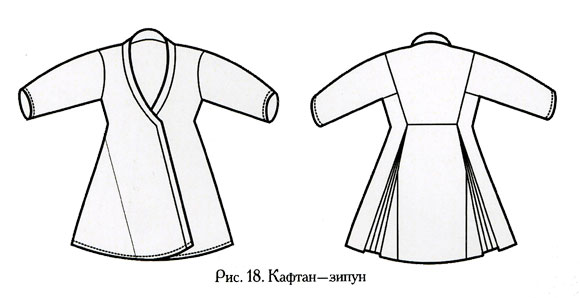
Kaftan-zipun (fig. 18), open-front outer folk clothing. Made from homespun cloth or factory fabric, most often brown, rarer black or gray. The back of the zipun is whole, slightly fitted or cut-off with gathers. Two or three wedges were sewn into the sides, sleeves cut-out. The zipun was made without a collar or with a small collar fastened with one or two buttons (at the neck and chest). Sleeve edges were often edged with leather, and sometimes (in women’s zipuns) with plush. The zipun was usually made without lining. It was worn, depending on the weather, in all seasons.
Poddyovka (fig. 19), as the name suggests, was worn under another, warmer garment. For this type of outer clothing, thin homespun cloth or “ponitchina” (warp linen, weft wool) was used. A feature of the cut can be considered the cut-off waist and gathers on the back of the poddyovka. Also a shoulder seam dropped back and arc-shaped darts on the back (preserved to this day, for example, in military or police short sheepskin coats), stand-up collar. From the neck to the waist were four hook fastenings. The length of the poddyovka reached mid-calf. The ponitok had a similar cut, only without gathers at the back waist.
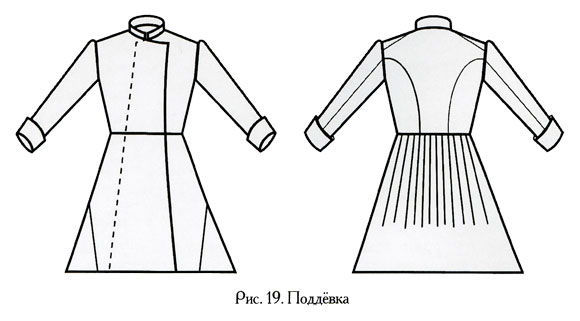
Short clothing has been considered impermissible and even law-breaking since Old Testament times, like beard-shaving18Collection on Worldliness and Beard-Shaving. Printing House at the Preobrazhensky Almshouse in Moscow in the year 7419 (1911). Folio 24.. In the Bible it is said: “And Hanun took David’s servants, and shaved them, and cut off their garments in the middle, even to their buttocks, and sent them away. Then certain came and told David about the men; and he sent to meet them, for the men were greatly ashamed”19First Book of Chronicles, chapter 19, verse 4..
Short — “shchapovataya” — clothing is also forbidden to wear in the well-known book of the early 19th century compiled from Scripture by “the abbot of blessed memory of the Kineshma regions Trofim Ivanovich, native of Moscow and spiritual son of Ilya Ivanovich, who ended in exile and glorified by incorruption.” “Short clothing, called telogreya, this is un-Christian attire, that is, pagan, or again women sewing men’s clothing for themselves or putting ready-made on themselves. Or again men and women keeping and wearing Circassian clothing, and not counting it a sin, some even standing in prayer in them”20Statute on Christian Life. On Walking in Clothing Unbefitting Christians. If a man or woman clothe themselves in attire not according to paternal tradition, let them be anathema. Chapter 34..
Clothing for Prayer
Until now, we have considered everyday, worldly or secular clothing, and in it it was considered impious to come to communal prayer. For prayer, there was a special cut long, to the ground azyam. Now, unfortunately, in the time of general mixing and loss of tradition, the poddyovka in many places has come to be considered church clothing. And to give it “solid churchliness,” it is simply lengthened like an azyam. Meanwhile, there are conciliar paternal prohibitions for Old Pomorians to come to prayer in poddyovkas: “in poddyovkas at prayer by no means to stand.”
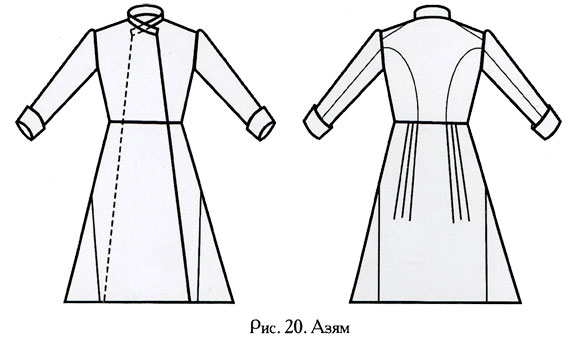
In fig. 20 is depicted the azyam — men’s outer clothing for communal prayer, accepted among Old Pomorians (Fedoseevtsy and Filipovtsy). Features of the azyam’s cut are recorded in the Statute for the Preobrazhensky Almshouse of Ilya Alekseevich Kovyline. The color can only be black, dark brown, dark gray, or dark blue. The azyam has a cut-off waist, shoulder seam dropped back, and arc-shaped darts on the back, like the poddyovka. But the collar is no longer just a stand-up but continues along the entire upper line of the front. On the back from the waist, under the lower edge of the darts, go three counter folds each 7–9 cm deep, almost one above the other.
The length, as mentioned above, reaches down to the footwear. A striking distinctive feature of the azyam was the red twisted “snurok” (twisted cord), with which the cuffs and the entire front panel from the side were edged, including the collar and hanging loops. From the loops, four fastenings were formed with two round buttons each from the collar to the waist. Such fastenings can be seen in old portraits in the city of Riga in the Grebenshchikov community. However, closer to the 20th century, these fastenings ceased to be made, and they switched to ordinary hooks as on secular or military clothing. Interestingly, by the 20th century, the twisted cord also disappeared from azyams, but edging of black velvet appeared on the cuffs and collar (possibly only for kliros members).
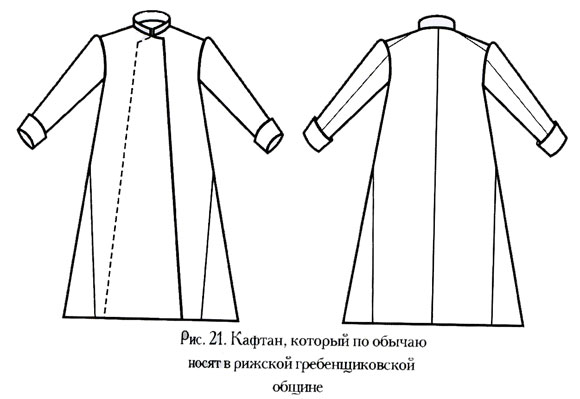
In fig. 21, as an example, a kaftan is shown, which by custom is worn in the Riga Grebenshchikov community. It is dome-shaped: there are neither folds nor darts, neither in front nor in back. This is most likely ancient outer clothing, under which an azyam or poddyovka was worn. A sample of it can be seen in the Historical Museum, where a velvet kaftan of this cut is displayed in a showcase.
In fig. 22, we see boots of ancient Russian cut: with turned-up toes and on heels. Such boots were worn during services, as seen in the same old photographs. There is also a prohibition against wearing “smaznye” boots, that is, shiny—patent leather—as well as boots without heels—in the Tatar style.
Women’s clothing for prayer also has its distinctive features that set it apart from traditional folk clothing. The complex of women’s prayer clothing consisted of the following elements: lower shirt belted with a belt, rukava (sleeves or upper bodice) worn over the lower shirt, sarafan, two shawls (lower and upper).
The sarafan for prayer (fig. 23) is an open-front kosoklinny sarafan with a collar like that of the deaf tunic-like sarafan. Its distinctive feature is three pairs of counter folds laid from the collar to the middle of the shoulder blades and stitched on the back. The front panels are fastened with buttons and hanging loops. The number of buttons must be a multiple of numbers symbolic for Christians (as on the lestovka, for example): 30, 33, 38, 40. Thus, even the buttons on the prayer sarafan were not decoration but reminded of truths significant in the Christian way of life. The hem of the sarafan at the back should lie on the ground, like a small train. The front part is shorter, so that the toes of the footwear are visible. For prayer sarafans, fabric in dark blue, dark brown, or black colors was used. Red in all shades was forbidden. It must be emphasized that sarafans for prayer are not belted (Article 41 of the Polish Council).
Under the sarafan was worn the lower shirt with a belt, and over it rukava (manishka) exclusively white in color (and not whatever one wants or happens to have!—V.S.). The wide sleeves of the shirt were gathered at the wrist or ended in a cuff and decorated with white lace. In Kazan, for prayer, it is customary to wear a white shirt with wide ungathered sleeves, also decorated along the edge with white lace (fig. 24).
An essential element of women’s prayer clothing is the shawl. First, the woman puts on the lower white shawl, completely tucking away the hair and covering the forehead to the middle. Then the head is covered with the upper shawl. There are special rules for wearing the shawl in prayer (fig. 25). Unmarried praying women (maidens and widows) wear the shawl loose, on the edge (image on the left). For praying women, fringes (bakhroma) along the edge of the shawl are unacceptable. Married women wear the shawl only cornerwise (image on the right). Let us recall that non-praying can include not only married women but also those excommunicated from communal prayer for other deviations or transgressions. In prayer, the shawl is not tied in a knot but is necessarily pinned under the chin with a fastener (in antiquity, this was most likely a fibula; now a simple safety pin). The color of the shawl, like the sarafan, is exclusively dark.
As regrettable as it is, nowadays we see complete multicolored variety in clothing and shawls among non-praying women. One should not follow the example of the “married” (those in marriages) and wear now white, now colorful shawls—this is entirely non-traditional for Pomorians, and especially for Old Pomorians. “The communal statute developed by Andrey Denisov in 1702 (… ) reflected the desire to eradicate habits of worldly life. In the 1720s, the statute was supplemented by conciliar decrees regulating the character of women’s clothing, prohibiting lace and ‘knitted plaits’ and ‘other improper’ decorations…”21Kapusta L.I. Folk Art of Karelia and Artistic Traditions of Vyg. Culture of Vyg Old Believers. (On the 300th Anniversary of the Founding of the Vyg Old Believer Community). Petrozavodsk: “Karpovan Sizarekset.” 1994. P. 38. And the Vyg Council of 1725 also says in Article 10: “Among all hermitage dwellers in the wilderness, strictly ensure that there be no cornered caps with tassels, no camel-hair or silk sashes, and no draget clothing”22See: BAN. Druzhinin Collection No. 8 and Pushkin House. Collection No. 3. Autograph of Andrey Denisov..
On clothing for communal worship, Article 41 of the Polish Council of 1752 says: “Youths in red shirts and kalamencovy trousers (of fine colorful fabric), and maidens in red boots and red shawls and with gold bindings, by no means to stand in prayer, and not to gird themselves with belts, and thereby not to scandalize the Orthodox (!—emphasized by V.S.); if they prove obedient, let them make 300 prostrations to the ground.”
The St. Petersburg Council of 1809 on clothing, already not only for worship, says: “Article 8. German dress is seen worn by many Christians, and on this there are most terrible prohibitions in divine Scripture. Therefore, superiors must in every way restrain from this soul-harming custom, and excommunicate those who resist.”
The sixth article of the famous Moscow Council of 1883 prohibited what had by then become fashionable non-Christian custom in clothing: “Not to adorn oneself with foreign and pagan garments (…) In such attire, by no means to stand in prayer houses” (this is as topical as ever today!—V.S.).
It must be recalled that even at home, in cell prayer, standing before holy icons, one cannot neglect Christian attire, just as in communal prayer.
At present, among modern Christians, there is an opinion that for newlyweds and other non-praying excommunicated from communal prayer, it is entirely unnecessary to wear Christian clothing either in everyday life or even when coming to communal prayer. And men need not wear beards, nor women uncut hair, and certainly not maintain Christian utensils. “After all, they say, one won’t pray anyway.” But this is utterly unsound, un-Orthodox reasoning. We ourselves, without any persecutions or prohibitions, thereby deprive ourselves of the Christian appearance (likeness of God), reject the holy fathers’ commandments, and do not wish to imitate the lives of God’s saints.
In conclusion, one must acknowledge, following the well-known spiritual father G.E. Frolov: “Here we call ourselves Old Believers, but our outward appearance testifies to the opposite. Often they reply: ‘One must keep the covenants of piety in the soul.’ But this is merely an evasion. Your impious outward appearance… proceeds from your will, from your attachment to everything new and corrupt. Your outward appearance clearly exposes empty inner content. On you is the uniform not of Christ’s warrior, but of Antichrist’s.” “If it is shameful on the street to show oneself as a Christian before the corrupt world, then why do you appear in the prayer house and at Christian gatherings and congresses in Antichrist’s guise? What sound advice can come from such counselors?”23Frolov G.E. Covenants of Antiquity. Calendar for the Year 1999 of Christians of the Ancient Orthodox Catholic Confession and Old Pomorian Concord. Moscow, 1999. P. 47.
From accounts of eyewitnesses of the proper attitude toward non-Christian corrupt clothing, one can cite Natalia Alekseevna Sergeeva (now reposed kliros singer of the Preobrazhensky Cemetery, disciple of G.E. Frolov). When a young man from the city arrived in their village of Rayushi (Estonia) in a fashionable jacket, one of the Christian elders approached him from behind and, pulling from bottom to top, tore the demonic attire. A similar episode was related to us by Kapetolina Platonovna Rokhina, whose great-grandfather Ambrosiy Rokhin was a participant in the council at Preobrazhensky Cemetery in 1883 (though non-praying). In their Christian village of Zubari in Nolinsky district, a certain dandy also returned from the city in “foreign attire,” so his grandfather simply hacked the “Antichrist uniform” with an axe.
Today, alas, we calmly observe, without any qualms of conscience, carefree people clad in these demonic garments walking into Christian churches. Is it really impossible for them to sew at least a Christian shirt for attending services? Of course it is possible! Let them divert a little means and time from worldly occupations in their lives, to at least attempt in this to resemble Christians, as the holy fathers and our pious ancestors called us from the beginning of the Orthodox faith to our last days.
The last among Christians V.G.S. Summer 7515
-The article is taken from the Old Orthodox calendar for the years 2007–2008.
-By Nina Lukyanova.
“Shake off, ye unbelievers, your mental slumber, open the eyes of your mind and behold: the sun of the world is already setting, night will soon come, the fateful hour will strike suddenly, Christ will appear like lightning—for all is ready. And yet, instead of Christ, Whom we must await with fear day and night and every hour, you still expect the beast—the Antichrist with ten horns.”
L.F. Pichugin (1859–1912), an outstanding figure of the Pomorian Church, a learned reader (nachetchik), and author of apologetic works
The various branches of the priestless Old Believers (bezpopovtsy) are united by the conviction that, after the schism of the 17th century, the apostolic succession of the Orthodox clergy was broken, the grace of the priesthood ceased, the church hierarchy ended, and the spiritual Antichrist came to reign. The bezpopovtsy began to understand the spiritual Antichrist as the entirety of the diverse heresies that had penetrated the Church—that is, the Antichrist is not a specific person, but a spiritual heresy reigning in the world, which has eradicated true priesthood. The bezpopovtsy view the dominion of the Antichrist as the rule of heretics with their persecutions of true Christians. And since the Antichrist already reigns, Christians must remain in a universal state without priests or sacraments. This is precisely why the bezpopovtsy did not recognize the ordinations of the dominant church and declared it impossible to accept priests from there.
In 1654, Bishop Paul of Kolomna opposed the heretical changes that Patriarch Nikon was introducing into the Church and was exiled to the Paleostrovsky Monastery in the Olonets district, where in confinement he taught and strengthened people in the patristic traditions and piety. It was Bishop Paul of Kolomna who established that all those coming from the Nikonian church must be baptized with the true Baptism. He enjoined not to accept newly ordained priests, but to baptize them, and under no circumstances to accept their “sacraments” from the new, heretical “false priests.”
Christians besought Bishop Paul to appoint priests and a bishop:
“O reverend one, our holy sufferer for the faith, holy and great ascetic father, if your holiness departs from us orphans into the ages to come, the holy and bloodless sacrifice will be extinguished on earth. And if the priesthood perishes to the end, who will kindle for us the lamp of priesthood, the holy Divine Service? Only you, father, possess the granting grace in priests, and all the holy church mysteries are sanctified by you. If you, most holy father, do not kindle this lamp, then truly visible priesthood will be extinguished in us, and then there will be great need for the faithful in the present time and for our brethren coming after us.”
To which Bishop Paul replied:
“Among you there are simple pious men and monks who fear God and keep Christ’s commandments, who can baptize and hear confessions, for true priesthood has ceased with Nikon’s innovations.”
While priests of the old, ancient Orthodox ordination were still alive, they communed the “remnants of ancient piety” with the Divine Mysteries. After it became impossible to find an Orthodox priest, out of necessity the fathers commanded that even a layman could baptize and hear confessions according to the tradition of the Holy Church, and the verbal flock was entrusted to unordained pastors who can perform only two church mysteries—baptism and penance.
From the time of the Solovetsky Uprising of 1667–1676, the monks and laypeople of Solovki who did not submit to the liturgical reform attempted to break with priests who, in particular, opposed the rebels’ decision not to pray for the tsar and patriarch. Some of the Solovetsky monks and laypeople stopped attending church and confession with spiritual fathers, rejected the heretical communion, and confessed “among themselves to laypeople.”
The priestless Old Believers never denied the church hierarchy as such, and therefore, in the first half of the 18th century, they continued to search for true priesthood of the ancient ordination. Thus, in early 1730, a joint expedition with the priestly Old Believers (popovtsy) was undertaken to Palestine to find “Orthodox priesthood.” Unlike the “runaway priests” faction (beglopopovtsy), the bezpopovtsy accepted clergy defecting from the dominant church without preserving their rank—that is, as ordinary laypeople. In 1765, in Moscow, the idea of uniting bezpopovtsy and popovtsy under the authority of an Old Believer archbishop was considered. Proposals were made to ordain such an archbishop using the hand of the relics of Metropolitan Jonah or another saint; however, all these attempts were unsuccessful—the unification never occurred. The dying out of priests of “pre-Nikonian” ordination and the absence of bishops in Old Belief led to the fact that, by the end of the 17th century, a portion of the Old Believers became convinced that it was no longer possible to have priesthood.
The bezpopovtsy divide all the sacraments, according to their importance for salvation, into “absolutely necessary” (baptism, penance, communion) and “necessary” (marriage, unction, priesthood, chrismation), which, out of necessity, may not be performed at all.
The priestless state of the bezpopovtsy (due to the spiritual heresy reigning in the world and eradicating true priesthood), the dominion of the Antichrist, and the “abomination of desolation in the holy place” formed the basis for the doctrine of spiritual communion.
In the 18th century, among the Vyg community and the Fedoseevtsy, there was a practice of communing with ancient reserved Gifts; in the Vyg Hermitage, there also existed a rite of “communion” with the God-bearer’s bread (prosphora blessed in honor of the Virgin Mary).
Old Believer priestless thinkers in the 18th century explained in their works that, in the current historical situation, it is impossible—due to the absence of an ancient Orthodox church hierarchy—to preserve “the unchanging fullness of all external forms of the Church’s existence,” and therefore partial departures are inevitable, as evidenced by examples from the Old and New Testaments, the writings of the holy fathers, and church history:
Those who dare without necessity to do what is not commanded are condemned as transgressors of the law. But one who dares out of necessity is not only not condemned, but is deemed worthy of praise and honor and is justified by all teachers. However, it is necessary to discern carefully in this, so that we dare only in those things where extreme necessity commands, lest, by proposing these things pertaining to necessity, we begin in non-necessary times to perform mysteries that are not subject to necessity.
Throughout the 18th century, the bezpopovtsy justified the impossibility of following the example of the popovtsy and accepting priesthood transitioning from the Synodal Church, explaining that this would merely reproduce external forms of worship but not the lost grace. While the “Deacon’s Answers” directly state the readiness of representatives of the priestly direction to reunite with the Synodal Church if it returns to pre-reform rites, the bezpopovtsy held a different opinion on this matter.
In Sacred Scripture and church history, the bezpopovtsy found answers to the question of how to compensate for the forced renunciation of certain church sacraments. Thus, in the ancient Church during times of persecution of Christians and in confrontations between Orthodoxy and Arianism, iconoclasm, and other heresies, Christians repeatedly found themselves deprived of hierarchy and clergy. Descriptions of such religious-historical events are well known from the lives of saints and other literature.
The 16th–17th century conflict between Orthodox and Uniates in Rus’ demonstrated that, with the near-total defection of the clergy and severe persecutions of Orthodoxy, laypeople found a way for the Church to exist even when deprived of priesthood.
Archimandrite Zacharias Kopystensky of the Kyiv-Pechersk Lavra argued in his writings that, in the absence of a clergyman, a layman may perform the sacraments of baptism and confession, and the sacrament of communion is replaced by spiritual communion—as the most sincere and “warm from the heart desire” to receive the Body of Christ.
The works of Zacharias Kopystensky, as well as those of other Orthodox writers—polemicists and church preachers—Stephen Zizanii (1550–1634) and John Vyshensky (between 1545–1550 — after 1620), were republished in Moscow already in the mid-17th century.
The most famous Old Believer publications—“The Spiritual Sword,” “The Shield of Faith,” and other priestless literature—repeat the doctrine of spiritual communion that became generally accepted among the bezpopovtsy. This doctrine is also expounded in detail in the main apologetic book of the Old Believers, the “Pomorian Answers” (Answer 104). Here, with references to the book “On the Seven Sacraments” (Chernigov, 1716) and “Dialogismos” (Kyiv-Pechersk Lavra, 1714), three types of communion are described. The first is the “ordinary,” when one receives the mystery with a pure heart and conscience and with the mouth; the second is spiritual, when “for blessed reasons those who have nowhere to commune, that is, to taste with the mouth the life-giving and most pure Mysteries, yet show warm faith and zealous desire for this, adorning their life with virtues: such people through faith and zeal spiritually commune of the Flesh and Blood of Christ”; and the third, when those who partake “with the mouth alone” receive communion unworthily, without cleansing themselves from sins, and for them it works not for salvation but for condemnation.
In response to unfair accusations of Protestantism, the bezpopovtsy replied thus:
It is not hierarchs we fear, but innovations; and it is not hand-made churches we flee, but the new traditions and statutes newly introduced into them.
The bezpopovtsy particularly emphasize that the state of a person’s spirit can determine the result of a sacrament’s effect and even compensate for the forced incompleteness of external forms, since it is precisely the “inner spiritual essence that predetermines the external forms and the character of their changes”—in other words, spiritual content takes priority over canonical external forms.
The priestless Old Belief has never rejected the idea of any church sacrament or rite, nor has it questioned the status of the priesthood as the bearer of God’s grace. The entire worldview of the bezpopovtsy is permeated with the awareness of loss, which is compensated by the spiritual power of faith.
In “The Shield of Faith” it is stated: “we, though we do not receive it because of the obstruction by heretics, yet complete it by our faith,” and this confirms the forced nature of their actions, rather than a desire to reform the Church in accordance with their own convictions.
In a Church without priesthood and hierarchy, the bezpopovtsy sought in everything to follow canonical rules and historical events, placing all their hope in the fact that God would complete what could not be performed due to compelled circumstances. At the same time, it is important to note that a layman baptized and heard confessions in place of a priest—and there are grounds and examples for this in church tradition—yet he never performed unauthorized spiritual actions, such as chrismation or the Liturgy, which laypeople could never perform. Unfortunately, the losses in the fullness of external forms occurred due to the loss of the priesthood, whose gracious power is not made by hands and cannot be recreated by any human efforts.
Many holy martyrs and ascetics went their entire lives without communing of the Body and Blood of Christ, yet were saved and are glorified by the Church. Such, for example, are the venerables: Paul of Thebes, Peter of Athos, Mark the Thracian, Theophan of Antioch, Mary of Egypt, Theoctista, and other martyrs: Eupsychius, Hesper and Zoe, Coprius and Alexander, Cyricus and Julitta, Drosida, Glyceria, and others.
Those who are now metropolitans, archbishops and bishops… priests and deacons, and other church clerics… Metropolitans are no longer worthy to be called metropolitans, nor archbishops, even down to the least; though they associate themselves with the rank and appear adorned with the beauties of sacred vestments as metropolitans and archbishops and others, according to the holy divine canons they are deposed; and whatever they bless is unblessed. For those baptized by them are unbaptized, and those ordained are not clerics… and for this reason all bishopric and priesthood has been abolished (Professor N. F. Kapterev, “Patriarch Nikon and Tsar Alexis Mikhailovich,” vol. 2, p. 200).
With the abolition of the priesthood, there is also no visible sacrament of holy communion, which can be administered only by truly Orthodox pastors.
In his commentary on the verse from the book of the holy prophet Zechariah, “And the Lord said unto me, Take unto thee yet the instruments of a foolish shepherd” (Zech. 11:15), Blessed Jerome writes: “undoubtedly, the foolish or unwise shepherd is the Antichrist” (Works of Blessed Jerome of Stridon, part 15, p. 150, 1915 ed.).
Venerable Ephraim the Syrian writes about the same:
In the image of this shepherd is represented the Antichrist (Works of St. Ephraim the Syrian, part 6, p. 189, 1901 ed.).
Thus, unwise shepherds who deviate from the true faith and sin against it, according to the words of the holy fathers, already represent the Antichrist.
John Chrysostom explains:
Those who are in Christianity should resort to Scripture, for from the time when heresies began to disturb the Church, those who wish to know the righteousness of the faith can have no true Christian refuge except Divine Scripture (Book on Faith, ch. 23, fol. 215 ob.).
This means that true Christians must always turn to Holy Scripture, because from the time of the Church’s disturbance by heresies, nothing except Divine Scripture can any longer be a Christian refuge for knowing the true faith, according to the word of the holy father Hippolytus, Pope of Rome:
By hearing the Divine Scriptures and holding them in their hands and always meditating on them in their minds, many will escape his deception (Third Word, on Meatfare Sunday according to the collection, fol. 183 ob.).
In the Reading Menaion for August 29, on the reverse of folio 527, we read:
For to see, in place of the true shepherd of Christ, a wolf entering Christ’s flock in the sheep’s clothing of the archbishopric. The right-believing people, seeing that false shepherd to be a heretic and the abomination of desolation presiding in the holy place in the Church, unwilling to turn to him, went out of the city into the field and, gathering in an empty place, performed services to God.
From the cited passages of Holy Scripture it is clear that believing people considered the emerging heretical hierarchs to be the “abomination of desolation” and, striving to distance themselves from everything abominable, went out into the field to perform divine services.
The holy place denotes the throne on which the sacrifice to God should be offered—that is, the sacrament of holy communion—as the Book of Cyril states on folio 31:
The throne is a holy place, on which priests offer sacrifice to God, consecrating bread and wine into the Body and Blood of Christ.
Consequently, the bezpopovtsy believe that heretical archpastors and pastors are servants of the Antichrist and constitute his body; they themselves are the abomination of desolation, performing service in the holy place—that is, at the throne.
Bishop Arseny of Uralsk (Shvetsov) of the Belokrinitsa hierarchy (Russian Orthodox Old-Rite Church) agreed with the bezpopovtsy that the prophecy about the abomination of desolation had been fulfilled. In his conversation with M. E. Shustov, he says:
These Nikonian preachers do not believe the Gospel; they have only set up one thing: the eternity of the priesthood! And they want to hear nothing else. Thus they do not see what is said: when ye shall see the abomination of desolation, spoken of by Daniel the prophet, standing in the holy place (whoso readeth, let him understand), then let them which be in Judaea flee into the mountains. The fathers called even heretical bishops the abomination of desolation. We saw that the bishops at the Moscow council rejected all that was ancient, and so we fled to the mountains from the tempting bishops. (Conversation of M. E. Shustov with Fr. Shvetsov in Moscow in May 1888, pp. 11–12).
The prophetic word about the Antichrist from the teacher of the 3rd century, St. Hippolytus, Pope of Rome:
The Churches of God will weep with great weeping, for neither oblation nor incense is offered, nor is there a service pleasing to God. The sacred Churches will be like a vegetable storehouse, and the precious body and blood of Christ will not appear in those days (Third Word, on Meatfare Sunday according to the collection, fol. 184 ob.).
Blessed Jerome (4. 2, col. 155, 1912 ed.) points out that heretics also imitate church meekness, but their offering is not a service to God but food for demons.
False sacraments of apostate pastors, according to the testimony of the holy fathers of the Church, bring perdition to Christian souls. The Lord, for the sins of the people, permits the defilement of holy temples, the holy sacrament, and the priesthood:
Thus God, for the sins of those in authority, delivers the subordinate to punishment, and for the impure deeds of those serving the altar, permits holy altars to be plundered by impious hands, and holy temples to fall into desolation.
Marvel, beloved, how God spares not His own houses when He permits wrath upon the earth. For if He spared not the holy Ark, but delivered it to foreigners, along with the lawless priests, the temple of sanctification, the Cherubim of glory, the vestments, the prophecy, the anointings, and the manifestations, to be trampled and defiled by pagans, neither will He spare the holy churches and the most pure mysteries (Book of Nikon of the Black Mountain, word 41, fol. 308 ob.).
If there is no true sacrament of holy communion, then the false one, pernicious to the soul, is not accepted. Cyprian of Carthage indicates (in letter 56, part 1, p. 316):
And thus the people obeying the divine commandments and fearing God must separate themselves from the sinful prelate and not participate in the sacrifices of a sacrilegious priest.
Theodore the Studite writes in the same volume 2:
As the divine bread of which the Orthodox partake makes all partakers one body, so exactly the heretical bread, bringing those who partake of it into communion with one another, makes them one body opposed to Christ (part 2, letter 153, p. 532).
Blessed Jerome, in part 6 of his works (p. 78, 1905 ed.), warns Christians about the church of heretics, “which entices the foolish in mind so that, deceived by it, he accepts stolen breads and stolen water—that is, a false sacrament.”
The sacrament of holy communion, even in its pure and inviolate form, cannot by itself save a person, as confirmed by the evidence presented:
It is true that in Judas it is evident that, having received the most holy bread from the most pure hand of the Lord Christ, Satan immediately entered into him because of his unworthiness (Prologue, March 22, fol. 117).
“Receive,” He said, “the bread of which thou hast partaken from Me…” Since the Lord gave bread to Judas, perhaps coming to his senses from the bread of the table, he would retreat from betrayal: but Judas did not resolve thus, and then became completely satanic (Explanatory Gospel, commentary of Theophylact on the 45th conception of the Gospel of John, fols. 222 and 223).
That is, communion from the hands of the Savior Himself, Who said to Judas Iscariot: “receive from Me the bread and partake,” and the performance of the sacrament of communion itself, whose purpose was to bring him to reason, did not restrain Judas from crime and his own perdition. Consequently, it is not communion that has the power to save a person or restrain him from crime—this depends first and foremost on the Christian himself, the manner of his life, the purity of his thoughts, his good deeds, and not on whether he partakes, as St. John Chrysostom teaches us:
For a faithful one should not be recognized by partaking of the holy mysteries, but by an excellent life and deeds pleasing to God (Explanatory Gospel in the preface to Matthew, moral teaching of John Chrysostom, fol. 24).
The main idea of spiritual communion lies in the Christian’s life in accordance with faith in Christ, in the assimilation by the whole human being of the Saving Sacrifice of Jesus Christ.
The robber crucified with Christ, considered a despairing sinner, throughout his greatly sinful life never partook of communion and was not even baptized, yet was led by the Savior into paradise, as Ephraim the Syrian says:
Since the Jews chose the robber and rejected Christ, God chose the robber and rejected them. But where is that (which was said): “If anyone does not eat My Flesh, he has no life”? When He accepted faith from the robber, in exchange for it He freely gave him immeasurable gifts, freely poured out His treasures before him, immediately transferred him to His paradise and there set the one introduced (into paradise) over His treasures: thou shalt be with Me in the paradise of delights! (Works of Ephraim the Syrian, part 8, p. 306).
In addition to the robber saved on the cross, one can read in the menaia or prologues about those holy martyrs who believed in Christ but had not yet been deemed worthy not only of the holy Eucharist but even of holy Baptism, like the robber, yet suffered for the faith and were granted the crown. Any literalism in interpreting Holy Scripture, the bezpopovtsy believe, can lead to dangerous heresies.
St. Gregory the Theologian writes:
They will not admit me to the altars, but I know another altar, of which the present visible altars are but images… which is entirely the work of the mind and to which one ascends by contemplation. Before it I will stand, on it I will offer a sacrifice pleasing to God and an offering and whole burnt offerings, as much better than those now offered as truth is better than shadow… from this altar no one will distract me; they may expel me from the city, but not from that city which is above (Works of Gregory the Theologian, part 1, cols. 382 and 3, Soykin ed.).
The holy father Athanasius of Alexandria teaches in his works: “They shall not be ashamed in the evil time” (Ps. 36:19). In times of persecution, when teachers are lacking, the Lord Himself will nourish with His Spirit those who believe in Him (part 4, p. 29, 1903 ed., in commentary on the psalms according to Permyakov’s extract, part 1, fol. 222 ob.).
According to the words of St. Athanasius of Alexandria and St. Gregory the Theologian, the bezpopovtsy, lacking now the visible sacrament of holy communion and true performers of it, nevertheless receive the possibility, through faith in Jesus Christ, to partake spiritually. This spiritual partaking of the Body and Blood of the Lord occurs also through the knowledge of the word of God, as Blessed Jerome writes about this:
Since the body of the Lord is true food and His blood is true drink, according to the mystical interpretation, in this present age we have only this one good: if we feed on His flesh and drink His blood not only in the mystery (of the Eucharist) but also in the reading of the Scriptures; for the true food and drink which is received from the word of God is the knowledge of the Scriptures (Blessed Jerome, part 6, p. 37).
Reasoning about spiritual communion, the bezpopovtsy say:
Just as the first coming of the Savior was in the diminution of the Old Priesthood, so the second coming will be. Let it be better that in our Church at least a bright and pure remembrance be preserved of the untrampled Throne of God, upon which the Lord will again come to step on the Day of His Second and Great Coming. Though we have no visible sacrifice of communion, yet according to the merit of faith and virtues, God nourishes His faithful with the Holy Spirit.
A superficial understanding of the words of Christ “he that drinketh My blood and eateth My body hath eternal life” as referring only to communion in the form of bread and wine—any literalism in interpreting Holy Scripture that leads to heresies—misleads many people, the bezpopovtsy believe; in other places the body of Christ is called the Church, and the blood is interpreted as the teaching of Christ.
The sacrament of communion is performed by the Holy Spirit, and not by the faith of the priest alone, yet the sacrifice of communion cannot be performed without a truly Orthodox priest.
In the life of the holy martyr Maria Golendukha we read:
The holy martyr Maria Golendukha prayed to God to reveal to her about the Severians—whether she should approach their communion or not—and she saw an angel holding two chalices: one full of darkness, the other filled with light, showing her that the chalice with darkness is heretical communion, and that with light is of the holy catholic Church. The saint abhorred heretical communion and quickly departed from there (Chet’i-Minei, July 12, fol. 433 ob.).
St. Theodore the Studite (part 2, letter 154, p. 385, 1867 ed.) writes:
Here too the light of the world shows that communion is fellowship: and no one of sound mind will say that communion is not fellowship. As the divine bread of which the Orthodox partake makes all partakers one body, so exactly the heretical bread, bringing those who partake of it into communion with one another, makes them one body opposed to Christ, and one who says otherwise vainly utters empty words.
To the question of how to acquire spiritual communion, the bezpopovtsy say:
Only through spiritual ascetic struggle.
Sometimes a person’s heart becomes a nest for various vices, while the mind skillfully finds justifications for them. Often the inner essence of a person is concealed by empty words and actions generated by a contentless mind that exists without any connection to the Creator.
It is fitting for a true Christian first of all to know the Lord his God, to believe in Him and confess Him, for all Christian wisdom consists in knowing the Lord God and oneself. Not every reasoning or teaching about God is truth; therefore, a Christian must be experienced in teachings—accepting the good and rejecting everything inconsistent with the Teaching of Christ.
-G. V. Markelov.
In the Russian Orthodox Church, the sacrament of repentance as a divinely instituted sacred act acquired its final forms only in the 17th century. The rite of repentance, known as the Order of Confession, was already included in pre-Nikonian printed books and, in this most ancient version with only minor changes and additions, was transferred into the liturgical practice of the Old Believers. The Old Russian Order of Confession was a ritual dialogue between the Christian who came to repent and the priest who examined him. This dialogue included obligatory elements that constituted its canonical form.
In the most general terms, repentance proceeded as follows. The priest was obliged to question the penitent in detail about his identity, the nature of his transgressions and violations of God’s commandments, and about where, how, when, and from what motive the violation occurred. The penitent was required to answer the questions fully and directly. After that, the priest demanded that he recite the Symbol of Faith (the Creed) to confirm that the person coming to confession believed in an orthodox manner without doubt. Then the priest either “absolved” the penitent (i.e., forgave his sins) if the repentance was sincere, or imposed appropriate penances (epitimia). Penances had long been regulated in detail by the various rules of the Nomocanon or “Book of the Pilot” (Kormchaia Kniga). Minor sins were forgiven on the spot through the “absolutory” prayer, and the penitent, having received admonitions, was admitted to Holy Communion.[1]
The order described above is found primarily in numerous manuscript Trebniks (Books of Needs) of the 14th–16th centuries. With insignificant differences, the same structure appears in printed Trebniks of the 16th–17th centuries. The particular variations in the Order of Confession found in Old Russian books were caused chiefly by differences in the social categories of those confessing. Thus, already in 16th-century Trebniks there appear special sections containing particular questions addressed to princes, boyars, boyars’ children, secular rulers and nobles in general, as well as to clerks and officials serving the authorities. There are also specific questions for peasants and merchants. Printed Trebniks further contain more differentiated sections addressed to married or unmarried men, maidens or married women, widows, children of both sexes, the literate or “those who do not know letters,” etc. Finally, among 17th-century texts one even encounters special questions for the confession of a patriarch or of the tsar himself.[2]
Often the texts of the Order of Confession consist not only of questions about the penitent’s sins but also include the penitents’ answers. These “standard” answers essentially repeat the sequence of questions and are phrased in the affirmative with the introductory verb “согреших” (“I have sinned in this and that, at such-and-such a time and place”).[3] Such responses at confession were called “ponovlenie” (renewal), because sincere repentance not only frees a Christian from the burden of sins but renews his soul, as it were, by a second baptism.[4]
As is well known, the priestless Old Believers (bespopovtsy) preserved the sacrament of confession and were forced to concentrate in it a significant part of their religious feeling, since they rejected certain other important church sacraments. For this reason the priestless Order of Confession constantly underwent corrections that expanded both the range of articles and the regulation of penitential discipline itself.[5]
A curious example of such an expanded Old Believer order of confession is a 19th-century text that has come down to us in a manuscript from the Ancient Manuscripts Repository of the Pushkin House (Institute of Russian Literature), collection of I. A. Smirnov, No. 7. The manuscript was first mentioned by V. I. Malyshev as the “Pomorian Order of Confession.”[6] In the 1960s, when describing I. A. Smirnov’s collection, A. S. Demin called this manuscript a “Pomorian Trebnik.”[7]
Below is a description of the manuscript with the present author’s title:
Confessional Miscellany. Early 19th century, quarto, 178 leaves. Leaves 2–162 are written in a semi-uncial hand close to the Pomorian type; leaves 163–171 in a rapid semi-uncial; leaves 172–175 imitate printed type; leaves 1, 176–178 are blank. Headings and initials are in cinnabar; binding: boards covered with embossed leather, one of the two original copper clasps survives. Paper with factory watermarks dated 1806 and 1807. On the upper flyleaf a pencil note “Ivan Stepanovich Ukashchin” (?), a note about the manuscript’s acquisition by the Pushkin House manuscript department in 1956, and a pencil note “G. Skachkov?” (in the hand of V. I. Malyshev?). On leaf 1 the ink stamp of the library of Ivan Alekseevich Smirnov.
Contents: Table of Contents (leaf 2), Preliminary Admonition to the Confessor (leaf 4 ob.), Preliminary Instruction concerning Newcomers (leaf 9 ob.), Order of Confession (leaf 11 ob.). Questions about Sins. Article 1. General (leaf 18), Article 2. Various Questions according to Rank and Station – To Spiritual Fathers (leaf 39 ob.), Article 3. To Chanters (leaf 43), Article 4. To Icon Painters (leaf 44 ob.), Article 5. To Masters/Landlords (leaf 46), Article 6. To Merchants and Traders (leaf 47), Article 7. To Goldsmiths (leaf 48), Article 8. To Silk Workers (leaf 48 ob.), Article 9. To Tailors (leaf 49), Article 10. To Gold-Embroiderers and Pearl-Stringers (leaf 49 ob.), Article 11. To Shoemakers (leaf 50), Article 12. To Coppersmiths (leaf 50 ob.), Article 13. To Blacksmiths (leaf 51), Article 14. To Millers (leaf 51 ob.), Article 15. To Day-Laborers and Workers (leaf 52), Article 16. To Farmers and Haymakers (leaf 52 ob.), Article 17. To Beggars (leaf 53), Article 18. To Writing Teachers (leaf 53 ob.?), Article 19. To Judges (leaf 54), Article 20. To Unmarried Men (leaf 55), Article 21. Questions to Married Men (leaf 57), Article 22. To Widowers (leaf 64), Article 23. Questions to the Female Sex – To Maidens (leaf 65), Article 24. To Married Women (leaf 67), Article 25. To Widows (leaf 75).
Ponovleniia (Renewals/Standard Responses). To Article 1, general (leaf 76 ob.), To Article 2 – Various according to Rank and Station: Spiritual Fathers (leaf 89), Chanters (leaf 92 ob.), Icon Painters (leaf 94), Masters/Landlords (leaf 95), Merchants (leaf 96 ob.), Goldsmiths and Silversmiths (leaf 96 ob.), Silk Workers (leaf 97), Tailors (leaf 97 ob.), Gold-Embroiderers and Pearl-Stringers (leaf 98), Shoemakers (leaf 98 ob.), Coppersmiths (leaf 99), Blacksmiths (leaf 99 ob.), Millers (leaf 100), Day-Laborers etc. (leaf 100 ob.), Farmers and Haymakers (leaf 101), Beggars (leaf 101 ob.), Writing Teachers (leaf 102), Judges (leaf 102 ob.), Unmarried Men who have fallen into fornication (leaf 103), Married Men (leaf 104), Widowers (leaf 107 ob.), Maidens (leaf 108), Married Women (leaf 109 ob.), Widows (leaf 113).
Conclusion after the confession of all sins… (leaf 114), Instruction to the Penitent (leaf 119 ob.), Consideration of Penances (leaf 128), Questions for the Illiterate (belonging to the beginning of confession) (leaf 130), The Ten Commandments (leaf 131 ob.), Seven Spiritual Works of Mercy (leaf 133), Seven Corporal Works of Mercy (leaf 134 ob.), List of Various Sins (leaf 136), Sins that Cry to Heaven (leaf 137 ob.), Sins against the Son of Man (leaf 139 ob.), Sins against the Holy Spirit (leaf 140 ob.), Sins arise from four causes (leaf 143 ob.), On the Detail of Questions (leaf 144), From the Book of Penances (leaf 153), On the Saving Fruits of Confession (leaf 163), How Repentance Should Be Offered in Good Time (leaf 165 ob.), That Christ, moved by tears and confession of sins, inclines to forgiveness (leaf 167 ob.), On God’s Mercy toward repentant sinners (leaf 169 ob.), Extracts from the Order of Confession (without title) (leaf 172).
The greatest interest in the miscellany is aroused by texts unknown from other Old Believer manuscripts, which begin with the second article (leaf 39). These contain lists of questions that were to be asked at confession to various categories (“ranks”) of members of the priestless community. The range of questions touches on the specific aspects of each profession or station. After the questions, the manuscript provides the corresponding “ponovleniia” (standard renewal responses) for each category. The manuscript concludes with instructional texts for penitents, discussions of penances, lists of evil and good deeds, etc.
Among the articles of the miscellany, our attention was drawn to the texts connected with the veneration of icons and with icon painters. Already in the opening section of the manuscript, in “Article One – General,” there are questions about icons that were to be asked at the very beginning of confession to every parishioner who came, because these questions contained the most important points of a confessional nature. Among them are the following:
- “For the sake of Christ’s Cross or holy icons, in order to confirm something as true, did you kiss them or lead others to do so, or advise anyone to do so?
- Did you raise an icon in your hands while swearing an oath, lead others to do this, or advise anyone to do so? …
- Did you blaspheme the writing of holy icons, lead others to do so, or think or say anything unseemly and blasphemous about holy icons?
- Do you call holy icons God and render them divine honor, or teach others to do so?
- Do you place special hope or trust in certain holy icons?
- Did you falsely invent miracles attributed to holy icons, teach anyone to do so, or advise anyone to do so?
- Do you light candles or pour oil only out of regard for the icon itself and not for the one depicted on it, or do you do this only for vainglory?
- Did you make icon covers (oklad not to honor the saint whose icon it is, but for vainglory? Or did you make covers using someone else’s money while wronging your neighbor?
- Did you rob holy icons or secretly take anything from them? Did you intend to rob a holy icon or secretly take from it something you liked – a cross, a stone, a pearl, or anything else – or teach or advise anyone to do so?
- Did you falsely collect candles, oil, or incense for the covers of holy icons, teach anyone to do so, or advise anyone to do so?”
Questions about one’s attitude toward icons, which from ancient times belonged among the obligatory general questions at confession, are found in all Old Russian Trebniks. In our manuscript at least two important aspects stand out: questions about the desecration of icon images and about false worship of icons as if they were “gods.” One may suppose that for the Old Believer spiritual fathers who, in the early nineteenth century, brought their flock to confession and repentance, these questions retained their doctrinal significance. In everyday consciousness various attitudes toward icons were permitted (recall the Russian proverbs “If it’s good – pray to it; if it’s no good – cover pots with it,” “If an icon falls – someone will die,” or the saying “I’ll even take the icon off the wall” (to swear by it)), rooted in the primordial duality of faith among the common people.
The manuscript in question contains a unique text: a special confession and ponovlenie (standard response) for icon painters that reveals certain features of their private life and professional activity. We present these texts in full:
Leaf 44 ob. “Article 4. For Icon Painters.”
- Do you paint and have you painted holy icons with true intent, for honor and veneration?
- Do you strive to depict the holy images truly, so that they resemble the prototypes and are not distorted in appearance?
- Have you deceived anyone by selling an icon painted without skill, claiming that it was of the very highest craftsmanship?
- For painting holy icons, have you taken an immoderate price and thereby wronged your neighbor?
- Have you slandered a fellow icon painter out of envy, disparaging his skill for your own gain?
- When giving work to someone for your assistance, have you wronged him in payment for his labor or disparaged a well-painted icon?
- When restoring someone’s icons, have you exchanged them, keeping the better one for yourself and returning a poorer one to the owner?
- Have you wronged your workers or apprentices in wages, food, or clothing, or beaten them without cause?
- After being with your wife and without washing, have you begun or even continued to paint holy icons?
- Have you painted or sold holy icons to heretics or those of other faiths for mockery and derision?
Leaf 94. “PONOVLENIIA (Standard Responses) to Article 4. For Icon Painters.”
- I have sinned: sometimes with flattering intent and without striving for true depiction I painted holy icons.
- I have sinned: when selling icons I sometimes practiced deceit and fraud, calling and assuring that low-quality work was high and excellent craftsmanship.
- I have sinned: for painting holy icons I sometimes took an excessive price from the ignorant, and those whom I gave work to for my assistance I wronged in payment for their labor.
- I have sinned: sometimes out of envy I slandered a fellow icon painter and disparaged his skill.
- I have sinned: sometimes out of envy I slandered a fellow icon painter.
- I have sinned: when restoring someone’s icons I sometimes exchanged them, keeping the better one for myself and giving the owner one of low quality.
- I have sinned: sometimes I wronged my workers and apprentices in wages.
- I have sinned: sometimes, after being with my wife and without washing, for various reasons I began and even painted holy icons.
- I have sinned: sometimes I painted holy icons for outsiders, though not for mockery and derision, but according to their zeal for honor and veneration.
Let us recall that in our manuscript the section for icon painters stands, in the list of those confessing, between the spiritual fathers and the chanters. Such a relatively high position of icon painters in the church hierarchy of the Old Believer community has ancient roots. Among Old Russian monuments this is witnessed, in particular, in the Stoglav. In chapter 43 of the monument the church authorities are instructed: “…to take care of the various church ranks, and especially of holy icons, of painters, and of the other church ranks…”[11] With regard to particularly outstanding masters the Stoglav calls upon the tsar to reward such painters and the bishops to protect and honor them “above ordinary people…”[12] From the text of our confession it is clear that in Old Believer communities of the eighteenth and nineteenth centuries, in accordance with the most ancient tradition, icon painters were still recognized “above ordinary people,” coming immediately after the spiritual fathers-mentors.
Let us turn directly to the content of the confession questions. The first question concerns the icon painter’s personal attitude toward his work. It was assumed that a pious icon painter paints icons for pious veneration and not for gain. The second question speaks of the “truthfulness” (istovost’) of the icon image – that is, its conformity with the “prototypes.”[13] It concerns the established correspondence of newly painted icons to the iconographic canon. This most important aspect of church-Orthodox art is formulated in chapter 5 of the Stoglav, in the third royal question about holy icons: “…according to the divine rules, according to the image and likeness and in every essence to paint the image of God and of the most pure Mother of God and of every saint, God’s pleasing ones, and there is testimony about all this in God’s Scriptures…”[14] Further, in chapter 41 of the Stoglav this provision is made more concrete: “Paint icons from the ancient models, as the Greek icon painters painted and as Andrei Rublev and other renowned icon painters wrote… and not to invent anything from one’s own imagination.”[15] In chapter 43 “On Painters and Honorable Icons” the Stoglav once again instructs icon painters: “…with very great diligence to paint and depict on icons and walls our Lord Jesus Christ and His most pure Mother… and all the saints according to the image, likeness, and essence, looking at the image of the ancient painters and signing from good models.”[16]
The third question of the confession concerns honesty in the sale of an icon. According to ancient tradition a finished icon could not be sold in the marketplace like ordinary handicraft, for the sacred nature of the image itself did not allow it (holy things are not sold). Therefore the actual sale of icons that did take place was called in old times by euphemisms: “to exchange,” “to trade,” “to barter,” etc. The content of the third question corresponds to the text of the Stoglav. In chapter 43 the monument states: “…and those icon painters who until now have painted without learning, by their own will and self-invention and not according to the image, and have cheaply sold such icons to simple ignorant peasants – let such icons be placed under ban so that they may learn from good masters; and to whom God grants to paint according to the image and likeness, let him paint thus, and to whom God does not grant it, let them henceforth cease from such work, lest the name of God be blasphemed by such painting. And those who do not cease from such work shall be punished by the tsar’s severity…”[17] In the appendix to the main text of the Stoglav there is yet another decree concerning the sale “in the rows” of poorly painted icons: “To inform the sovereign about the icon painters so that in Moscow and in all cities the unskillful icons sold in the marketplaces be collected, the painters of them be questioned, and henceforth they be forbidden to paint icons until they have learned from good masters.”[18]
Thematically connected with the third question is the fourth – about taking an excessive price for an icon. This question also finds a parallel in sixteenth-century sources. In the well-known “Tale of Holy Icons” by Maximus the Greek, chapter 6 contains the following: the icon painter “…should not burden the holy icons with the price of silver, but be content to receive from the one who orders enough for food, clothing, and the materials of the craft.” At the same time the one who commissions the icon should “…not be stingy but satisfy the honest painter as is proper and possible, so that he not be troubled by certain necessary needs.”[19] Note that the writings of Maximus the Greek exerted noticeable influence on the texts of the Stoglav Council decisions, including the formulations concerning icon painting and icon painters themselves.[20]
The fifth question again concerns the personal qualities of the icon painter as a Christian. The question unequivocally condemns envy toward another master. In the Stoglav the sin of envy is also mentioned, but there the object is the painter’s apprentice: “…and if God reveals such craft of icon painting to some apprentice and he begins to live according to the proper rule, but the master out of envy begins to slander him so that he not receive the same honor that he himself received – the bishop, having investigated, shall place such a master under canonical ban and grant the apprentice still greater honor.”[21]
The relationship between master and apprentices (or workers) is also the subject of the sixth and eighth questions of the confession. In the Stoglav the same theme appears as a direct invective: “If any of those painters hides the talent that God gave him and does not pass it on to his apprentices in its essence, such a one will be condemned by God together with those who hid their talent, unto eternal torment”[22] – and further: “…painters, teach your apprentices without any guile, lest you be condemned to eternal torment.”[23]
The seventh question of the confession concerns the restoration (ponovlenie) of icons, which was a common practice among icon painters from ancient times. The Stoglav records an instruction of similar meaning addressed to archpriests and senior priests: “…in all holy churches to inspect the holy icons… and those holy icons that have grown old, order the icon painters to restore them, and those icons that have little oil varnish, order them to be re-varnished…”[24]
The wording of the ninth question of the confession unambiguously testifies to the status of the Old Believer icon painter as a married man. It follows that the text under consideration comes from an Old Believer community that recognized marriage as lawful. Such a community could have been one of the priestless Pomorian-agreement communities settled in Moscow or St. Petersburg.[25] By the time our manuscript was written – the early nineteenth century – there existed, for example, the Moninskaia community in Moscow, headed from 1808 by the spiritual father G. I. Skachkov, whose name we find on the flyleaf of our manuscript. It is noteworthy that G. I. Skachkov organized an icon-painting workshop at the Moninskaia prayer house, which brought the community considerable income and whose works were distributed throughout Russia.[26] It is also known that G. I. Skachkov repeatedly attempted to introduce various rites of his own composition, with the help of which he regulated the ritual practice of the community he led. In particular, Skachkov is the author of: The Order of Matrimonial Prayer, The Order of Reception into the Pomorian Church from the Fedoseevtsy and Filippovtsy, The Order of Purification for a Woman Who Has Borne a Child, The Order Sung at the Time of the Joining in Marriage, and others.[27] In the Historical Dictionary of Pavel Liubopytnyi, one of Skachkov’s works is recorded under the title “A Beautiful, Easy, and Convenient Order of Church Confession, Setting Forth the Sins of People According to the Ranks of Popular Calling”[28] (emphasis mine – G. M.). It is quite possible that the manuscript we are examining contains precisely this work by Skachkov.
The ninth question of the confession also corresponds to a provision of the Stoglav. In chapter 43, the married state of the icon painter is permitted as one “joined in lawful marriage”: “For the painter must be humble and meek, reverent, not a gossip nor a jester, not quarrelsome, not a drunkard, not a murderer, but above all preserve purity of soul and body with all caution; and for those who cannot remain so to the end – to marry according to the law and be joined in wedlock, and to come frequently to spiritual fathers for confession.”[29]
Finally, the tenth question of the confession concerns the presumed sale of icons to persons of other confessions, which was evidently severely condemned in Old Believer communities. This issue is not addressed in the Stoglav, but the already-mentioned work of Maximus the Greek contains the following prohibitive passage: “…and to the unfaithful and foreigners, and especially to the impious and pagan Armenians, one must not paint holy icons nor exchange them for silver or gold. For it is written: Give not that which is holy unto the dogs.”[30] Meanwhile, as the established practice of Russian icon painting testifies, Old Believer icons very often found their way into the daily life of Orthodox “Nikonian” believers. Old Believer icon painters frequently fulfilled orders from “Nikonians” according to their “zeal,” which is unambiguously recorded in the text of the ponovlenie to the ninth question of the confession. In various strata of Orthodox society people loved the traditional icon painted by Old Believers according to the old Russian canons, preferring it to the new ecclesiastical painting created according to the rules of “synodal realism.”
The content of the questions and ponovleniia of the confession leads to the following conclusions. The text reflects the established practice, in a particular Old Believer milieu, of the icon painter’s regular repentance before his spiritual father.[31] From the meaning of the questions asked one can clearly see the orientation of the icon painters’ lives toward the strict ideals of three centuries earlier, as reflected in a number of articles of the Stoglav.[32] Copies of the Stoglav are found in abundance in various collections of Old Believer manuscripts, since for Old Believer readers the Stoglav served as a fundamental source on many other issues as well. Moreover, selections of articles from the Stoglav, together with the corresponding words of Maximus the Greek, almost always appear as introductory chapters in the special books of Russian icon painters – namely, in the icon-painting podlinniki (pattern books), which served not only as reference works or practical manuals for the craft, but also as comprehensive guides on the theoretical questions of icon painting. It is highly probable that precisely these introductory chapters of the podlinniki served as the textual sources for the author of the confession. The directives of the Stoglav Council of 1551 concerning icon painting and icon painters retained their effective force even at the beginning of the nineteenth century,[33] because they concentrated not only the main principles of the Orthodox attitude toward the icon and toward icon painters, but also the immutable norms of Christian ethics for the painter.
Footnotes (translated)
[1] Novaya Skrizhal’. Moscow, 1992. Vol. 2. Pp. 367–370. Many aspects of Old Russian penitential discipline were studied in S. Smirnov, The Old Russian Confessor. Moscow, 1913.
[2] Almazov A. Secret Confession in the Orthodox Church: An Essay in External History. Odessa, 1894. Vol. 3. Pp. 170, 171, 174, 185, 207.
[3] For example, in a seventeenth-century text of ponovleniia for monks there is the insertion: “To scribes: I have sinned, when copying the holy divine writings of the holy apostles and holy fathers according to my own will and my own misunderstanding, and not as it is written.” See Almazov A. Secret Confession… Vol. 1. P. 368.
[4] In the text of the Order of Confession from a seventeenth-century Trebnik the priest says the following words to the penitent: “Behold, child, now you desire to be renewed (emphasis mine – G.M.) by this holy repentance” (Trebnik. Moscow, 1625. Leaf 162). The text “Skete Repentance,” very common among eighteenth- and nineteenth-century Old Believer manuscripts, is essentially a text of such a general ponovlenie intended for reading at home or in a cell without the participation of a priest or spiritual father.
[5] In V. G. Druzhinin’s index are noted “The Priestless Order of Confession” and “The Vygoresky Rule on Confession” (“Spiritual fathers should properly ask at confession: First, does anyone have hidden silver, money, etc. …”), see Druzhinin V. G. Writings of the Russian Old Believers. St. Petersburg, 1912. P. 462, No. 846; p. 453, No. 804.
[6] Malyshev V. I. Old Russian Manuscripts of the Pushkin House: Survey of Collections. Moscow; Leningrad, 1965. P. 144.
[7] See the description by A. S. Demin in the inventory card of the I. A. Smirnov collection in the Pushkin House Ancient Repository. The manuscript has no self-designation.
[8] In church and monastic Obikhods there are special “rules” concerning the kissing of icons. For example, in a Pomorian manuscript copy of the obikhods of the Kirillo-Belozersk and Trinity-Sergius monasteries made by F. P. Babushkin, it is said that the brethren, following the hegumen, kiss the icon lying on the analoy “…the image of the Savior on the foot, the Not-Made-by-Hands Image of the Savior on the hair, the image of the Most Holy Theotokos on the hand, and the image of the saint on the hand” (BAN, Druzhinin collection, No. 327, leaf 89 ob.). The custom of kissing icons on various occasions is reflected in the proverb “First kiss the icon, then father and mother, and then bread and salt.” In the Stoglav the kissing of icons is noted in article 38: “Worst of all is to kiss the life-giving cross falsely or the icon of the Most Holy Theotokos or the image of any other saint,” see Stoglav. Edition of D. E. Kozhanchikov. St. Petersburg, 1863. P. 121.
[9] Cf. the question in the Order of Confession: “Have you not blasphemed the craft of icon painting and mocked it?” (from a late-nineteenth-century manuscript of the Ancient Repository, Ust-Tsilemskoe collection, No. 18, leaf 150).
[10] Cf. the question in a nineteenth-century Pomorian Order of Confession: “…did you not call icon images gods?” (from a manuscript of the Ancient Repository, Latgalskoe collection, No. 452, leaf 118 ob.). The prohibition against swearing oaths before icons is connected with the same principle.
[11] Stoglav. P. 150.
[12] Ibid. Pp. 151, 297.
[13] With this question corresponds a text found in monastic penitential texts: “I looked upon holy icons with unseemly thoughts,” see Almazov A. Secret Confession… Vol. 1. P. 215.
[14] Stoglav. P. 42.
[15] Ibid. P. 128.
[16] Ibid. P. 151.
[17] Ibid. Pp. 152–153.
[18] Ibid. P. 310.
[19] Philosophy of Russian Religious Art: Anthology. Moscow, 1993. P. 48. Cf. Tarasov O. Yu. The Icon and Piety: Essays on Icon Affairs in Imperial Russia. Moscow, 1995. Pp. 138–139.
[20] Ivanov A. I. The Literary Heritage of Maximus the Greek. Leningrad, 1969. P. 119, note 56.
[21] Stoglav. P. 152.
[22] Ibid.
[23] Ibid. P. 154.
[24] Ibid. P. 95.
[25] In the priestless Fedoseevtsy communities icon painters could only be celibates, and their status was almost equal to that of the superior. See Tarasov O. Yu. The Icon and Piety… P. 134.
[26] Old Belief: An Encyclopedic Dictionary. Moscow, 1996. P. 260.
[27] A list of G. I. Skachkov’s works is found in Liubopytnyi P. Historical Dictionary and Catalogue of the Library of the Old-Believer Church. Moscow, 1866. Pp. 91–96; Druzhinin V. G. Writings of the Russian Old Believers. St. Petersburg, 1912. Pp. 251–255. The Order of Confession is not mentioned among Skachkov’s works there.
[28] Liubopytnyi P. Historical Dictionary. P. 94, No. 268.
[29] Stoglav. P. 150.
[30] Philosophy of Russian Religious Art. P. 48.
[31] On the necessity of systematic repentance for icon painters the Stoglav says: “…to come frequently to spiritual fathers for confession and to be instructed in everything, and according to their admonition and teaching to abide in fasting and prayer, without any scandal or disorder,” see Stoglav. P. 150.
[32] “The moral code for icon painters was, as a rule, taken from chapter 43 of the Stoglav and reinforced by reference to the written Kormchaia, whose chapter ‘Tale of Icon Painters, How They Ought to Be’ was an extract from Isidore of Pelusium. Their connection is undoubted, since the Kormchaia, as is known, was compiled by Macarius on the eve of the Stoglav Council,” see Tarasov O. Yu. The Icon and Piety. P. 132.
[33] It is characteristic that even at the beginning of the twentieth century “not only the medieval artistic language of the icon was revived, but also the medieval moral-religious model of the icon painter. The orientation toward the Stoglav was clearly sounded at the opening of the (icon-painting) school in Palekh…,” whose students were to be prepared for entry into the training workshop “in accordance with the teaching of the Stoglav,” see Tarasov O. Yu. The Icon and Piety… P. 281.
