Homily on the Sunday of the Holy Forefathers. From the Great Reading Menaion.
On the same day, a homily for the Sunday of the Holy Forefathers.
Bless, Father.
The ancients—those divine men who lived before the Law of Moses—were not taught by written words. Instead, having a pure heart, they were enlightened by the illumination of the Holy Spirit. In this way they came to know God’s will, receiving revelation from Him: that very God conversed with them, guided them, and spoke with them face to face. Such were Noah, Abraham, Isaac, Jacob and his descendants, Job, and Moses.
But people lost this capacity and became unworthy of receiving revelation and being taught by the Holy Spirit. Therefore, in His love for mankind, God gave us the Holy Scriptures, so that at least through them people might remember and come to know God’s will.
In the same way, Christ first conversed with the Apostles in His own person and sent them His grace as their teacher. But knowing in advance that heresies would later arise and spread, and that our morals would become corrupted, in His goodness He willed that the Gospels be written. Thus, being taught the truth from them, we would not be led astray from it by heretical falsehood, and our morals would not be utterly corrupted.
He gave us precisely four Gospels so that through them we might learn the four cardinal virtues: courage, wisdom, justice, and temperance. Of courage the Lord speaks thus: “Do not fear those who kill the body but cannot kill the soul.” Of wisdom He teaches: “Be wise as serpents.” Of justice He teaches and commands: “Do to others whatever you would have them do to you.” And of temperance: “Anyone who looks at a woman with lust has already committed adultery with her in his heart.”
Another image: we were given exactly four Gospels because they are the four pillars of the world. The world has four directions—East, West, North, and South—so there had to be four pillars.
It is called “Gospel” (Good News) because it announces and proclaims to us such good and blessed things as the forgiveness of sins by God, the justification of man before God, ascension to the heavens, man becoming a child of God, inheriting eternal goods, and deliverance from torments. The Gospels proclaim and teach us that we have received all this in the easiest way possible for us: we did not labor to acquire these blessings, we did nothing good to earn them; rather, God Himself, being a lover of mankind and desiring to share His grace, deemed us worthy of such gifts.
There are also four Evangelists: two of them, Matthew and John, from among the Twelve Apostles; the other two, Mark and Luke, from among the Seventy Apostles. Mark was a follower and disciple of Peter, and Luke was a follower and disciple of Paul.
Matthew was the first to write a Gospel, in the language spoken by the Jews, addressing those Jews who had come to believe in Jesus. He wrote it eight years after the Ascension of our Lord Jesus Christ; later John translated it from the Hebrew language into Greek. Mark wrote his Gospel ten years after the Lord’s Ascension, as he had learned it from Peter. Luke wrote fifteen years after the Ascension, and John the Theologian thirty-two years after the Ascension.
It is related that after the death of the first three Evangelists, their three Gospels were brought to John the Theologian—he had sought them out in order to examine them, test them, and judge whether the accounts were correct, good, and in accord with the truth. When he saw them, he greatly rejoiced at the truth contained in them, accepted them, supplemented what they had omitted, and described in greater detail in his own Gospel what they had mentioned only in passing. For this reason he began with theology. Since the other Evangelists had not spoken of the eternal existence of God the Word, he theologizes about this; whereas Matthew speaks only of Christ’s human existence and birth, for he was addressing Jews, and it was sufficient for them to know and accept that Christ was born of Abraham and David. A believer from among the Jews is satisfied when convinced that Christ is descended from David.
But someone might say: Would not one Evangelist have been sufficient? Yet, to make the truth shine forth more clearly, four were appointed who undertook the labor of writing the Gospel. When you see these four—who did not gather together, did not sit at one table, but were in different places—yet all wrote about the same things as if dictated by one person, will you not marvel at the truth contained in the Gospel and say: They spoke by the Holy Spirit!
If someone claims that the Evangelists disagree in certain respects, we reply that in the main points they are in complete agreement: that God became man, born of the blessed Virgin Mary who is above all people and ever-virgin; that the Lord performed many wonders; that He was crucified, placed in the tomb, rose again; that He ascended into the heavens; that He will judge the living and the dead; that He gave us His saving commandments; that He did not act contrary to the ancient Law; that He is the only-begotten Son of God, eternally existent, of one essence with the Father and the Spirit—and all such things. If they do not differ in what is most important and essential, why be surprised if they appear to disagree in something minor and unimportant? Indeed, the very fact that there are differences between them testifies all the more to their truthfulness. If there were none, one might suspect that they had gathered together, consulted with one another, and then written their Gospels. But as it is, what one omitted another recorded, so they appear to disagree in certain points.
Yet we believe and accept without question everything that the holy disciples of Christ—the Apostles and Evangelists—have taught us; we obey all their commands and teachings, preserve their traditions with complete reverence, and do everything as we have been taught.
And so that we may not merely call ourselves believers and keepers of the Lord’s commandments in words alone, while proclaiming and glorifying the great wonders of the Lord and God and Savior, let us strive to demonstrate this by our own deeds. In this way we may also encourage and lead to the true faith those who have not yet come to believe and who doubt—if the Lord supports us with His wonders. For, as the divine Apostle says: “Faith is made manifest in works; otherwise it is dead.” Neither works without faith nor faith without works save a person; but faith together with works, and works with faith, save us.
Faith was the witness of all the ancients; even before the Law, the divine men testified that they had pleased God. It was faith—stronger than sacrifice—that Abel offered to God, and in this he surpassed Cain. Faith testified that he was righteous, and God testified concerning his gifts; through faith, though dead, he still speaks. Through faith Enoch was taken up so that he did not see death: they could not find him because God had taken him. Without faith it is impossible to please God; for whoever approaches God must first believe that He exists and that He rewards those who seek Him.
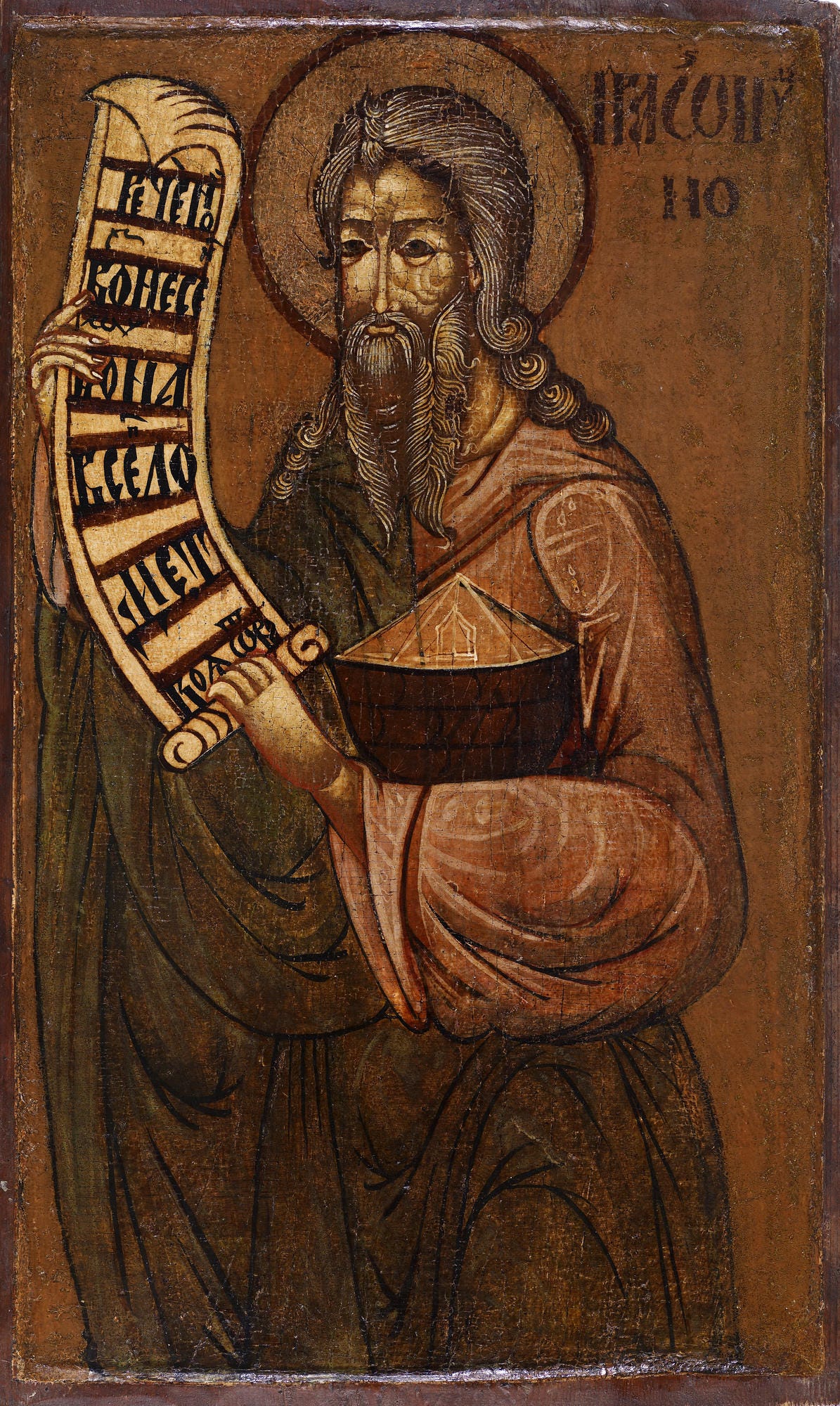
Through faith Noah, being warned about things not yet seen, in reverent fear built an ark for the salvation of his household; by this he condemned the world and became an heir of the righteousness that comes by faith. Believing and carrying out what God commanded, with reverence and wisdom free of doubt, he built the ark and was saved from the destruction of the flood—he and those with him.
Called by faith, Abraham obeyed and went out to the place he was to receive as an inheritance, setting out without knowing where he was going. By faith he dwelt in the promised land as a stranger, living in tents with Isaac and Jacob, fellow heirs of the same promise; for they looked forward to the city with foundations, whose architect and builder is God. By faith even Sarah herself, though barren, received power to conceive and, beyond the proper age, bore a child, because she considered Him who had promised to be faithful. By faith Abraham, when tested by God, offered up Isaac—his only son, concerning whom he had received the promise. For it had been said: “Through Isaac shall your descendants be named.” He reasoned that God was able even to raise him from the dead, and thus the account is given as a parable. By faith in things to come, Isaac blessed Jacob and Esau. By faith Jacob, as he was dying, blessed each of Joseph’s sons and worshiped, leaning on the top of his staff. By faith Joseph, at the end of his life, remembered the exodus of the sons of Israel and gave instructions concerning his bones.
By faith Moses, when he was born, was hidden for three months by his parents because they saw that the child was beautiful, and they did not fear the king’s edict. By faith Moses, when he had grown up, refused to be called the son of Pharaoh’s daughter, choosing rather to suffer affliction with the people of God than to enjoy the fleeting pleasures of sin. He considered reproach for the sake of Christ greater wealth than the treasures of Egypt, for he looked to the reward to come. By faith he left Egypt, not fearing the king’s anger, for he persevered as seeing Him who is invisible. By faith the Passover was kept and the blood was sprinkled, so that the destroyer of the firstborn passed over the houses of the believers. By faith they crossed the Red Sea as on dry land, while the Egyptians, when they attempted it, were drowned. By faith the walls of Jericho fell after they had been encircled for seven days. By faith Rahab the harlot did not perish with the disobedient, because she had received the spies in peace.
By faith the three youths resolved to keep the Law, entered the furnace heated seven times over, and were not terrified or afraid. Therefore dew fell in the midst of it, and they were not scorched by the fire. By faith the prophet Daniel, having purified himself with fasting and tears, descended into the lions’ den and, free of doubt, was preserved unharmed from the lions.
By faith all the saints endured struggle even unto death, living their lives in asceticism and martyrdom; for this reason they were deemed worthy of heavenly blessings. By the power of faith, as it is written, all the saints conquered kingdoms, obtained promises, were protected from the jaws of the lion, quenched the violence of fire, escaped the edge of the sword; from weakness they became strong, turned aside foreign armies; women received their dead raised to life again, while others were tortured and did not accept deliverance, that they might obtain a better resurrection. In faith they all died without receiving the promises, but seeing them only from afar, rejoicing in them and confessing that they were strangers and pilgrims on the earth. For faith is the substance of things hoped for, the evidence of things not seen. What one sees, one does not hope for. But if we do not see and yet hope, we await it with patience. Believing, we hope; hoping, we endure; enduring, we love; and loving, we strive and urge ourselves toward good deeds, possessing equal zeal, will, and inspiration. Having received one Spirit in faith, we must think alike, for we are one body and one soul; those who are one body will evidently also have one spirit. God has called all equally and granted life to all; He is equally the Head of all, and our souls are His members. He raised all with Christ and seated them beside Himself, received all with equal honors, and likewise we all await to see and inherit the blessings in the age to come and to be equal in the heavens—though on earth we differ from one another, are separated and divided. One Lord, one faith, one baptism. Is the Lord greater for one and lesser for another? Is one justified by faith and another by works? Does the resurrection free one but not another? There is one God and Father of all, who is over all and through all and in all, who desired that we all be one through love for Him, through faith, through harmony, through gathering with one another, becoming kin to each other and reconciled.
And having, brethren, love and harmony for the sake of our faith, and being united as members to the body of Christ’s Church and bound together, let us suffer with one another and also rejoice together, receiving the grace of the Holy Spirit that flows from our Head—Christ—and thus be saved. Faith in God, brethren, is one, yet it can be greater or lesser depending on understanding or lack thereof. Christ says: “O you of little faith, why did you doubt?” and elsewhere: “You have great faith,” “Let it be done according to your faith,” and again: “I have not found such faith even in Israel.” It is precisely according to our will and effort that faith increases or diminishes. Let no one say: “I am too simple—how can I precisely understand and know the faith?” For grace makes no distinction between persons; to anyone desiring good—small or great, most wise or simplest, elder or youth, rich or poor, men and women, regardless of age—the good God directs the rays of His grace upon all. Therefore the Apostle says: “Consider, brethren, your calling: not many wise according to the flesh, not many mighty, not many noble; but God chose the foolish of the world to shame the wise, the weak to shame the strong, the lowly and despised of the world, even things that are not, to bring to nothing things that are.” Let us not, then, excuse ourselves with ignorance, inexperience, lack of understanding, or weakness, but let us seek, learn, be taught, and grow greater in our faith, will, and effort.
For when all we faithful are born anew from the one font of holy baptism, the Holy Spirit makes us one body, though our origins, characters, and deeds differ. It is the Holy Spirit who unites everything by His grace, binds, sustains, and promotes unity. And if we lack bonding in love for one another, if we do not keep harmony unbreakable, we risk losing the unity in faith and the grace given us by the Holy Spirit. God is love; if we truly love, everything in us will multiply in Him. So it will be with us if our good life brings profit to our faith, and faith working through love and self-control accomplishes our salvation.
Let us, therefore, brethren, believe; let us love God with all our soul, all our mind, all our heart, and all our strength. Moreover, let us love our brethren according to the commanding precept “and your neighbor as yourself,” and act justly at all times, in every place and matter. Thus I shall attain the perfection possible for man, being filled to the full with Christ, and we shall be deemed worthy, together with those who have pleased Him from the beginning of time, of His promised eternal blessings—through the same Christ Jesus our Lord, to whom be glory and power, with the Father who has no beginning and the Holy Spirit, now and ever and unto the ages of ages. Amen.