Feb. 11 – Martyr Vlasiy (Blaise)
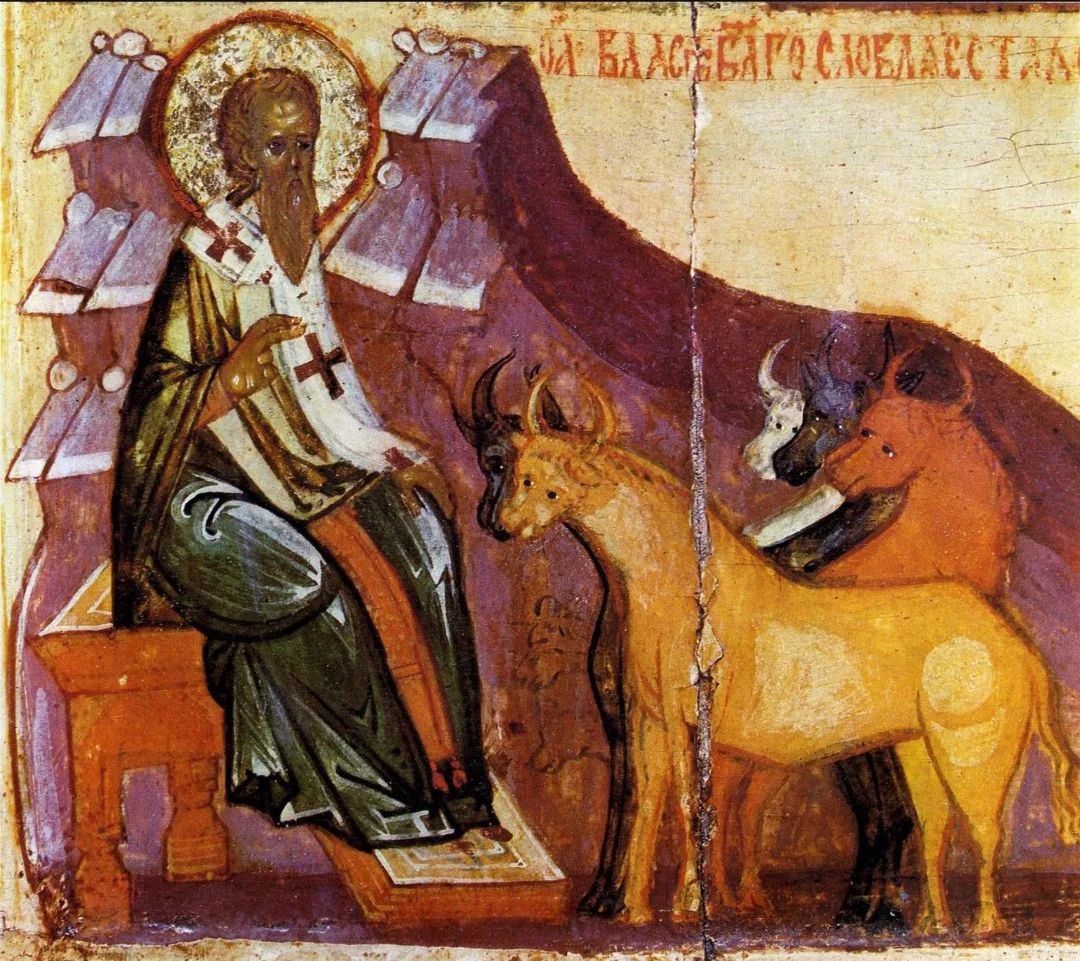
The Hieromartyr Vlasiy was bishop of the Cappadocian city of Sebaste. During the persecutions of Christians by the Roman authorities, he exhorted those suffering to patience, visited those imprisoned in dungeons, and strengthened them in faith and love for God; for this reason many at that time died for Christ and received the martyr’s crown. St. Vlasiy had withdrawn to the desert, but there hunters, the persecutors of Agricolaus, found him, and he himself went with the soldiers who had come for him to the city to Agricolaus. On the way, by his teaching and miracles he converted many pagans to Christ; there, through his prayers, not only people but also animals received healings, for which reason the holy saint is venerated as the patron of animals. Agricolaus began with flattery to incline Vlasiy to renounce the faith, but when he remained unyielding, he ordered him hung on a tree, scraped with sharp iron, and then cast into prison. When they led the martyr, covered with blood, seven pious women followed him, collecting the blood dripping from his body and anointing themselves with it. The women were brought before Agricolaus. “And are you Christians too? If you wish to escape torments, worship the gods!” said Agricolaus to them, and he ordered iron plates heated and tin melted, and there placed women’s beautiful garments and costly ornaments. “Choose one or the other,” Agricolaus said again to the women. Then one of them seized the costly garment and cast it into the furnace. The enraged governor ordered the women tortured and then beheaded with the sword. After that Vlasiy was brought from prison, and the governor again demanded that the saint worship the idols. “Torment my body as you will—this is in your power,” said Vlasiy to the governor; “but over my soul God alone has authority.” The governor ordered the hieromartyr thrown into the lake. But he walked upon the water as upon dry land. Stopping in the middle of the lake, the saint said to the soldiers standing on the shore: “Now show also the power of your gods—come here.” Sixty-eight soldiers, calling upon their gods, threw themselves into the lake, but all drowned. Then Agricolaus ordered St. Vlasiy beheaded with the sword. With him were also beheaded two lads, sons of one of the seven martyrs. This took place in the year 316.
The Venerable Dimitriy of Priluki lived in the fourteenth century. He was the son of wealthy parents of merchant rank in Pereyaslavl-Zalessky. In childhood he loved the reading of soul-saving books, which produced in his soul the most pious disposition: he thought only of the life to come and counted all temporal things as nothing. In his young years he left the world and was tonsured a monk in the Goritsky Pereyaslavl Monastery. He often journeyed to the Venerable Sergiy, who at that time had founded his monastery in the forests near the town of Radonezh. Soon he himself founded a monastery on the shore of Lake Pereyaslavl. St. Dimitriy was extraordinarily handsome, and therefore he covered his face with dark cloth and did not permit himself to converse with others, especially with women. One noblewoman from Pereyaslavl, hearing of the beauty of Dimitriy, desired to see him, and she saw him when he was preparing for the divine service; but she was punished with paralysis. St. Dimitriy healed the woman, saying to her: “Why did you wish to see a sinner, who has already died to the world?” Avoiding glory, St. Dimitriy left his monastery and, three versts from the city of Vologda, at the bend (luka) formed by the knee of the river Vologda, founded a new abode, where he was abbot, for which reason he is called Prilutsky. Here, together with the ascetic labors of a monk, the venerable one combined works of mercy: he fed the poor, received strangers, clothed the naked, and comforted the sorrowful. Having the gift of foresight, he learned and announced to the brethren the death of Dimitriy Donskoy. He reposed in 1391. Immediately after the death of the saint, fragrance spread throughout the entire monastery. His relics rest in the abode he founded.
Prince Vsevolod of Pskov, in holy baptism Gavriil, was the son of the great prince Mstislav and grandson of Vladimir Monomakh. He ruled for a time over the Novgorod region. He built a great temple in the Yuriev Monastery in honor of the great martyr George. When during his rule a terrible famine struck the Novgorod region, and people were forced to feed on straw, bark, and moss, from which many died, he used all his means and all his treasury to feed the hungry; and when he had nothing left with which to help, he personally appeared to the suffering and exhorted them to submit to the will of God. Despite his beneficent rule, Prince Vsevolod had to suffer from the wilfulness of the Novgorodians: he and his whole family were condemned by them to exile. Then the Pskovites asked him to be their prince. And here, as in Novgorod, the prince was a benefactor to his subjects. Sensing his approaching end, he redoubled his labors of love and devoted himself to strict fasting. He reposed on February 11, 1138. In 1192 his relics were found incorrupt. Upon their opening they were transferred to the cathedral Trinity Church founded by the prince, where they rest under the bushel (i.e., concealed, in their original place of repose).
Holy Empress Feodora was the wife of Emperor Feofil, who persecuted the veneration of icons. As much as she could, she tried to restrain her husband from persecutions against Orthodoxy. When Feofil died and, due to the minority of her son Mikhail, she ruled the empire, then at the council in 842 she restored icon veneration, returned the Orthodox from exile, and sent the iconoclasts there in their place. She took care to deliver the soul of her husband from God’s punishment through the prayers of the great holy fathers. Under Feodora the celebration of the Triumph of Orthodoxy was established on the first Sunday of Great Lent, when anathema—that is, excommunication from the Church—is proclaimed against all heretics and persecutors of the Orthodox Christian faith. The chief care of St. Feodora was to raise her son in the rules of the true faith, so that he might be a good emperor, and for this she surrounded him with honorable and gifted instructors. St. Kirill, enlightener of the Slavs, brother of Mefodiy, was taken as a companion in studies to the tsarevich. Unfortunately, the empress did not succeed in her good intention: when the tsarevich grew up, he was drawn away by the example of dissolute youth. Feodora, however much she admonished her son, could not bring him to reason, and with deep sorrow bidding him farewell, she enclosed herself in the monastery of St. Evfrosiniya and spent the remainder of her life in spiritual labors. She reposed in 867.
”