Home Prayer
For a Christian – there are two settings for prayer: personal prayer, and common (communal) prayer.
Common prayer is primarily prayer within the temple, but common prayer can be anywhere, for “where two or three are gathered in my name, there I am in the midst of them”.
The holy martyr Avvakum, when he could no longer pray in the reformed temples, prayed in a barn for those who gathered there!
Christ spoke of prayer in numerous places, but only for the act of common prayer did he give this promise of his personal presence. Common prayer should always be desired!
Today, though, I want to focus solely on personal prayer – or prayer within the home, which does not have to be private.
A certain kind of psychological wall has been erected today that serves to separate temple prayer, or even prayer with a priest, from prayer within the home, or without a priest. To separate the one as necessary, and the other optional. The one as effective, the other superfluous.
But home prayer is prayer. For the one who has faith, and knows he will be made to give account of every moment of his life – home prayer, or the lack thereof, will account for the overwhelming majority of that which condemns him, or saves him.
The one ought not to be thought of as an “imitation” of the other. The emphasis on temple prayer is so marked, that it can, and in many instances, has gone to an extreme that perverts the very intention of common prayer.
Common prayer means the prayer of each individual together. It does not mean the act of outsourcing the duty to pray to the clergy while simply standing in attendance during their prayers and the songs of the choir.
This is rather an offense, when it is done. In listening, one should also be praying with the words being spoken or chanted, and if the words are unintelligible, one should quietly pray to himself the Jesus Prayer, or even “Lord, have mercy.”
Private Prayer
In the sixth chapter of the Gospel of Matthew, Christ teaches his followers to pray privately:
And when ye pray, ye shall not be as the hypocrites: for they love to stand and pray in the synagogues and in the corners of the streets, that they may be seen of men. Verily I say unto you, They have received their reward. But thou, when thou prayest, enter into thine inner chamber, and having shut thy door, pray to thy Father which is in secret, and thy Father which seeth in secret shall recompense thee. (Matthew 6)
There are many spiritual interpretations of this passage, but Cyprian of Carthage has a literal reading that is at once practical and profound:
The Lord has commanded us in his instructions to pray secretly in remote and withdrawn places, as best suited to faith; that we may be assured that God who is present everywhere, hears and sees all, and in the fullness of His Majesty penetrates even hidden places…
What senselessness is it to be caught daydreaming in meaningless and profane thoughts, when you are presenting your petition to the Lord, as if there were something else that you should know other than that your conversation is with God!
How can you ask God to attend to you, when you do not attend to yourself? This is altogether to make no defense against the enemy; this is, when praying to God, to offend God’s Majesty by the neglectfulness of your prayer.
The purpose of going into a separate room, even an inner, small room, and shutting the door, is to keep out the hustle and bustle of the outside world. This is especially true for those who live in cities, or families with many children. Distractions abound, and the needs of the world pull at us instantly from all directions.
Christ tells us how to shut these things out.
Close the door!
It is almost too obvious. Christ even demonstrated the literal meaning of his instructions by, time and again, going away from the Apostles in order to pray.
Then, in the quiet, we can begin to pray to God. He always hears, and knows all. But it is possible for us, in that setting, to be sincere, and heartfelt in our prayer. To give thanks for what God has given us, personally. To ask for those things that we need, personally. To ask forgiveness for our sins, personally.
In other words – to offer our own prayer.
For many, myself included, in the silence of your place of solitude, comes an unwelcome inner silence – a realization that when the noise stops, you have nothing to say.
Or rather, that you cannot put your inner disposition into words. The thoughts and intentions in coming to prayer are suddenly drowned out by the unusual noise of silence.
The Church has given us collections of prayers of those holy men of old to offer to God. Not only are these suitable for times when we cannot form our own prayers, but, through continued use, they form a ready collection of all the petitions and praises we may need.
Praying the Cycle of Services
The ancient Eastern collection of prayers for the hours of the day, collected into the Book of Hours (Chasoslov, Horologion), is the official daily cycle of prayers, spaced out such that we can pause for prayers of varying length approximately every three hours, morning and night.
Here also we see that the Church knows full-well the wisdom of being removed from the distractions of the world. The longest, most poignant and penitential of the services are reserved for saying in the middle of the night – when the rest of the world is sound asleep.
The Church provides instructions on how people at home can use these services, and looking at these instructions, some general principles can be gathered. The following sources were gathered from the Potrebnik of Andrey Antipin.
In the pre-Schism Book of Hours, as an example, in the Midnight Office, it says:
The priest says “Blessed is our God.” But if a monk is alone in his cell, he says: “Through the prayers of our holy fathers.” This verse is said at the beginning of every office if there is no priest. For monks alone, instead of the litany at the dismissal, the prayer (the “forgiveness”): “For those who hate and offend us…” (Chasoslov, chapter 5, leaves 8, 62).
Other pre-Schism books explained how services could be conducted in the absence of priests. Again, from Potrebnik:
“If there is no priest, then ‘Through the prayers of our holy fathers’ … and he says vespers, or compline, midnight office, matins, and the hours, and whatever else he wishes.” (patriarchal printing of the Book of Hours, leaf 12)
Common beginning for all canons: But if a layman: “Through the prayers of our holy fathers … and God is the Lord and hath appeared unto us.” (Kannonik leaves 134–136)
In the canon of Holy Pascha: If there is no priest, the dismissal is thus: “He that is risen from the dead…” (leaf 108).
Rule in the cell for Pascha: compline, midnight office, and the rest—all according to the service (leaves 209–215).
It is possible, based on these instructions, to pray the cycle of services at home. Priestly prayers, which are not part of the Book of Hours, are omitted. Responses are replaced with either “Through the prayers…” or “Lord Jesus Christ, Son of God, have mercy on us”. And litanies are also omitted, being replaced by “Lord, have mercy”, 3, 12 or 40 times (occasionally 30 or 50 as well). Dismissals can also be done by laymen.
These are not special orders, but the very Hours themselves, only adjusted minimally for those instances when there are no priests. The ability to say this services is restricted in no way to persons of any rank or status. Young or old, male or female.
You need not be a “reader” to read these services!
Most people, however, do not have access to the resources necessary to serve a complete service, with the variable parts. Also, having the know-how to properly put together a service is not for the novice, as there are many conditional rules for the endless combination of liturgical calendrical events.
In this situation, it is not only possible to avoid saying the cycle, but it is better to not say it at all:
There is only soul-profiting benefit when the church service is performed entirely well, with tenderness, correctly, as has been indicated above.
And if somewhere the service is performed carelessly—read very quickly and poorly, sung also carelessly without any tenderness, and everything in general is done disorderly and haphazardly—then such a service will bring no benefit at all, ‘but only harm! And for this all will be condemned to eternal torment’” (Book of Faith, chapter 16, leaves 142–144).
“Therefore, whoever cannot perform church services well had better not take it upon himself, but pray instead with the Psalter or with bows!” (Potrebnik, leaf 42)
Pray instead with the Psalter or with bows!
The most ancient and praiseworthy official prayer book of the Church is none other than the Psalter – the Psalms of David.
The very cycle of services themselves are little more than the Psalms embellished with songs of praise or petition to God, the God-bearer, and the saints.
Within the Old Believer tradition, even in those places where complete observance of the daily cycle was demanded, exception was made for those who used the Psalter alone.
Moreover, we offer this good counsel: Where in some village or settlement people live in different houses, one or two in each, and there are no books or services, on feasts and Sundays they should all gather together in one house (if possible) and at least stand with the Psalter or with prayers. This is exceedingly good, pleasing to God, praiseworthy for piety, and saving for souls. For the Lord loves good counsel and commands all to abide in undivided love. (Fedoseev Book on Christian Life)
It is not just good, but exceedingly good. And the force of this is toward common prayer. How much more, then, will it apply to those who pray alone!
There are some suggested guidelines for how to employ the Psalter in place of the daily cycle. They must be held as that – guidelines. For, in some, multiple options are presented, that the strength or circumstance of the individual might not be crushed under the weight of his burden.
For those who wish to keep the cycle, and employ the Psalter in its stead, this scheme is a traditional set of options. Note that here, the reading of the Psalter is already somewhat shortened, and in the “lighter” option, considerably so:
For Vespers – read 2 kathismas, or 1.
For Compline – read 2 kathismas for Great Compline, or 1 for Small Compline.
For Midnight Office – read 2 kathismas, or 1.
For Matins – read read 5 kathismas, or 3, or even 2.
For 1st Hour – read 1 kathisma, or 100 Jesus Prayers, with bows.
For the Hours (3rd, 6th, and 9th together) – read 3 kathismas, or 2.
Even taking the smallest portions, one would cycle through the complete Psalter every three days.
During Great Lent, the traditional practice is to pray the Psalter with the addition of the penitential prayers that are found in the back of every Psalter, along with the assigned prostrations.
When using the Psalter for prayers, begin with the following opening sequence, arranged for multiple people. For one person, he says all parts himself. After the entrance bows:
Elder: Through the prayers of our holy fathers, Lord Jesus Christ, Son of God, have mercy on us. (Bow)
Reader: Amen.
Holy God, Holy Mighty, Holy Immortal, have mercy on us. (Thrice, with bows.) Glory to the Father and to the Son and to the Holy Ghost, now and ever, and unto the ages of ages. Amen.
Most Holy Trinity, have mercy on us. O Lord, cleanse us from our sins. O Master, pardon our iniquities. O Holy One, visit and heal our infirmities for thy name’s sake.
Lord have mercy. (Thrice.) Glory to the Father, and to the Son, and to the Holy Spirit, now and ever and unto the ages of ages. Amen.
Our Father, who art in heaven, hallowed be thy name. Thy kingdom come, thy will be done, on earth as it is in heaven. Give us this day our daily bread, and forgive us our debts as we forgive our debtors. And lead us not into temptation, but deliver us from the evil one.
Elder: Lord Jesus Christ, Son of God, have mercy on us. (Bow.)
Reader: Have mercy on us, O Lord ; have mercy on us, for laying aside all excuse, we sinners offer this supplication to thee as to our Master: Have mercy on us. Glory…
The precious memorial of thy Prophet David has shown thy Church to be Heaven, O Lord, for angels exult together with Man. By his prayers, O Christ God, guide our lives in peace, that we may sing to thee: Alleluia. Now and ever…
In need of salvation from the great multitude of my transgressions, I flee to thee, O pure God-bearer. Visit my infirm soul, and beseech thy Son, our God, to grant me forgiveness of my evil deeds, O only blessed one. Lord have mercy (40 times).
Repeat the following set of three prayers five times:
God cleanse me of my sins and have mercy on me. (Bow)
Thou hast created me; Lord have mercy on me. (Bow)
I have sinned immeasurably; Lord forgive me. (Bow)O all-holy Trinity, Creator of all the world, as I, the unworthy, now desire to pronounce these God-inspired psalms, which the Holy Ghost placed upon the lips of David, make haste and guide my heart to begin with understanding, and to end with good deeds. Aware of my ignorance, I fall down before thee in prayer, begging for thy help, and calling out : O Lord, direct my mind, and strengthen my heart. May I not be taken up with words, but rather may I find joy in the meaning of these words, and be prepared to perform the good deeds they teach me. Enlightened by good deeds, may I, at the Judgement, together with all thine elect, be with those at thy right hand. And now, O Master, bless. Having sighed from my heart, may my tongue pronounce these following words:
Come let us worship God our King. (Bow)
Come let us worship Christ, our King and our God. (Bow)
Come let us worship and fall down before the very Lord Jesus Christ Himself, our King and our God. (Bow)Then begin reading the kathismas.
The Prayer of Jesus
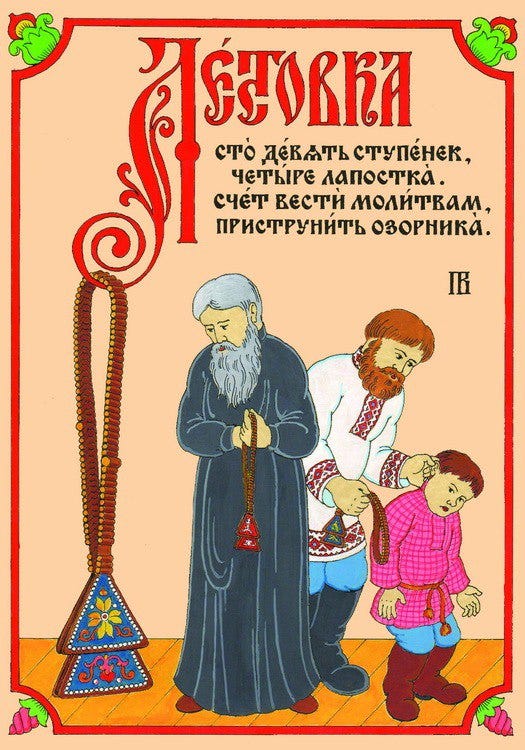
Some may benefit from the practice of the Jesus prayer instead of the Psalter, or the cycle. For with this method, armed with a lestovka, a person needs no books at all! It may be used, silently, at any time, at any place, in any condition.
Lord Jesus Christ, Son of God, have mercy on me, a sinner. (Bow)
To use you prayer ladder (lestovka) for the daily cycle, this scheme may be used, assuming a bow to the waist is done after each prayer:
For Vespers: 3 ladders (300 prayers), or 2, or even 1.
For Great Compline: 3 ladders. For Small Compline, 2 ladders, or 1, or even 1/2. (Usage for Middle Compline is never given, but can be assumed as the midpoint between Great and Small. This should be done for the Psalter as well.)
For Midnight: 3 ladders, or 2, or even 1.
For Matins: 7 ladders, or 4, or 2.
For 1st Hour: 1 and 1/2, or 1, or 1/2.
For the other Hours, together: 5, 3, or 2.
During Great Lent, it is customary to make the last 17 bows for each ladder to the ground, that is, full prostrations (this is the last full section on a lestovka).
With such a method, one may use the usual opening sequence for prayer – the Entrance Bows, through Come, let us worship, and Psalm 50. But this is not necessary. It is possible to even say the prayers alone.
Conclusion
Common prayer is never to be replaced by private prayer. To say otherwise, shunning Christian gatherings for prayer, is an offense. Both are beneficial, and both should be employed.
But private prayer has an essential place, as Christ both showed and taught. And, since most do not have the opportunity to gather for common prayer several times a day, every day, it happens that private prayer, at home, must be used to show God that our faith is alive, rather than simply a statement that we agree with the teachings of our local Church.
The practice of individual, or even common prayer at home is given form by many different paths in Old Belief. Those within it are provided with the lightest of burdens, for the elderly, the infirm, or even to the beginner, or the spiritually infirm.
The pull of the world is immense. The spiritual reality that flows through our world is dark and malicious, and this gives every Christian the opportunity to prove his faith through suffering, spiritually or physically, and even to die for Christ’s sake. A kind of martyrdom, to “die to sin”. This opportunity lies within our own bedrooms, our living rooms, our “inner places”.
With our smart phones, it seems like our attention spans have grown short. I know mine has.
It may be a burden to even achieve the lightest level in our time of faithlessness.
But, with the abundance of practices outlined above, it should be clear that anyone, and everyone must fulfill a very full life of prayer in the home. If it is possible to say the full cycle, then it should be done, but with the knowledge of how to do it correctly.
Yet such a burden is highly impractical unless one’s home serves as a meeting point for common prayer.
Of each method, the use of the Jesus Prayer is obviously best suited to those times when removing oneself to another room and closing the door is used. But the other methods can even be used beneficially in this setting also.
This article is meant only to convey information, not to pass on any kind of personal advice.
I am a hypocrite, and a struggling one at that… But, I also know that when people are honest, that most are in the same place. We have many options!